
 United States ‘The Wanderer’ – Songs of Travel from the Middle Ages: Sequentia members – Benjamin Bagby (voice, harps), Norbert Rodenkirchen (flutes). Trinity Episcopal Church, Columbus, 23.10.2026. (MSJ)
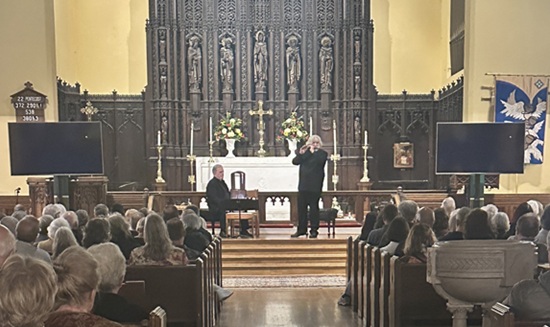
The timing could not have been better. It was a mild autumn evening in Columbus, Ohio, in late October. As night and the temperatures fell, Sequentia’s Benjamin Bagby and Norbert Rodenkirchen took the stage and summoned a spellbinding performance that felt like the first bracing wind of winter. The program, titled The Wanderer, assembled songs of travel from medieval times in reconstructions of the long-lost melodies made by the performers with the assistance of other scholars.
Part science and part speculative art, the process is one that Bagby has been immersed in for many years as a co-founder of Sequentia, and it has led to performable reconstructions of ancient poems like the Edda, songs of Rhineland harpers of the first millennium, and most famously, Beowulf. That latter provided the opening song, ‘Him tha Scyld gewat’. One could hear the Anglo-Saxon words – strange but occasionally fleetingly familiar – and feel how Bagby has found plausible melodic shapes from the rhythms and tones of the words themselves. Now in his seventies, Bagby’s voice remains strong, and Trinity Episcopal Church offered a balance of warmth and intimacy that made it easy to imagine sitting around a fire in a Saxon great hall over a thousand years ago, hearing a master harper perform this music. Grim, stoic and powerful, the stark music was put across hypnotically by Bagby, accompanying himself on a small, hand-held, medieval-style harp.
Between Bagby’s towering songs, flautist Norbert Rodenkirchen played instrumental versions of reconstructed tunes from the period as palate cleansers. First came ‘Iam dulcis amica’, a Goliardic melody dating from a few centuries later. Bagby followed with a solemn pre-voyage prayer, ‘Ic me on thisse gryde beluce’, based on a Christian text though likely with even older roots. Translations of the texts were shown on large screens, making it possible to follow the texts quite closely which enhanced their instrumental impact. ‘Fistula’ was a partially-improvised version of a textless sequela notated in an 11th-century manuscript. Rodenkirchen’s arrangement shrewdly demonstrated that a hook is a hook: even ancient music can make the walls of time melt away and leave you feeling directly connected to the people of centuries past.
The intensity rose in the bleak ‘Hwæthere ic me ealles’, a traveler’s lament of better days and lost friends, with Bagby’s voice rising hauntingly through the still air. Knowing that bleaker peaks were yet to come in the program – which was performed without pauses – the performers smartly followed with the strangely comical ‘Advertite, omnes populi, ridiculum’, which illustrates the story of a faithless wife’s illegitimate child which she blames on a particularly bad snowstorm! The performance was replete with winter winds conjured on Rodenkirchen’s flute and sly timing from Bagby, who throws himself just as wholeheartedly into comic relief as he does into aching laments.
After a flute interlude based on textless neumes from an 11th-century source, the sorrow rose to piercing heights in ‘Oft ic anhagan’, a 10th-century Anglo-Saxon elegy that gave the program its title: ‘The Wanderer’. The lament may have been long – it was hard to tell in such a hypnotic performance – but the music was heart-piercing as the singer enumerated his losses, particularly his protector whom the narrator longs for with an almost romantic despair.
There was a final flute interlude and the program closed with the staggeringly stoic ‘Welund him be wurman’, a 10th-century piece from Deor that laments the loss of a spouse, a child, a homeland and of an entire dying culture. It spirals from specificity to an all-encompassing sense of cosmic dread, and Bagby and Rodenkirchen were stoically unflinching in their wrenching delivery. It was an unforgettable testament to the power of music to communicate humanity, regardless of the passage of time.
The program was presented by Early Music Columbus, which is in its 47th season. Later performances this year will include the Jupiter Ensemble, The Early Interval, The Gesualdo Six, Apollo’s Fire and Acronym, featuring Reginald Mobley. More information can be found at here.
Songs:
‘Him tha Scyld gewat’ (from Beowulf, 8th century)
‘Iam dulcis amica’ (Goliardic tune, 10th century)
‘Ic me on thisse gryde beluce’ (Anglo-Saxon, 9th century)
‘Fistula’ (based on a sequela attached to ‘Alma chorus’, Echternach, 11th century)
‘Hwæthere ic me ealles’ (England, 9th century)
‘Advertite, omnes populi’ (Rheinland, 10th or 11th century)
‘Wolfenbuettel – Nota’ (Wolfenbüttel, 11th century)
‘Oft ic anhagan’ (England, 10th century)
‘Vaga varia’ (based on a sequela attached to ‘Laus inclita,’ Winchester, 11th century)
‘Welund him be wurman’ (from Deor, 10th century)
Mark Sebastian Jordan