
 United Kingdom Byström, Brahms, Saariaho, Sibelius: Maya Iwabuchi (violin), Royal Scottish National Orchestra / Emilia Hoving (conductor). Usher Hall, Edinburgh, 23.10.2026. (SRT)
Britta Byström – A Walk to Brahms’s Violin Concerto
Brahms – Violin Concerto
Saariaho – Ciel d’hiver
Sibelius – Symphony No.6
I went to this Edinburgh concert between the departure of Storm Austen and the arrival of Storm Boelo, so it felt like an appropriate evening to hear a piece about a winter sky. In fact, Kaija Saariaho’s Ciel d’hiver was much more placid than the weather that has buffeted Scotland this weekend; mystically so, in fact. Saariaho’s vision is unmistakably Nordic (rather than blustery Celtic), with slow-moving fragments of melody, implausible percussion effects, and glittering textures that created an eerie and otherworldly look up into and perhaps even beyond the night sky. It was fairly unnerving in places, but it still beat the tempest I had to struggle through to get to the concert hall.
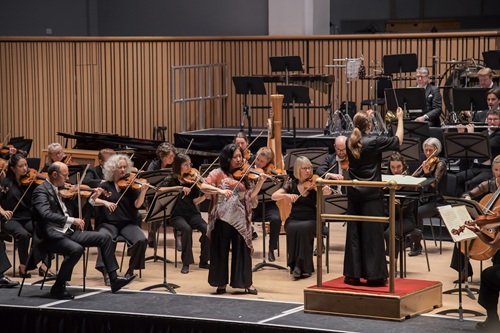
The Royal Scottish National Orchestra played it with a feeling of the piece’s textures being prised open, revealing its inner workings while making it still sound compelling. Perhaps it helped having a Finn on the podium to conduct this and music by Sibelius. Emilia Hoving is an agile musical presence and she conducts in a way that leans directly into both the music and the section of the orchestra she is trying to influence. That was very effective in the glacial textures of the Saariaho piece, and every bit as much in Sibelius’s Sixth Symphony which seemed to have frost on the bar-lines, so much glitter was there to the sound of the divided violins at the opening. The slow emergence of the opening textures had a chilly beauty to them, and Hoving guided the orchestra expertly through the organic, slightly mysterious tempo changes that Sibelius builds into the symphony. She made the motivic throbbing of the inner movements sound natural and even architectural, while the finale was shaped with a line that seemed to be heading through a gentler tempo into the final silence, helped by strings that played with such softness and lilt that they could almost have been playing Vaughan Williams.
Maya Iwabuchi, the soloist for Brahms’s Violin Concerto, is the orchestra’s leader, and it is often a lovely thing to see an orchestra supporting one of their own when they take the limelight. Here, however, it seemed that Iwabuchi never quite made the transition from concertmaster to soloist. She had all the technical knowhow to play the part beautifully, but her playing lacked the centre-stage assertiveness that a concerto soloist needs, as if she was always primus inter pares rather than the main deal. There are gains there, of course: the lyrical second theme that Brahms lets the soloist introduce in the first movement was a treat (subsequently taken up beautifully by the orchestral violins), and she duetted gorgeously with the choir of winds in the slow movement, but the ‘look-at-me’ moments that Brahms gives the soloist never really jumped out until the finale, where the soloist cannot help but be the centre of attention.
Brahms’s concerto was preceded, without a break, by Britta Byström’s ‘walk’ towards it; and a walk it was, with a pervasive, gently persuasive tread over which fragments of Brahms’s first movement melodies floated in and out in layered counterpoint. I found it very engaging. Apparently Byström has written several more of these ‘walk’ introduction pieces: this one made me want to hear more.
Simon Thompson