 Ireland Wexford Opera Festival 2026 [1] – Mascagni, Iris: Soloists, Chorus and Orchestra of Wexford Festival Opera / Francesco Cilluffo (conductor). O’Reilly Theatre, National Opera House, Wexford, Ireland. 23.10.2026. (RB)
This year is Wexford Festival Opera’s 75th anniversary. During its first 75 years, the festival has built an enviable reputation staging forgotten, rare and neglected operas. This year’s festival was no exception: it opened with Mascagni’s Iris, which had a successful premiere in 1898 but subsequently fell into decline. It has had sporadic revivals from the 1990s onwards, including one in Wexford in 1995. Mascagni will of course be forever known as the composer of Cavalleria rusticana. He wrote many more operas after Cavalleria although he was never able to recapture the success of his first opera.
Iris is known for its lush orchestration and exotic atmosphere, and it explores themes of innocence, exploitation, suffering, and spiritual transcendence. It contains some very fine and memorable music although the plot is thin and the characters lack depth. The eponymous heroine is an innocent young Japanese woman who is abducted by an obsessed nobleman, Osaka. The abduction takes place during a puppet show and Iris is subsequently taken by Osaka and the pimp, Kyoto, to a brothel in Tokyo’s pleasure district. She remains unaware of her captors’ sordid intentions until Osaka tries to seduce her with promises of gifts. He grows frustrated by her naivety and abandons her to the pimp Kyoto who puts her on public display. Her blind father assumes she went willingly with Osaka, and he tracks her down and publicly curses and throws mud at her. Overwhelmed by shame and grief, she leaps down a sewer shaft but somehow manages to survive. Ragpickers subject the fatally injured Iris to one final indignity as they attempt to rob her. The opera ends with a symbolic vision of redemption as the dying Iris is embraced by the rising sun.
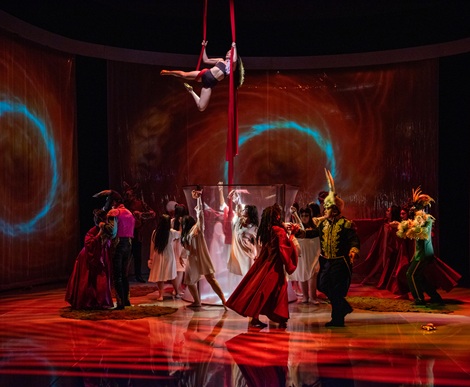
Rosetta Cucchi’s impressive new production breathes life into Mascagni’s neglected opera. In the opening act, Thomas Achitz’s arresting visual images were projected on to diaphanous screens at the back of the sparse set. A sequence of natural images predominated in the early part of the act, giving the production a rather dream-like atmosphere. The build up to the Act I abduction sequence was impressive as dancers, puppeteers and an aerialist worked together to concoct a heady brew. As the mood darkened, frightening Noh masks were projected on to the back of the set. The lighting became increasingly dark and red colours dominated during the scene which had a surreal quality.
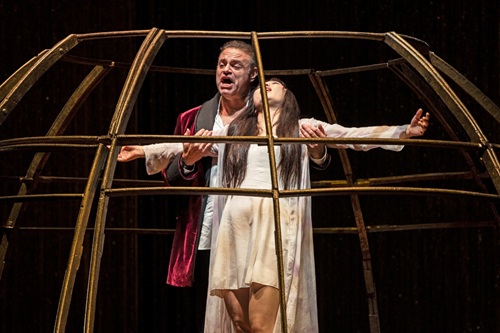
In the second act Iris woke in the brothel surrounded by a vast gilded cage. We saw the other prostitutes sleeping beside her in tiny cages underscoring the abject cruelty of this world. When the prostitutes arose from their cells the small cages morphed into skeletal skirts. In the bleak but transcendent final act, video images of Iris’s male tormentors were projected on to the back of the set before we saw the desolate setting of rubbish and sewer pipes. The opera ended on a note of transcendence as Iris was hoisted into the air with the sun shining on her.
Cucchi’s production shone a spotlight on the bleak subject of prostitution and sex trafficking but did so through the prism of Japanese symbolism. In the first act there was a strong emphasis on the Freudian unconscious as innocence and dreams collided with sordid drives and desires. The visual images were projections of thoughts and desires stirring in Iris’s unconscious mind. The masks and faces seemed to represent Iris’s fear of unidentified dangers lurking in the darkness of the outside world. It contrasted with the more fixed second act were Iris found herself trapped in a cage but unwilling to yield. In spite of all the degradation around her, Iris seemed to be untouched in her inner self. The final act of redemption provided a reflective mirror to this inner purity. Cucchi’s symbolic, psychological interpretation was entirely consistent with the opera’s source material. It helped to elevate the opera in new and imaginative ways and to override the weaknesses in the plot.
The main cast did a superb job bringing their respective characters to life. Iris is a particularly demanding role; at the start of the opera, we see her playing with dolls and engaging in gentle conversations with her blind father and she moves from this to the world of primps, brothels, prostitution and complete degradation. Chinese soprano, Leyla Gu, was outstanding in the role. She made Iris’s dramatic arc from the innocent childlike opening to the darker existential struggle for survival seem entirely believable. She had a powerful and flexible voice, and I loved the way she was able to inject colours into the vocal line to convey the emotions and reactions of the character. Gu effortlessly soared up to the top of the vocal register and produced thrilling top notes. She produced moments of soaring lyricism, raw dramatic terror and ethereal luminosity.
The inimitable Joesph Calleja was equally impressive in the role of the predatory and shallow Osaka. He did an excellent job bringing out the complexity and conflicted elements in the character; this Osaka could be suave and alluring although ultimately self-absorbed, destructive and hollow. Calleja’s voice has an innately lyrical quality, and it projected effortlessly across Wexford’s O’Reilly Theatre. He conjured a sensual Italianate tone and injected irresistible charm into the vocal line In the Act II seduction scene. The contrast with the subsequent cold and impatient rejection of Iris was striking and effective.
Jolyon Loy characterised the pimp Kyoto as a deeply unpleasant, slippery, manipulative operator. In the early scenes we saw him coaxing and cajoling Osaka and pulling on Iris’s strings like a puppeteer. As the opera progressed, he became more ruthless and menacing revealing more of Kyoto’s true character. In one particularly unpleasant scene, he ran his hands all over Iris’s body and put her on public display seemingly determined to treat her as a commodity. He was reasonably successful in negotiating Mascagni’s vocal demands. Occasionally, his tone was a little thin, particularly in the early scenes, but it got better as the production progressed. Jihoon Kim was impressive in the role of Iris’s blind father, Il Cieco. He brought immense clarity to the vocal line and his diction was excellent. His bass voice was resonant and powerful, and he used this to excellent effect in his denunciation of Iris in Act II when the unyielding, judgemental side of the character came to the fore. The rest of the cast all acquitted themselves well in their respective roles.
The Wexford Festival Chorus were firing on all cylinders throughout this production. The opera is bookended by the ‘Hymn to the Sun’ which the chorus initially delivered silhouetted against a darkened stage and then from the top of the opera house at the close of the production. They displayed immense control of dynamics as the piece began softly and gradually built into radiant engulfing layers of sound. They played their roles effectively during the puppet show in Act I and in the various chorus numbers.
Francesco Cilluffo was marvelous in ensuring the orchestra, chorus and singers remained on track and in maintaining an effective balance of sound. I loved the dark sepulchral opening from the bass instruments of the orchestra. Cilluffo and his orchestral partners superbly conjured up exotic impressionistic textures and sonorities in Act I. They provided a flexible accompaniment to the singers in Act II and the chamber-like textures and unusual instrumental combinations helped to enhance the dream-like quality of the piece and feelings of existential terror.
Overall, this was a first-rate, highly imaginative production, featuring some very fine singing and playing.
Robert Beattie
Featured Image: Wexford Festival Opera’s Iris © Padraig Grant
Production:
Stage Director – Rosetta Cucchi
Set designer – Tiziano Santi
Costume designer – Claudia Pernigotti
Video designer – Thomas Achitz
Choreographer – Libby Seward
Lighting designer – Daniele Naldi
Chorus master – Andrew Synnott
Cast:
Iris – Leyla Gu
Osaka – Joseph Calleja
Il Cieco – Jihoon Kim
Kyoto – Jolyon Loy
Dhia – Hannah O’Brien
Merciaiuolo / Il Cenciaiuolo – Yu Shao
Un Cenciaiuolo I – Meilir Jones
Un Cenciaiuolo II – Joshua Baxter
Dancers/Aerialist/Puppeteers