 United Kingdom BBC Proms 2026 [19] – Bushra El-Turk, Haydn, Mahler: Jamie Barton (mezzo-soprano), Clay Hilley (tenor), BBC Philharmonic Orchestra / Anja Bihlmaier (conductor). Royal Albert Hall, London, 21.8.2026. (CK)
Bushra El-Turk – Mosaic
Haydn – Symphony No.45, ‘Farewell’
Mahler – Das Lied von der Erde
I came to this BBC Prom with mixed expectations, for two reasons. First, it looked like one of those programmes that might work better on paper than in sound; second, Das Lied von der Erde is one of those pieces that can be one of the great musical experiences of your life, but – as Sir Simon Rattle once ruefully observed – no performance gets everything right; the stars never quite fully align; perfection is elusive. I have to confess that in the live performances I have attended I have found this to be true: there may well have been wonderful performances, but I wasn’t there.
Bushra El-Turk, London-born with Lebanese parents, is clearly a serious composer, brave enough – so the programme note told us – to deal with the faultlines where cultures collide and women suffer; honour killings, female subjugation, the murder of Mahsa Amini by Iran’s morality police. Mosaic is a short piece, just long enough to engage our feelings as well as our attention; written for a classical-sized orchestra, it is a continuous web of sound arising from a barely audible susurration, coalescing into a restrained and rather beautiful hymn. It could not be more different from Gabriela Ortiz’s militant feminist ballet played here nine days earlier by Dudamel and the Los Angeles Philharmonic (review here); but it registered nonetheless. I would like to hear more of El-Turk’s music.
Haydn’s Farewell Symphony – his Abschied, if you like – was a neat pairing for Mahler’s great song-symphony: but it is also a magnificent work and would be still if Haydn had ended where we expect, without springing the surprise which has guaranteed the work’s extramusical fame.
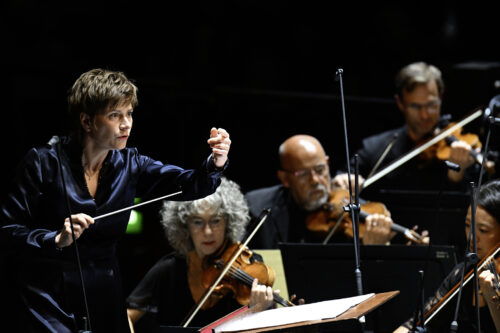
The stormy opening movement was cleanly and powerfully articulated; the Adagio was both graceful and stealthy, loping, catlike; the Minuet brisk, nicely sprung, with suave horns in the Trio. The finale proper went at quite a lick, full of rhythmic verve; Anja Bihlmaier’s batonless conducting throughout was fluid, balletic, but always clear. The unexpected bonus Adagio was touching visually as well as aurally (and must have been more so when each player extinguished his candle before departing). The ending was played for laughs – Bihlmaier striding off abruptly, the last viola yawning theatrically before getting to his feet.
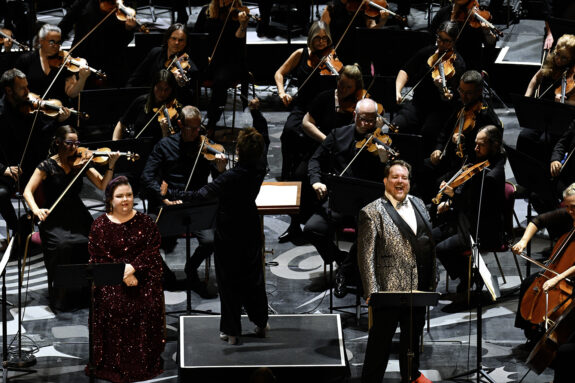
It seemed, after the interval, that we were not quite done with the comedy. Jamie Barton came on in shimmering scarlet, very much on the side of life; Clay Hilley followed her in an expansive light grey tux with a blingy bow tie (I feared it might be the sort that spins), almost as if he was the diva’s warm-up act. Which, in a way, he is. Anyone who saw and heard his Tristan at the Barbican in July will not have been surprised at his theatrics: the ape howling among the gravestones in the moonlight (that central Expressionist image – it always makes me think of the suicide Richard Gerstl’s contemporary Laughing Self Portrait) was pointed at, in horror, squatting just over the Prommers’ heads; so was the bird in the tree in his third song. He was inhabiting, completely, his three songs; and it is worth bearing in mind that in two of them he is supposed to be drunk. What mattered, of course, was his singing, which was magnificent.
It soon became apparent that Jamie Barton has the stillness, the tonal range and the imaginative and emotional commitment her songs demand. Her entry in Der Einsame im Herbst was perfectly judged, like a continuation of Jennifer Galloway’s long, haunting oboe solo; she managed the empty desolation of ‘Mein Herz ist müde’ and the passionate anguish of ‘Sonne der Liebe’ alike. She captured the warmth of Von der Schönheit and managed to stay in the saddle with Mahler’s galloping young lads. Der Abschied deserves a review to itself: it was wonderful. I’m leaving it at that.
What of the orchestra? They were superb. The orchestration of this work is Mahler at his most refined, the textures often spare, the woodwind predominating: much of the score is made up of a myriad tiny solos, from the flutter-tonguing flutes and soft high trumpet of the first song’s magical interlude to the lonely, wandering solos of Der Abschied. Every Principal deserves a mention; perhaps every player, including the sensitively handled percussion (Mahler’s mini-gamelan – harps and celesta – augmented by not one but three mandolins). The greatest compliment I can pay Bihlmaier as conductor is to say that I was not aware of her.
Our allocated seats were in the side Stalls, almost level, sideways on, with the soloists. For this reason, and perhaps others, I think that this lovely performance may well have been best experienced on the radio. I shall certainly be listening to it again.
A nostalgic postscript. Back in 1972 the BBC recorded this orchestra – then called the BBC Northern Symphony Orchestra – in a performance of Das Lied von der Erde conducted by Jascha Horenstein, with Alfreda Hodgson and John Mitchinson as soloists. They had never played the work before. The American Mahler expert Jack Diether hailed the original broadcast as ‘far and away the finest Mahler performance I have ever heard’. Five years later they made a second BBC recording, with Janet Baker and John Mitchinson as soloists, conducted (surprisingly) by Raymond Leppard. The Horenstein performance is still my favourite. It would be nice to think that, half a century on, the work is embedded somewhere in this fine orchestra’s DNA.
Chris Kettle
Featured Image: Jamie Barton (mezzo-soprano), Clay Hilley (tenor) and BBC PO conducted by Anja Bihlmaier © BBC/Chris Christodoulou
While I understood what you meant when you wrote about Anja Bihlmaier’s conducting of DLvDE that ‘The greatest compliment I can pay Bihlmaier as conductor is to say that I was not aware of her’, the phrasing was perhaps not the most felicitous. Perhaps you meant more that ‘The greatest compliment I can pay Bihlmaier as conductor is to say that I noticed the music instead of her’.
In one sense, Anja B. was worth awareness, if only for a historical glass ceiling that shattered that evening without any fuss. The previous 20 performances of DLvDE at the BBC Proms were all with male conductors. The 21st Proms performance of Mahler’s ‘Das Lied von Der Erde’ this past Friday, August 21, 2026 was the first with a female conductor. Anja B. made similar history two Proms seasons ago when she conducted the Glyndebourne Prom performance of ‘Carmen’, the first woman to conduct the Glyndebourne Prom. In an ideal world, of course, none of this would matter. But in the real world, it does matter!
It does matter. Immensely. Thanks Geo for your comment. And goodness me, what a tremendous performance it is – listening on BBC Sounds. I couldn’t be there on the night, but also previous Das Lieds in the Royal Albert Hall hardly survived the acoustic. On the radio it sounds absolutely wonderful!
The BBC Phil also performed Das Lied von der Erde at the Proms in 1988 I think. I played in the performance. It was televised, and conducted by Kurt Sanderling. I think John Mitchinson was the tenor, but can’t remember who the mezzo-soprano was. The performance is available to buy I think.
The mezzo-soprano at that 1988 BBC Phil Prom of DLvDE was Carolyn Watkinson, from a check of the Proms Performance Archive. It was also her 4th and final Proms appearance. There is indeed a DVD of that Prom.