
 United Kingdom BBC Proms 2026 [16] – Beethoven, Ortiz: Los Angeles Master Chorale (upper voices), Los Angeles Philharmonic Orchestra / Gustavo Dudamel (conductor). Royal Albert Hall, London, 12.8.2026. (CK)
Beethoven – Symphony No.7
LonGabriela Ortiz – Revolución diamantina (UK premiere)
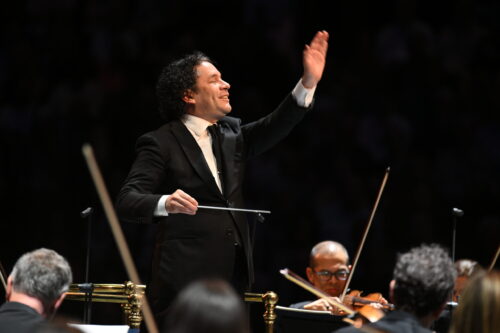
Dudamel and the LAPO’s second Prom had the same shape as their first the previous night (review here): a Beethoven symphony and a large-scale contemporary ballet. As with their performance of Thomas Adès’s Inferno, it would be hard to imagine Gabriela Ortiz’s work better done: but what about the Beethoven? Following Iván Fischer’s performance with the Budapest Festival Orchestra at last year’s BBC Proms was a tough ask…
The oboe that ushers in the uncommonly spacious slow introduction was so graceful and delicious -as, too, the flute that follows it – that the whole section sounded like a tiny tone poem in itself. What was missing was a sense of expectancy, anticipation, preparation: there was no energy in those rising scales (like bubbles in water), so instead of being kept teetering on the edge of the Vivace until Beethoven releases it like a coiled spring we just sat and waited for him to get on with it. Or at least, I did. What followed was well drilled and breezy, with impeccable manners.
Whereas the first movement, the scherzo and finale are all of a piece, the enigmatic Allegretto seems to come from somewhere else (rather as the Allegretto in Shostakovich’s Tenth Symphony does). Dudamel’s measured tempo paid off in the movement’s later stages, the music evolving into something inexorable before mysteriously evaporating.
In the scherzo and finale we were back into bright sunlight, the rhythms immaculate, everything impressively clear and transparent, the music’s momentum driven by crisply emphatic timpani. The finale approached, perhaps achieved, a genuine Beethovenian wildness along with superb discipline (the horns refrained from drawing attention to themselves by braying too loudly). It was undeniably exciting, the conclusion irresistibly so, the lightness and tightness of the sound persisting to the last bar.
There seems to be a critical tendency to denigrate Dudamel in the core classical repertory. I enjoyed this Beethoven Seventh; though to say that it got better as it went on may sound like faint praise.
Ortiz’s interesting programme note about her ballet Revolución diamantina, composed in 2023, told us a good deal about the work’s context and its themes, but little about the music. Quite right, of course – we have ears – but those of us who hadn’t heard it had to work our way into and around the multifarious and exotic sounds her large forces produce. Prominent among them are the percussion – stretched all around the platform’s top step – and the miked voices of the eight female singers from the Los Angeles Master Chorale. It is quite an aural (and visual) spectacle, tailor-made for the BBC Proms: but what does it amount to?
At one point I was wondering whether it is anything more than a medley of Latin American rhythms; other passages sounded like a mash-up of The Rite of Spring and Steve Reich’s The Desert Music. Of course there was a missing dimension – the dancers, telling the story, focusing and intensifying the ideas and emotions in the music, making them visually powerful and explicit. Should I be feeling their absence? Did I do so, I wonder, when I first heard Petrushka or The Rite of Spring in concert?
The initial impulse for the work (which provides the ballet’s title) was the ‘Glitter March’ in Mexico City in 2019, in which protesters threw pink glitter at the chief of police in denunciation of the lack of response to the alleged rape of a woman by local officers – a march that unleashed an intense reaction and further protests. Ortiz’s ballet is divided into six acts, each one depicting – or responding to – a different scenario of the oppression of women: harassment; love exploited by manipulation, control, violence; solitude and exclusion; intimate terrorism in a relationship; street protest and the cry for justice; and the aspiration that ‘only by walking together will we be able to find a way out…their cause is also our own.’ The excellent women’s voices were at the heart of this scheme, sounding by turns militant, sensual, eerie, defiant.
One mark of the effectiveness of a new piece is whether the music stays with you over the following days or vanishes, leaving nothing behind. Ortiz’s music is with me still: the icy sounds with which the first of the six acts opens, with delicate tuned percussion and disembodied voices, a slow crescendo capped by brittle trumpets; the quiet, sultry sounds of Act 2, hypnotic and with hints of Ravelian gorgeousness, the female voices blooming in the Hall’s vast space, the string body finally becoming articulate; the ominous rumblings and tappings of Act 3, the sighing of the voices, the concluding take on Stravinsky’s Dance of the Earth…
We were moving, in my case blindfold, towards the climactic Act 5, an exploding, overwhelming enactment of protest, the cry for justice, the march itself. The Prommers erupted: Dudamel waited before beginning Act 6, hypnotic, its slowly oscillating syllables sounding almost like a lullaby, a calm crescendo climbing towards – what? Benediction? Transfiguration? Such terms are probably too sentimental, too religiose to be appropriate; but wherever we had got to, Gabriela Ortiz, Dudamel and the orchestra were cheered to the rafters.
Chris Kettle