
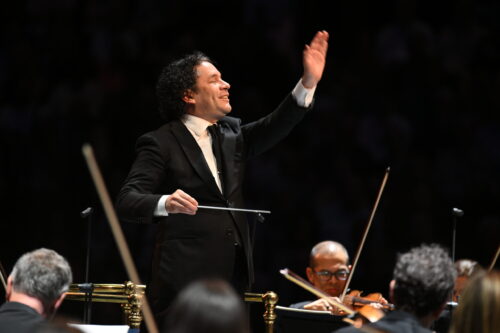
 United Kingdom BBC Proms 2026 [15] – Beethoven, Adès: Los Angeles Philharmonic Orchestra / Gustavo Dudamel (conductor). Royal Albert Hall, London, 11.8.2026. (AV-E)
Beethoven – Symphony No.6 in F major, ‘Pastoral’
Adès – Dante – Part One: Inferno
I came to this BBC Prom just to hear Dante – Part One: Inferno, by the world’s greatest living composer, Thomas Adès. My only regret was that we heard Inferno alone rather than the complete Dante. At around 93 minutes in total, the complete work would have made a magnificent Prom in its own right, with Inferno followed after the interval by Purgatorio and Paradiso. Inferno itself lasts around 45 minutes and unfolds continuously across thirteen sections, tracing Dante and Virgil’s descent through Hell.
Of course, the logistical complications of presenting a complete Dante with a touring orchestra, together with the relative unfamiliarity of the work, would make such a proposition far from feasible. However, Dante – Part Two: Purgatorio was performed at the Proms on 8 August by the National Youth Orchestra, conducted by Adès himself. Regrettably, I overlooked that performance; otherwise, I would have been there.
Instead, we were given a leaden and lacklustre performance of Beethoven’s Pastoral Symphony. Despite the Los Angeles Philharmonic deploying a larger-than-usual string section — including seven double basses — their tone, weight, body and attack were severely lacking throughout. The opening, Awakening of cheerful feelings upon arriving in the country, was nothing of the kind, lacking almost everything the title promised. It felt less like an arrival in the countryside than a visit to Kew Gardens: sterile, sanitised and meticulously cultivated, with none of the uncouth and untamed rustic vitality Beethoven demands.
The Scene by the Brook was taken at an absurdly hurried pace, more like a brisk country ramble than an unhurried stroll beside a babbling brook. The double basses and cellos lacked grit, attack and presence, while the woodwind was curiously characterless. What should have unfolded with natural ease instead felt rushed and oddly earthbound, the music never acquiring the sense of spaciousness and gentle flow that Beethoven’s serene scene demands.
The Merry Gathering of Country Folk was anything but merry. The tempo was far too fast, robbing the movement of its rustic ponderous ease and lumpen swagger. There was zero rustic roughness or mercurial merriment, and the divided strings sounded flaccid and listless rather than adroit and animated. Beethoven’s gruff humour and vivacious physicality were conspicuously absent
The Thunderstorm was totally devoid of storm and thunder. There was no gathering menace, no elemental violence, no sense of nature suddenly turning hostile. The timpani were effete and timorous, lacking attack, while the horns remained restrained and tepid, incapable of generating the weight, danger and elemental force the music demands. It was a pathetic excuse for a thunderstorm.
Finally, the Shepherd’s Song: Cheerful and thankful feelings after the storm offered little release. Instead of sheer radiance, an overwhelming sense of forlornness and despondence emanated from the stage. Dudamel weighed down with turgid phrasing, dragging out the melody and robbing it of its natural flow. The closing horn solo fluffed the song, bringing the symphony to a thankless conclusion rather than the gratitude its title suggests.
Perhaps our current drought had already taken its toll on Beethoven’s dry pastoral landscape, for there was certainly not a drop of life-giving rain to be heard. But none of this barren aridity seemed to matter to the audience, who showered conductor and orchestra with animated and appreciative applause, bringing us a ray of sunshine at last.
Thomas Adès’s Dante – Part One: Inferno was an entirely different proposition. Here, the LA Phil seemed miraculously transformed, and Dudamel displayed a far more instinctive affinity with Adès’s astringent adrenaline, at last sounding alive, alert and attuned, playing with visceral energy, gleaming colour and an almost unnerving sense of infernal immediacy.
Abandon Hope — established the abysmal atmosphere immediately, the orchestra creating a sense of immense foreboding and inexorable descent. Adès’s orchestral writing is extraordinarily physical: brass, percussion and strings collide and interlock with an almost architectural precision, while fragments of melody emerge from the darkness before being swallowed back into the orchestral mass. I was totally absorbed.
The Selfish—stung by wasps intensified the sense of disorientation. Dudamel maintained a relentless forward momentum, the stinging music needling and buzzing with nervous agitation, accumulating pressure without ever becoming merely loud. The LA Phil’s percussion section was particularly waspish, its sharp, stinging attacks adding a venomous edge and an extraordinary range of colour and impact. I was well stung; I can tell you!
The Ferryman brought a more grotesque theatricality. The origami orchestra seemed to shape-shift before the ear, its colours folding and refolding through sharply etched instrumental gestures, lurid splashes of brass and sudden orchestral eruptions that conjured a fiendish, feverish apparition. Dudamel judged the contrasts superbly, allowing each grotesque detail to flash into view before being swallowed by the next.
Pavan of the Souls in Limbo — offered a striking contrast, its sensuous orchestral textures creating an intensely arousing atmosphere of corrupted beauty. Adès’s writhing writing here was seductive whilst unsettling, the music glistening and languishing in acidic harmonic colours, lyrical fragments curling sinuously through the texture before dissolving into something darker and more elusive.
The Gluttons—in slime descended into a grotesque, viscous world of musical excess. The orchestral texture seemed to thicken and coagulate, with low strings gurgling beneath bloated percussion and lumbering orchestral figures, as though the music itself were wallowing in some foul, glutinous mire. There was something almost nauseatingly sumptuous about the stinking sound, a glutinous musical feast from which every last drop of restraint had been squeezed out and greedily swallowed.
The Miserly and the Prodigal was driven by an obsessive rhythmic energy, the two opposing impulses sharply etched against one another. One seemed to hoard every note while the other flung musical riches recklessly into the arid hot air, the rhythmic patterns tightening and unravelling with manic insistence. Dudamel kept the musical argument taut and incisive, the orchestra responding with remarkable rhythmic acuity and visceral energy — qualities so glaringly absent from the Beethoven.
The Suicides—the bleeding trees — erupted with an enjoyably savage, volcanic force. The brass ripped through the orchestral thicket with metallic teeth and startling ferocity, while the pernicious percussion supplied a brutal, visceral weight, the whole orchestra sounding potently possessed by an almost uncontrollable fury. Yet beneath this vivacious violence, every detail of Adès’s intricate and scintillating scoring remained ferociously alive, each orchestral layer seething with its own poisonous potency.
The Deviants—on burning sand — was among the most physically overwhelming passages of the evening. The orchestra erupted into a searing, sun-scorched soundscape, the brass blazing above thunderous percussion while the strings drove the music forward with almost unbearable intensity. The LA Phil played with phenomenal commitment, the orchestral attack striking with a beautiful violence, as though the music itself were being scorched from beneath, and enjoying taking the heat.
The Fortune-tellers—facing both ways introduced a strangely bifurcated, hallucinatory soundworld, the orchestra seeming to split into two constantly shifting visions. Musical gestures twisted back upon themselves, bright flashes of instrumental colour suddenly turning inside out, fragments darting forward only to recoil, reverse and dissolve into the orchestral haze. Dudamel navigated these slippery currents with impressive clarity, the music continually flickering between opposing faces, as though viewed through a distorting mirror.
The Popes’ Adagio—heads first — created a darker, more static and stickier atmosphere, the monstrous music seeming to burn from within. Dudamel sustained the tension with remarkable patience, low strings growling beneath cavernous brass, while muted woodwind murmurs and sinister percussion conjured strange, subterranean sonorities. There was something deeply unsettling in its stagnant silence — a feverish, almost hallucinatory intensity that made the spaces between gestures feel as charged as the deliciously demonic sounds themselves.
The Hypocrites—in coats of lead — created a very different kind of oppression. The music seemed to buckle beneath its own weight, its dense sonorities dragging themselves forward with a grotesque, leaden gravity. Dudamel drew a metallic murkiness from the orchestra, low strings and sombre brass spreading a funereal pall across the movement, while isolated instrumental lines surfaced like warped, half-submerged voices, as though struggling to breathe beneath the weight of their own metallic skins.
The Thieves—devoured by reptiles was a brief but extraordinarily vivid eruption of grotesquerie. This swamp seemed to writhe and scuttle, with skittering rhythmic figures, whip-cracks and darting instrumental gestures conjuring a wriggling menagerie of reptiles slithering and snapping through the subterranean waters. Adès’s Lisztian delightful devilry gave the music a manic, carnivalesque colouring, a kind of crocodilian chaos in which gleaming reptilian replicants seemed to coil around one another before suddenly swimming off into the sensuous sewers of Hell itself. The final percussive eruption was so earth-shattering that the exhilarated audience erupted into spontaneous applause.
Satan—in the lake of ice provided the ultimate culmination. Adès’s orchestral forces were deployed with extraordinary control, the malevolent music gradually freezing into a bleak, glacial stillness. Dudamel and the LA Phil allowed the final sonorities to recede almost imperceptibly, dissolving into an icy Hell of desolate silence — a strangely understated ending to such a vast descent into darkness.
There was a standing ovation, with both Adès and Dudamel turning towards the Los Angeles Philharmonic to acknowledge an extraordinary orchestral achievement, receiving ecstatic and richly deserved applause from an appreciative audience — what a diabolically divine performance to remember with hellish relish.
Alexander Verney-Elliott
Featured Image:
I say it ALL the time: Ades is the greatest living composer. As well as an extraordinary pianist. And conductor!