 Austria Innsbruck Festival for Early Music – Pietro Antonio Cesti, Il pomo d’oro: Soloists, Street Motion Studio, Compagnia Fattoria Vittadini, NovoCanto, Accademia Bizantina / Ottavio Dantone (conductor). Tiroler Landestheater, Innsbruck, 7 & 8.8.2026. (AB)
For the 50th-anniversary celebrations of the Innsbrucker Festwochen der Alten Musik, artistic director Eva-Maria Sens and musical director Ottavio Dantone went for the perceived impossible: bringing Antonio Cesti’s Il pomo d’oro back to the stage in virtually complete form for the first time since 1668. Yet the result is not merely impressive, but one of those rare festival events that makes one feel, almost physically, that something thought impossible has suddenly become possible again – with resounding success.
The legend surrounding Il pomo d’oro is almost absurdly large: commissioned for Emperor Leopold I and Margarita Teresa of Spain, the opera was originally intended for their wedding celebrations, but repeated delays, not least because the specially constructed theatre was not ready in time, meant that the work was finally performed only on 13 and 14 July 1668. It was conceived on a scale that, even by the standards of 17th-century court spectacle, seems almost fantastical: a prologue and five acts, more than 40 singing roles, plus dancers and chorus, 23 stage sets, spectacular machines, and a performance spread over two evenings lasting around eight hours.
The even greater obstacle to a revival, however, was not the size of the undertaking but the state of the music itself, since substantial portions of Acts III and V had been lost, leaving Il pomo d’oro for centuries in the strange position of being famous as an operatic monument and yet impossible to encounter as a complete work in the theatre.
Dantone’s reconstruction of these missing sections, based on surviving fragments, related music by Cesti and his own intimate knowledge of the composer’s language, is therefore central to the entire Innsbruck project, and it is striking how naturally those reconstructed passages sit within the surviving score, without drawing attention to themselves as acts of scholarly repair.
The story itself is wonderfully simple at its centre and gloriously complicated in almost every direction around it. Discordia, excluded from the wedding of Thetis and Peleus, throws a golden apple into the gathering with the inscription ‘to the fairest’; Giunone, Pallade and Venere immediately claim it; Giove, wisely or perhaps cowardly, refuses to decide between them and appoints Paride as arbiter; Venere offers him Elena, the most beautiful woman in the world, and wins the apple, while Paride abandons his lover Ennone and thereby begins the chain of events that will ultimately lead to the Trojan War.
But Il pomo d’oro does not unfold like a tightly organised drama: its prologue and five acts proceed through a succession mini-scenes from the sublime to the ridiculous with sudden changes of emotional temperature, so that at times one has the feeling of watching an immense 17th-century soap opera in which gods and mortals constantly reorganise their loyalties, their desires and their grudges.
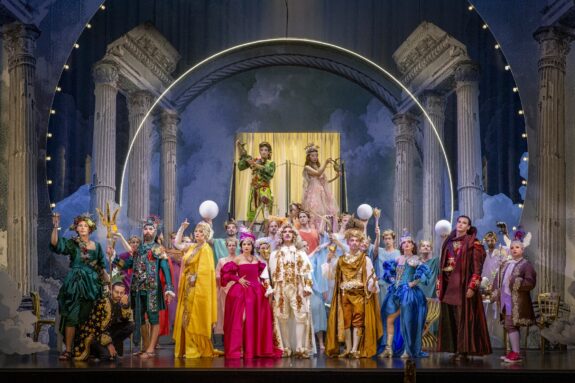
That this remains gripping, moving and entertaining over two evenings is one of the great achievements of Fabio Ceresa’s direction. The sheer quantity of his ideas is astonishing: some are elegant, some grotesque, some deliberately vulgar, some touching, and some so cheerfully excessive that one simply gives in to them. The prologue, turned into a grotesque beauty contest between personifications of the Austrian lands, immediately establishes vanity as the central force of this universe, and from there Ceresa moves freely between Baroque illusion theatre, modern revue, slapstick and serious tableaux, without ever completely severing the connection to the opera’s original world.
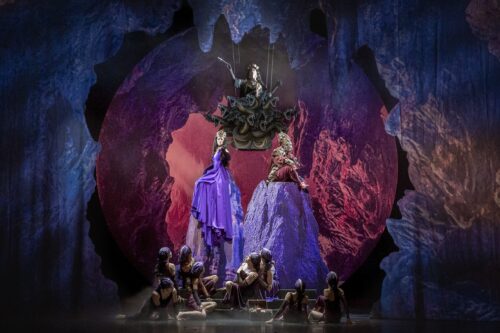
Nikolaus Webern’s stage designs are crucial to the production’s vitality and show the world is in almost constant transformation: the heavens, the underworld, modern interiors, revolving constellations, fire effects and spectacular aerial machinery appear and disappear with an almost childlike delight in what theatre can do. Add to that the approximately 260 fabulous costumes designed by Giuseppe Palella, and you arrive at something approaching the sumptuousness the opera must have possessed in 1668.
It is remarkable that Innsbruck managed to assemble a cast of 20 singers who were, at the very least, good in all 47 roles, beginning with the three rival goddesses, who were the dramatic axis of the two evenings. Sophie Rennert gives Giunone authority, vocal presence and an imperious sense of offended dignity; Jone Martínez’s Venere is sharper, more dangerous and more volatile, while Shira Patchornik’s Pallade has the necessary steel and martial determination.
Mauro Borgioni was an elegant and persuasive Paride, singing with warmth and clarity while making the character’s disastrous susceptibility to temptation entirely believable, whereas Mathilde Ortscheidt’s lyrical alto gave Ennone, the wounded lover, an inwardness and emotional stillness.
One of the most endearing and surprising characters was Alberto Allegrezza’s Filaura, who comes close to stealing the entire production: he approached the travesti role with enormous comic freedom and a unique mixture of physical comedy, shameless exaggeration and musical assurance. Rocco Cavalluzzi’s Momo was equally effective in a different way, providing dry and sardonic commentary on the actions of the gods.
Giacomo Nanni’s Giove had the necessary authority without becoming heavy or pompous, while Margherita Maria Sala brought impressive contralto weight to her various appearances, including Mercurio and Alceste. Jiayu Jin was agile and bright as Amore, and José Coca Loza contributed appropriately dark colour as Plutone and Caronte. The NovoCanto chorus was equally excellent, singing with clarity and refinement throughout the two evenings.
In homage to the extended ballet scenes of Il pomo d’oro, two dance companies completed the action on stage. Under Davide Riminucci’s effective choreography, the dancers help to create battles, landscapes and comic disruptions that add to the spectacle in an almost lyrical way.
The final praise must go to Ottavio Dantone, who miraculously held the two evenings together musically and led both the singers and the Accademia Bizantina to perform at their best. Of course, no one knows the details of Cesti’s score better than he does, and it was a sheer pleasure to hear how Dantone drove forward the melodic and harmonic arcs, moving from intimate lyricism to ceremonial splendour and from comedy to martial energy with a supreme feeling for tempo and texture.
The end of the opera found a fitting image for the entanglement of virtues and vices that had unfolded over two evenings: the work’s original function as Habsburg glorification was transformed into an all-encompassing image of community. The golden apple, once the source of rivalry, is multiplied and distributed by the goddess Europa to everyone, and so the final chorus became an unexpectedly moving and uplifting plea for harmony and reconciliation.
After around seven and a half hours of excellent music and drama at the end of the second evening, what remained most strongly was therefore not a sense of endurance but of exhilaration. For its 50th birthday, Innsbruck could hardly have given itself a finer present, and for two remarkable evenings, Il pomo d’oro became living theatre again – and certainly the operatic event of the summer. Congratulations!
Andreas Bücker
Featured Image: All the gods and the golden apple © Birgit Gufler
Creatives:
Direction – Fabio Casera
Set designs – Nikolaus Webern
Costumes – Giuseppe Palella
Lighting – George Tellos
Choreography – Davide Riminucci
Cast:
Gloria Austria / Giunone – Sophie Rennert
Spagna / Venere – Jone Martínez
Sardigna / Pallade – Shira Patchornik
Amore / Hebe / Zeffiro – Jiayu Jin
Proserpina / Tesifone / Aglaie – Neima Fischer
Discordia / Aletto / Eufrosine – Ester Ferraro
Ennone – Mathilda Ortscheidt
Italia / Mercurio / Alceste – Margherita Maria Sala
Himneo / Apollo / Adrasto – Filippo Mineccia
Aurindo – Rémy Brès-Feuillet
Boemia / Ganimede / Elemento del foco – Paul Figuier
Magera / Volturno / Pasithea – Danilo Pastore
America / Filaura – Alberto Allegrezza
Marte / Austro – Žiga Čopi
Hongheria / Paride / Euro – Mauro Borgioni
Imperio / Giove / Eolo – Giacomo Nanni
Germania / Bacco – Balázs Bán
Plutone / Caronte / Sacerdote – José Coca Loza
Nettuno / Cecrope – Federico D.E. Sacchi
Momo – Rocco Cavalluzzi