
A strong tradition and a bright future. David Francis, CEO of the Three Choirs Festival in conversation with John Quinn
The Three Choirs Festival is almost certainly the oldest music festival in the world: it can trace its origins back to around 1715. The Festival began as an annual gathering, lasting just a couple of days, of the Musical Societies of the cathedral cities of Gloucester, Hereford and Worcester; the respective cathedral choirs were part of these societies and sang services, accompanied by an orchestra, during the gatherings. From the outset, each of the three cities took it in turn to host the annual get-togethers. The gatherings gradually widened in scope and duration. Nowadays, the Festival runs for a week and includes a wide variety of concerts, recitals, talks and social events. Throughout its long history, only three times have the annual Three Choirs Festivals been disrupted: they were suspended during the two World Wars and the 2020 Festival was cancelled during the Covid pandemic. This long, almost uninterrupted sequence means that the 2028 Festival will be the 300th.
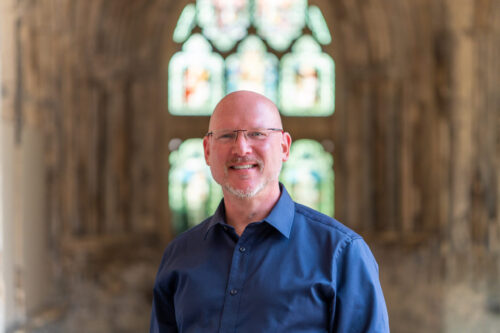
In October 2024, David Francis took over as the CEO of the Three Choirs Festival. He has an ideal background for this role; his career to date has embraced both music and business administration. Indeed, I noticed with considerable interest, when I read his online profile, that not only was he a postgraduate student in vocal studies at the Guildhall School of Music and Drama; he also holds an Executive MBA from Exeter Business School. Earlier in his career, David had management posts with both the BBC Symphony Chorus and the City of Birmingham Symphony Orchestra. His CV also includes senior roles with The Performing Right Society (PRS) and with the PRS Foundation (which he developed and launched), Arts Council England and Dartington. Immediately before joining Three Choirs, David lived and worked in Australia for some 10 years, running, at various times, Sydney Philharmonia Choirs, the Four Winds Festival and Wollongong Conservatorium of Music (known as WollCon).
When I went to meet him recently it was with the intention of discussing his role with and vision for the Three Choirs Festival. However, it occurred to me that European readers might share my lack of knowledge of the organisations with which he worked Down Under, so I asked him to tell me a little bit about them. David explained that he began the Australian part of his career in 2014 by working for about 18 months as General Manager of the Sydney Philharmonia Choirs (SPC). The organisation was approaching its centenary – it was established in 1920 – but the organisation was struggling. David arrived with a brief to turn it round, a challenge he relished because, as he put it, he is ‘really interested in organisational strength and health, and finding sustainable futures for organisations’. He put the SPC back on track. From there, he went as Executive Director to the Four Winds Festival, a classical music festival based in a town of only about 2000 inhabitants on the Sapphire Coast in the south-west of New South Wales. This had been established in 1991 as a biennial festival but there was an ambition to expand into a year-round programme with music at its heart, serving the community. In his five years with Four Winds David oversaw that expansion, leading the development of an artistic organisation of which the local community were proud and with which they were deeply engaged. David’s last Australian appointment was in Wollongong, a city of some 300,000 people located about 60 km south of Sydney. This is a steel town which is also home to a major university. There, he headed up the Wollongong Conservatorium, known by everyone as WollCon. This is one of 17 regional conservatories in New South Wales funded by the state government. Led by David, WollCon’s outreach to the wider community included providing music teachers in schools, sending out peripatetic teachers, and the provision of individual music lessons in the conservatory. WollCon also ran extensive music therapy programmes and hosted musical ensembles right across the age spectrum. As president of the organisation representing all the NSW conservatories, he lobbied for music education in the rural areas of the state. When he arrived, WollCon ‘was going well but needed some direction and some financial sorting out’. So, David was able to use his skill set to good effect and also address some of his concerns about music education in New South Wales.
He told me that he loved his job at WollCon but, by the autumn of 2023, for personal reasons the time was right to return to the UK. I asked David what it was that had drawn him to apply for the Three Choirs Festival role. He told me that it was a job which appealed strongly because his background is in choral singing and it is an art form he knows well. He grew up in the Anglican choral tradition which had ‘run through my bones since I was a child’. Fortunately, the stars aligned because the Three Choirs CEO role became vacant in 2024; he applied and was successful. The role is, as he put it, ‘close to my heart in terms of its repertoire and community’; given his musical background and career experience he feels that he has something to contribute to the organisation’s future.
David took up his post in October 2024. Because so much forward planning is needed, I presumed that he didn’t have a huge amount of input into the planning of the 2025 Hereford Festival but that his involvement in the 2026 Gloucester Festival would have been much fuller. In fact, David told me that my assumption was only partly correct. He explained that the planning cycle is longer. As a result, ‘for 2026 the cornerstones were in place [when he arrived] and there had been a strategic decision which was that we want this festival to look and feel like a kind of heartland Three Choirs Festival. We wanted to programme repertoire that would really explore whether there is still an audience who want to come and hear this music in big numbers.’
It is often claimed that the audience for ‘Classical’ music is shrinking and elitist. I was, therefore, greatly heartened by what David told me about ticket sales for the 2025 Hereford Festival: ‘over the course of the festival last year, through our box office, we sold 16,500 tickets; and 47% of the people who came were new to the festival’. Given that Hereford is the most remote of the three cathedral cities, with, for example, no direct motorway link, it is astonishing that several thousand tickets were sold to Three Choirs newcomers. As David said, there are ‘these kind of tropes around Classical music that the audience is ageing and so music is a dying art form…I think it’s probably true that as a population we are ageing, so it’s natural that our audience would age, but the reality is that our audience is refreshing itself.’ He went on to caution that factors such as the reduction in music education in schools and a decline in church-going means ‘there may be a gap down the line. I think that’s one thing that we need to think about for the future. But at the moment, we’re seeing a really, really strong response to the programme’. The picture is extremely promising for the 2026 Gloucester festival. Ticket sales, he told me, are ‘very strong’; sales are about 7% ahead of where they were at the same time in 2025. When one considers all the current cost of living pressures on incomes that is really good to hear.
David believes that the very fact that many of the concerts are given in the host cathedral is an important factor; as we agreed, it is a different proposition to hear The Dream of Gerontius in a secular concert hall as compared to a venue like Gloucester Cathedral. But, in David’s view, this is something that goes beyond a question of the respective acoustics. As he said, ‘there’s definitely something about hearing sacred works in a sacred building…this sense of the festival being somewhere where people can come for a collective experience and something that connects them at a spiritual level in the context of an event that’s not a religious service’
One word that came up many times in our conversation was ‘community’. David is keen to explore initiatives that will draw in audience members more completely than simply by coming to listen to a concert. Referring back to the start of our conversation, he explained: ‘what I learnt a lot about in Australia was that the audience that I was working with was so interested in the music, even if they were not musically really literate. They were really interested in the artists, what they were doing, where they come from; but also, the music and the compositional process and what should they be listening out for and so on. So, what I learned from that is that there’s a real opportunity to connect the audience more deeply to the music’. He suggests that for Three Choirs in the future this might include, for example, asking a mezzo-soprano to give a talk about the role of The Angel in The Dream of Gerontius and how a singer goes about preparing and performing it.
This plan to engage the audience more deeply in the music goes to the heart of David’s vision for the Three Choirs Festival’s ambitious Associate Composer scheme. The scheme has already begun with Gavin Higgins announced as the first composer; his three-year term starts with the 2026 Festival, and another composer will join the scheme in 2027 followed by another in 2028, by which time there will be no fewer than three participating composers on a rolling programme. The idea is that each composer’s involvement will build up over time. Year one of a composer’s term will be, as it were, ‘getting to know you’; some music by the composer will be programmed. In year two it is envisaged that one or more chamber-sized works will be commissioned and performed; for a composer’s third festival the plan is to commission a substantial choral/orchestral work. But David is looking for much more to come out of the scheme than audiences simply turning up to hear the composers’ music in concerts. He is looking for the composers to engage with festival audiences so that their music – and how it is created and performed – is more deeply understood and appreciated. By co-commissioning pieces with other organisations, David hopes that commissioned works will achieve further performances beyond the premiere. This seems to me to be an ambitious but novel and exciting approach to the concept of composers in residence. David believes that Three Choirs has a good track record when it comes to reviving works, citing the 2025 revival of William Mathias’s This Worlde’s Joie (review here). I think that’s a fair point: the 2023 revival of Francis Pott’s A Song on the End of the World is another recent example (review here).
Though he recognises the challenges that an institution such as Three Choirs faces nowadays, David’s optimism for the future is palpable. In particular, he is keen to expand the reach of Three Choirs beyond the one-week festival, through ideas such as collaborations with schools and involving young people in singing activities, perhaps annually at Easter. He sees the 300th Festival in 2028 as a great opportunity to build on the tradition of Three Choirs, using that milestone to raise awareness even more widely. He reminded me that many other festivals have come and gone. He is convinced that the reason Three Choirs has endured is because it has consistently had sustainable foundations – both artistic and financial; also, throughout its history it has had strong community support; he is determined to build on all of that.
Since David has been immersed in choral music both in the UK and in Australia, I invited him to compare and contrast the choral scene in the two countries. He told me that on coming back to the UK after 10 years it was ‘incredible to be reminded of how much singing and participation in choirs of all different sorts there is here. It strikes me that belonging to a choir is a far more common activity here than, for instance, in Australia. There are so many opportunities to sing here. As an example, many members of the Bromyard Choral Society (which I conduct) are in multiple choirs.’ He added that in his experience ‘the number and range of opportunities would not be the same for a choral singer in Australia…or people would have to travel significant distances to take part. I used to drive 5 hours (each way) once per month to work with my chamber choir in Australia who were based in a remote costal town. Luckily, I had a wonderful, retired music teacher as a co-director who used to take weekly rehearsals and teach all the notes – so she did the hard work and I had the privilege of applying the polish.’
At the end of our conversation, I couldn’t resist asking David the invidious question: to which events is he most looking forward at the 2026 Festival? Unsurprisingly, the first event he mentioned was the morning concert on 1 August by his old friends, the Sydney Philharmonia Choirs. They will come to Gloucester fresh from appearing at the BBC Proms on 26 July when they will join the CBSO and Chorus to perform John Adams’s Harmonium under the baton of Kazuki Yamada. For Three Choirs they will perform a programme of mainly British choral classics, and they will also introduce the audience to some pieces by contemporary Australian composers. David is also looking forward keenly to Janáček’s Glagolitic Mass which will take him back to his days as Chorus Manager of the CBSO Chorus and the occasion when they went to the Bridgewater Hall in Manchester to take part in a performance of that exciting work to celebrate the installation of that hall’s new organ. The Three Choirs performance will be part of a thrilling programme which will show off Gloucester Cathedral’s new Nicholson organ. During his university days, David sang some Elizabethan lute songs, so the Dowland recital by Ian Bostridge and Fretwork is firmly in his diary; he thinks the music will sound wonderful in the acoustic of Gloucester Cathedral. The Dream of Gerontius is a quintessential Three Choirs work. David vividly recalls taking part, as a tenor member of the BBC Symphony Chorus, in a 1995 performance in Westminster Cathedral conducted by Sir Andrew Davis; he is impatient to hear Adrian Partington conduct the work in the acoustic of Gloucester Cathedral to bring down the curtain on the 2026 Three Choirs Festival.
David Francis’s enthusiasm for the future of the Three Choirs Festival is infectious. I came away from our conversation with the clear impression that the Festival is being led by someone who has a strong respect for the Three Choirs tradition and is keen to build on it and also by a man who is determined to grow the festival strongly and sustainably well beyond the 300th festival in 2028.
The 2026 Festival takes place in Gloucester between 25 July and 1 August. The programme is very exciting and you can find more details and book tickets here. However, given David’s message about strong ticket sales it would seem that prompt booking will be advisable.
John Quinn