 Germany Wagner, Die Meistersinger von Nϋrnberg: Soloists, coruso e.V., Nordwestdeutsche Philharmonie / Frank Beermann (conductor). Stadttheater Minden, 11.8.2026. (DM-D)
Unique for any composer of opera, the International Richard Wagner Association has got 127 member associations across the world. 45 of them are spread across Germany. They have their individually organised events, and they send a Wagner scholar to attend the annual Bayreuth Festival. Among those 45 associations in Germany, Minden has been unique because it has organised professional productions of by now all 10 of Wagner’s Bayreuth canon, starting with Der fliegende Holländer in 2002 and culminating with Die Meistersinger von Nürnberg in 2026. The orchestra involved in all those years was the Nordwestdeutsche Philharmonie, with their conductor Frank Beermann. Different production teams were assembled for each production. On this occasion, Jakob Peters-Messer directed the production, with set, light and video by Guido Petzold and costumes by Angela Schuett.
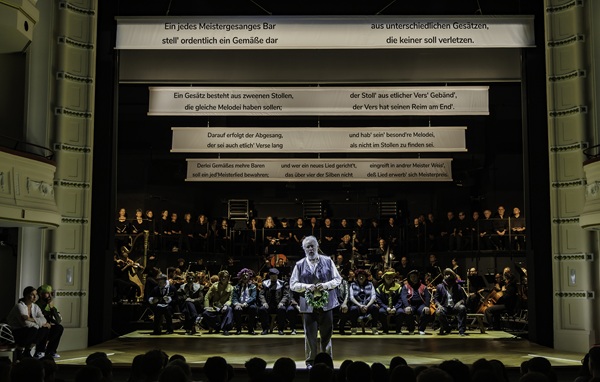
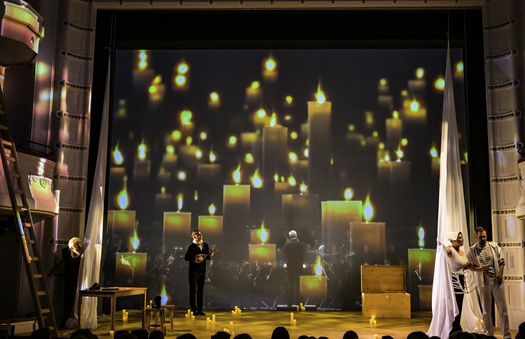
The municipal theatre in Minden, where all productions have been staged, does not have any company of its own: it is one of the many receiving only theatres in Germany, i.e. its artistic management puts together seasons of touring work across the genres of musical theatre, dance and drama. Given the size of the theatre building, the orchestra was placed at the back of the stage, on rising platforms, with the chorus at the very back, very high up. The orchestra could be separated from the front of the stage by a gauze curtain. The floor of the orchestra pit was raised to form a large part of the playing area. That area was predominantly bare, with a wooden floor and a couple of simple wooden chairs or benches and one or two equally simple wooden tables. To the left was the abode of Hans Sachs, with the box adjacent to the stage used as the entrance or exit. A wooden ladder led to the box in the first tier, which was also used for the indoor scenes. On the opposite side, the two boxes represented the home of Pogner and his daughter, Eva.
On various occasions video was projected onto the screen separating the orchestra from the front of the stage, and all remaining walls of the stage, and the auditorium except its back wall – stills of flowers, candles, a brick wall with debris on it, which changed colour in line with the mood of music and libretto – for example, lilac flowers for one of Hans Sachs’s monologues, and the neutral colour of the brick walls taking on shades of red for his ‘Alles ist Wahn’ monologue. When Walther related his dream, the text was projected onto wall by wall. When Beckmesser read the text as written down by Sachs, the letters disintegrated, the words became illegible, reflecting Beckmesser’s incomprehension.
Given that the front row audiences were literally within reach of the singers on occasion, and certainly always very close, director Jakob Peters-Messer did well in focusing much of his directorial attention on Personenregie. The overall frame for the plot was a group of contemporary performers assembling for a production of Die Meistersinger, with plenty of copies of the score and libretto all over the place when the performance started. They took their costumes for their roles from costume stands on the side of the stage. What we saw, then, was a friendly, relaxed engagement of the artists with the material of the opera, and both that atmosphere and the good-natured feeling dominated the production. Hans Sachs was a very good-natured, wise man throughout, with many moments where he sadly or knowingly shook his head or shrugged his shoulders, sometimes also with a melancholy smile. Beckmesser was shown as a man easily overpowered by his emotions, be it rage at the infringement of the laws of singing, or foolish love for Eva. He was genuinely in awe of the song he believed to have been written by Sachs, and equally genuinely devastated that he could not do it justice, no matter how hard he obviously tried, and then genuinely impressed by Walther’s rendition of the song. He had learnt his lesson and emerged a better or wiser man by the end. There was no need for genuine bitterness for and around this character. After his hilarious failure at the contest, he was ‘back to normal’ for himself and within the group in no time.
This overall framework also allowed for a witty take on the otherwise difficult ending of the opera. When Sachs, in line with the libretto, launched into his appeal for the preservation and importance of German Art, the others around him became the members of the contemporary company again: they just did not know what to do with all of this, in today’s political climate of increasing insecurity, and just left the stage, quietly, thoughtfully, perhaps a little sadly. They left Sachs alone on the stage at the end. A very poignant moment in the days characterised by just that very ‘not knowing what to do’, uttered vociferously in ever so many news programmes in the face of the first major election victory in a German federal state of a far-right party (with the unspoken implication: those fellows can just leave, we cannot).
The overall impact of the production was thus one of realising truths, achieving insights, and making the best of or with them, for oneself and the others. Seek to achieve a change where possible, but do not seek to enforce change, and give up generously towards the others and towards yourself where attempts at achieving change are not successful.
The Nordwestdeutsche Philharmonie, now in their 10th Wagner production with Beermann for Minden, played with an obvious awareness of the requirements of the score and the acoustics resulting from being placed on the stage behind the singers. Beermann’s interpretation of the music picked up and supported the playfulness of the production, swiftly changing moods from exuberant to thoughtful, from subtle to bombastic, but never explicit and bland, but always very subtle, hinted at, playful.
Over the years, Minden Wagner productions have seen many role debuts, including Andreas Schager as Tristan in 2012. This year’s Meistersinger was no exception, with debuts by Simon Bailey as Sachs, Emma McNairy as Eva, Jussi Myllys as Walther, Michael Borth as Beckmesser and Stephen Chambers as David. Bailey was a noble Sachs, singing with nuanced emphases, his voice sonorously ringing even in piano passages, and effortlessly rising to become an equal partner with the unleashed orchestra. Even in forte passages, Bailey’s voice was still well rounded and gentle, a combination that is most rare among Wagner singers. Emma McNairy was announced as indisposed – as I have not heard her before, I have no standard for comparison and can only say that I was not disappointed. Jussi Myllys already gave his debut in the role of Parsifal in Minden in 2023. Compared with that, his voice has developed well, with further grounding in the lower register and thus much more ease in reaching the exposed highest register, which sounded much freer now. With a strong awareness of his vocal capacity and the demands of the role between more lyrical and more dramatic material across the four-and-a-half hours, he was able to sustain a high quality of sound throughout, culminating in a beautiful rendition of the Prize Song. Michael Borth had the advantage of the sympathetic interpretation of his character, Beckmesser: he did not have to resort to vocal means to express any nastiness, and thus the dilemma of ugly sounds for ugly characters did not present itself here. Borth sang with vocal abandon, rounded, robust, but also able to vocally express both Beckmesser’s yearning at the basis of his pedantic activity of enforcing the rules, and his feelings of love, which thus came across as genuine even if their expression was rather misguided.
Stephen Chambers sounded particularly young and fresh as David, with much more of a lyrical rather than character tenor. Kathrin Göring’s mezzo-soprano contrasted well with McNairy’s Eva, she made the smaller role of Magdalene fully her own, singing with ease and relish. The singers entrusted with the Meistersinger roles fitted in well with the leading roles and voices. Peters-Messer had clearly developed a full life story for each of these characters, impacting on and informing the moments depicted in the opera. Peter Lobert, singing from the first tier, had a particularly rounded and voluminous bass voice for the Night Watchman and his horn (Stierhorn) was also played from the first tier.
The chorus for this production was coruso e.V., an association of freelance singers offering their services to opera productions where the producers cannot use the services of a local resident chorus at an opera house, or where the smaller resident chorus needs to be enlarged. They do not have a permanent chorus master but work with the leader employed for the respective productions they are hired for. In this case it was Raymond Hughes, under whose leadership coruso achieved an impressive rendering of the choral material of the opera.
With all ten productions ‘done’, the question arises what next for Minden Wagner? The person behind the organisation of all those ten productions, solicitor and long-serving chair of the Wagner Association, Dr. Jutta Winckler, may want to call this production a glorious ending to the project, her project. However, future generations may well want to pick up on the memorable achievement and see where to take it next.
Daniel Meyer-Dinkgräfe
Featured Image: Act III: [l-r] Kathrin Göring (Magdalene), Stephen Chambers (David), and Simon Bailey (Sachs) © Christian Becker
Production:
Director – Jakob Peters-Messer
Stage and lighting design and video – Guido Petzold
Costumes – Angela Schuett
Chorus master – Raymond Hughes
Cast:
Hans Sachs – Simon Bailey
Veit Pogner – Christoph Seidl
Walther von Stolzing – Jussi Myllys
David – Stephen Chambers
Eva – Emma McNairy
Magdalene – Kathrin Göring
Kunz Vogelgesang –Leon Noel Wepner
Konrad Nachtigall – Frieder Flesch
Sixtus Beckmesser – Michael Borth
Fritz Kothner – Johannes Schwarz
Balthasar Zorn – Václav Vallon
Ulrich Eisslinger – Ilya Silchuk
Augustin Moser – Steffen Schantz
Hermann Ortel – Mykola Piddubnyk
Hans Schwarz – Oscar Mrin-Reyes
Hans Foltz – Maurice Giancarlo Avitabile
Night Watchman – Peter Lobert