
 United Kingdom Puccini, La bohème: Soloists, Chorus and Orchestra of Opera North / Catriona Beveridge (conductor). Lowry Theatre, Salford Quays, 13.11.2025. (MC)
When Puccini’s La bohème is in town I find it an opera hard to resist. It is difficult to fathom why Puccini’s masterpiece when premiered in 1896 at Turin received such a mixed reaction. In 1900 when New York’s Metropolitan Opera staged the work for the first time the reaction was equally disappointing. In the New-York Tribune its influential music critic Henry Krehbiel thrashed the opera writing ‘La bohème is foul in subject, and fulminant but futile in its music.’ Krehbiel’s disparaging view couldn’t have been further from actuality, as La bohème soon captured the hearts of audiences. At the Met over eighty-nine seasons between the period 1900-96 La bohème was staged one thousand and one hundred times. With enduring audience acclaim La bohème has a near-fixed position in the top five operas staged worldwide.
For his irresistible opera La bohème Puccini set a libretto by Luigi Illica and Giuseppe Giacosa. They based it on Henri Murger’s Scènes de la vie de bohème (Scenes of Bohemian Life), a series of chronicles, mostly semi-autobiographical, containing his view of a bohemian way of living. Illica and Giacosa’s libretto narrates a heartbreaking love story set around 1830 focused on a freezing cold garret in the Latin Quarter of Paris. Inside the garret our impoverished band of young bohemians, the poet Rodolfo, painter Marcello, musician Schaunard and philosopher Colline all live, or more accurately, eke out an existence, whilst dreaming of their time in the limelight.
On Christmas Eve, Rodolfo meets and soon falls in love with Mimì, a young seamstress. Rodolfo then discovers that Mimì is dying from consumption. Thinking it best, Mimì leaves Rodolfo and within weeks her condition has vastly deteriorated. In the final scene she staggers back to the garret, and they reaffirm their love for each other. Mimì dies in Rodolfo’s arms, leaving him heartbroken.
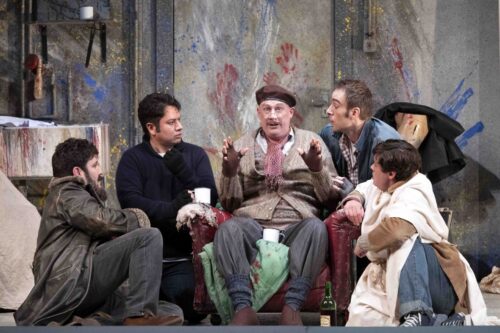
Having seen several stagings of La bohème I admit disappointment with Phyllida Lloyd’s 1993 production that has been revived here. Essentially my reservations are with Anthony Ward’s set notably the garret and the Café Momus. Foremost, the garret is surely a small attic room. Our garret was depicted as a substantial high room, grimy and uninspiring with concrete walls such as a large, ex-military warehouse. Strange too, the bed where Mimì was laying consisted of old rugs and blankets all piled on the floor. Oddly, the bonhomie between our four bohemians was much less than I expected. A crucial and key feature the Café Momus must surely provide a colourful and high-spirited contrast to the demoralising character of the garret. Unremarkably our Café Momus was represented as a long, straight banquette, upholstered in red with three brass rails along the top, all of which could be swung round. Set on Christmas Eve the unimaginative café design contributed to a rather pedestrian party atmosphere. The merrymaking was meagre with little evidence of wine and beer flowing.
However, I can put a disappointing staging to the back of my mind if the singers show their worth, as I feel they did here. As poet Rodolfo, British-American tenor Joshua Blue showed his stage ability together with his effective voice. In his Act I aria Che gelida manina Blue’s voice and feeling for the text created a heartwarming appeal. In Act IV, as Mimì lay dying, Blue communicated a heartbreaking response that sent a shiver down the spine. Isabela Díaz had the role of Mimì the consumptive seamstress. Displaying an attractive, girl-like tone the Chilean soprano will surely grow into the role. Much of the time I was unable to hear Díaz’s small voice clearly over the orchestration. At this point I must mention the beautifully sung duet O soave fanciulla between Mimì and Rodolfo that closes act one.
The role of professional singer Musetta is a crucial one with soprano Katie Bird starring as the larger-than-life, party-girl with a big heart. A huge part of the success of the production was due to Bird’s passionate interpretation of the character. Of the group at the garret, aside from Rodolfo, it was Colline the philosopher sung by South Korean Han Kim who stood out. His bass voice felt so necessary to the production, and he equipped himself so well. In fine form the chorus of Opera North were a credit to chorus master Anthony Krause. Under conductor Catriona Beveridge the Opera North orchestra played commendably throughout, creating a compelling sound.
Puccini biographer Michele Girardi wrote that La bohème was a ‘perfect masterpiece, in which not one note is insignificant.’ Although the sets were not to my taste Girardi certainly wasn’t wrong.
Michael Cookson
Featured Image: Opera North’s La bohème © Richard H Smith
Production:
Stage Director – Phyllida Lloyd
Revival Director – James Hurley
Set and Costume designer – Anthony Ward
Lighting designer – Rick Fisher
Revival Lighting designer – Richard Moore
Choreographer – Quinny Sacks
Revival Choreographer – Maxine Braham
Chorus master – Anthony Krause
Cast:
Mimì – Isabela Díaz
Rodolfo – Joshua Blue
Musetta – Katie Bird
Marcello – Josef Jeongmeen Ahn
Schaunard – Seán Boylan
Colline – Han Kim
Benoît / Alcindoro – Jeremy Peaker
Parpignol – Kamil Bień
Customs Sergeant – Simon Grange