
 United States ‘Requiem and Revelation’ – Cornelius, Cherubini: Wendy Bryn Harmer (soprano), Krysty Swann (mezzo-soprano), Eric Taylor (tenor), Harold Wilson (bass), Bard Festival Chorale (director: James Bagwell), American Symphony Orchestra / Leon Botstein (conductor). St. Bartholomew’s Church, New York, 13.11.2025. (ES-S)
Peter Cornelius – Stabat Mater
Cherubini – Requiem in C minor
The nineteenth century is often portrayed as the moment when Enlightenment rationalism finally eclipsed the old certainties of faith, when modern Europe supposedly moved past religious sentiment for good. Yet the art of the period tells a far less tidy story. In music, from Beethoven’s searching Missa solemnis to Brahms’s inward German Requiem, from Rossini’s operatic Stabat Mater to Verdi’s thunderous vision of judgment, the era’s sacred works expose how false the narrative of triumphant rationalism really is. Far from abandoning such topics, composers continued to wrestle with ritual, transcendence and mortality, often in forms that probe deeper than their symphonies or operas. Beyond such well-known works are others that are more or less relegated – often not for their subject but for the vagaries of taste, fashion and historical contingency – to the dustbin of history. It is from within that neglected archive that the American Symphony Orchestra’s program at St. Bartholomew’s Church – pairing Peter Cornelius’s Stabat Mater with Cherubini’s Requiem in C minor – emerged, offering not an exercise in curiosity but a reminder of how much of that sacred landscape we have allowed to slip out of view.
The evening opened with a surprise in itself: the U.S. premiere of Cornelius’s Stabat Mater, a work by a young composer whose entire oeuvre remains little more than a footnote in nineteenth-century music history. Written in 1849 and divided into ten movements that follow the structure of the medieval poem, the piece alternates between choral writing, a cappella sections that gesture toward Renaissance polyphony and moments for the vocal quartet of soloists. It concludes with an affirmative number, ‘Fac me cruce’, for choir and orchestra, incorporating unmistakable fugal elements. Even if not necessarily modest in scale, Stabat Mater’s rhetoric is restrained: Cornelius avoids the operatic sweep cultivated by many of his contemporaries, preferring clarity of text, directness of line and a devotional atmosphere that is contemplative rather than theatrical.
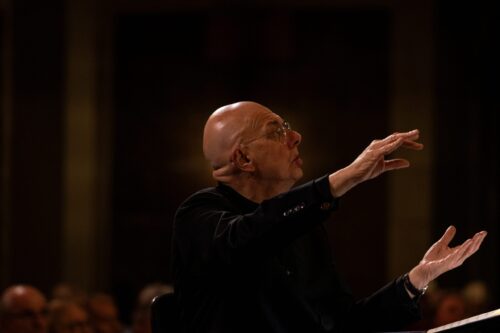
Botstein conducted with a light touch, allowing each movement’s character – whether austere, contrapuntal or lightly colored – to register without overstatement. The Bard Festival Chorale, prepared by James Bagwell, navigated the alternating textures with welcome precision, especially in the a cappella sections. Fulfilling the central role that Cornelius assigns it, the chorus generally rose to the demands of the writing, even if moments of tentativeness surfaced and the diction did not always project clearly in St. Bart’s resonant acoustic.
Wendy Bryn Harmer, whose soprano lines are by far the most prominent in the score, often soared cleanly above chorus and orchestra; hers was a bright, appealing sound, though a few upper-register entrances carried a touch of harshness. She was also the only soloist given an independent movement – ‘Eja Mater’, a brief but expressive arioso – which she shaped with poise and a welcome sense of line. In ‘Quis est homo’, her duet with bass Harold Wilson was well balanced, the two voices meeting on equal terms without strain. By contrast, mezzo-soprano Krysty Swann and tenor Eric Taylor – whom Cornelius assigns far less material – were more occasional participants than sustained presences, their brief entrances folded into the texture rather than featured. It is a design that reflects the work as a whole: a small-scale, intentionally varied meditation that relies as much on choral weight and shifting vocal constellations as on individual display. It is not difficult to discern in the work the influence of Cornelius’s uncle, the painter Peter von Cornelius, whom he greatly admired. The composer’s preference for clarity, restraint and a devotional tone over theatrical incident mirrors the sober, spiritualized aesthetic of the Nazarene movement that shaped his uncle’s artistic world.
Listening to Cherubini brought a different set of pictorial reminiscences, the choral blocks and ceremonial pacing evoking the austere classicism and seeming moral rectitude of Jacques-Louis David’s painting. Cherubini’s career – marked, like David’s, by a remarkable ability to navigate shifting political waters, setting convictions aside when expedient – parallels that of the great French painter in striking ways. Like David, he rose to prominence in the orbit of the pre-Revolutionary court, weathered the turbulent politics of the Napoleonic period with a mixture of adaptability and institutional savvy, and emerged after 1815 as a central figure in the cultural landscape of the Restoration. The Requiem in C minor (1816), premiered in the crypt of Saint-Denis on the anniversary of Louis XVI’s execution, belongs wholly to that moment: commissioned under the restored Bourbons and closely associated with the ceremonial reburial of the royal remains that preceded it, a gesture of symbolic repair for a nation grappling with its recent past.
The work unfolded with architectural clarity that emphasized its function as public rite rather than personal lament. Cherubini’s writing, severe in contour and cumulative in impact, builds its expressive force through layered choral sonorities, and Botstein drew out that carefully wrought gradation with notable finesse. The opening Introitus rose in long, measured spans, the ASO Chorus maintaining a disciplined blend that allowed harmonic inflections to register with quiet intensity, their dark-hued sonority kept deliberately uninflated. The vocal ensemble sounded notably more unified and responsive here than in the Cornelius, the lines locking into one another with greater precision. Throughout the entire rendition, Botstein maintained a careful equilibrium between chorus and orchestra, ensuring that neither sonority overshadowed the other and that Cherubini’s contrasts of weight and transparency could emerge naturally. Even the central Dies Irae, frequently treated as a moment of operatic excess, retained a cultivated discipline. After the movement’s opening brass calls, the chorus attacked ‘Dies irae, dies illa’ with striking delicacy, opening the sequence in unexpectedly hushed tones. Whispered interventions – ‘Mors stupebit’ – were interlaced with stepped crescendos, creating a sense of ebb and flow that proved highly effective. In ‘Recordare’, where the music turns inward and pleading, simple descending string garlands underlined the text’s character without tipping into sentimentality. Fleeting moments of brightness glowed naturally, never exaggerated for rhetorical effect.
Botstein’s ear for detail carried into the triple fugue of the Offertorium, shaped with enough transparency to counter familiar doubts about its coherence, the ‘Olim’ firm and chiseled in character, the ‘Hostias’ unfolding with a more pliant lyricism. Later movements sustained this interplay of gravity and lift – the Sanctus loosening the prevailing darkness in a rhythmically enlivened hymn, the Pie Jesu unfolding with a quiet, steady clarity, the chorus sustaining its gentle contour without over-inflecting the line. In the Agnus Dei, the music’s plaintive simplicity briefly flared before settling into a quietly suspended final vision, Botstein shaping the closing pages with a sense of gravity emerging through control rather than weight. What resulted was an interpretation attentive to the Requiem’s central paradox: a work conceived for royal commemoration yet articulated through a sobriety that resists grandeur, its emotional resonance carried by the unified breath of the chorus.
Botstein, long drawn to neglected corners of musical history, placed Cornelius and Cherubini side by side to revealing effect. The program’s unusual juxtaposition illuminated both the strengths and the limitations of these rarely heard scores. The conductor and the ASO delivered committed performances, but the evening also suggested why parts of this repertoire remain on the periphery, partially rewarding but not quite essential, inviting admiration without ever demanding it.
Edward Sava-Segal
Featured Image: Wendy Bryn Harmer and Harold Wilson with Leon Botstein and members of the ASO © Matt Dine