
 Italy 103rd Arena di Verona Opera Festival 2026 [1] – Puccini, Turandot: Soloists, Ballet, Chorus and Orchestra of Fondazione Arena di Verona / Francesco Ivan Ciampa (conductor), Verona Arena, 27.8.2026. (DM-D)
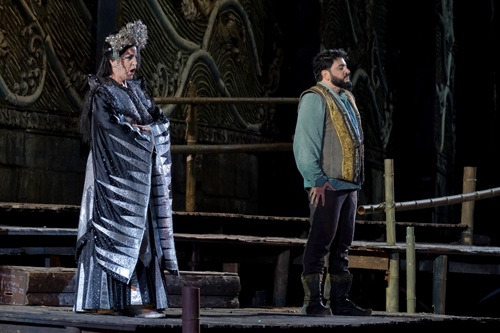
This production of Turandot, directed by Franco Zeffirelli, who also designed the set, goes back to his production of the opera at the La Scala, Milan, in 1983, which he developed further for the Metropolitan Opera in New York (1987), and which premiered at the arena in Verona in 2010. Here, it has been revived biannually since. The costumes for the Milan and New York productions were created by Anna Anni and Dada Saligeri, while Zeffirelli chose to invite Emi Wada to design the costumes for the Verona production. The Milan production remained in the company’s repertoire for six years, while the Met production has remained in the company’s repertory.
For the scenes outside the palace, the set was actually not spectacular but rather functional: a number of steps led up to a raised level in front of a set of walls obscuring what was behind. The realm depicted in the opera was a fairy tale China rather than any real country which could be located in history. The chorus of inhabitants were uniformly dressed in grey, loose-fitting garments and moved about with movements reminiscent of a combination of stereotypical monkey movements combined with stereotypical ideas of what we have come to see as Southeast Asian body postures of lower-class subservience. For most of the time, there was a lot going on among those people, there was constant well-choreographed movement to and fro, up and down the steps, left to right and right to left, interactions among those people and, in pivotal moments of the plot, in relation to the current protagonists of that plot.
The screens hiding the background, and in fact the largest part of the stage, were moved to the sides to reveal the imperial court, brightly lit (compared with almost hesitant lighting before and after), and with many facets of gold in terms of objects and colour. This revelation was spectacular, drawing an immediate round of well-deserved applause from the capacity audience. Altogether, the production elements combined excellently to narrate a story that was first and foremost interesting and intriguing. The production combined, in its fairy tale nature, the comfortably familiar with the potentially strange, unfamiliar. The result was visually striking and both entertaining and giving rise to further thought and reflection.
The music of Turandot can be quite overwhelming in the confines of an opera house, where conductors do not always find the right balance between bombastic volume that the score offers, and what sounds comfortable in a given venue’s acoustics. Right from the first bar of Turandot, it was obvious that such restrictions do not apply in the Verona Arena. Nothing can sound uncomfortably loud. Francesco Ivan Ciampa has conducted regularly in the arena since 2018 and was able to draw from the orchestra the full range of volume and tempi Puccini has composed for Turandot, all the while supporting the singers carefully, especially when they were placed far back on the stage.
The chorus, directed by Roberto Gabbiani, impressed with solidly nuanced unison. The international cast of this evening was stellar. Lise Lindstrom sang Turandot, a role that marked her professional breakthrough at the Met in 2009. Her voice was steely and strong. Her experience of singing Brünnhilde and major roles in the Richard Strauss canon was evident, while she was able to do full justice to Puccini’s musical idiom. Exposed high notes sounded effortless and their poise was never shrill. There was a good combination of single attack notes and long, sustained legato lines. Lindstrom’s singing underlined the shift in Turandot’s character across the duration of the opera as a gradual development; not a sudden or ultimately unconvincing change of heart. Thus, there were many striking moments of softness of the heart underneath the outward (protective) shield if ice, which Lindstrom portrayed on her Act II entrance at the start. This made the character more complex and thus even more intriguing,
Yusif Eyvazov sang Calaf. It has become a signature role for him. I found the performance uneven vocally. There were many moments, particularly at the beginning of the opera, even within a legato line where the voice sounded throaty and not open (enough). At other times, fortunately more and more so as the evening progressed, the voice was unrestrained, free and open. Here, Eyvazov was able to express many vocal nuances, shades, and differentiate his sound in terms of volume too (which is quite an achievement in such a vast setting). He reached his top notes with ease and held them for very long indeed and with relish. After Nessun dorma, audience calls for an encore were left unanswered.
Lisette Oropesa sang Liù. She displayed secure and rich, velvety lower and middle registers, from which she soared effortlessly to the generously blooming high notes. Compared with her recital in early 2025 (see review here), meticulous study and knowing from experience exactly how to place the voice at every moment, was still in evidence throughout, but combined now with more of what came across as spontaneity.
Michele Pertusi sang Timur with a sonorous, mellifluous bass, while Ankhbayar Enkhbold impressed with his robust bass-baritone as the Mandarin. Carlo Bosi’s tenor was in well-sustained form the Emperor’s throne at the very back of the stage. It differentiated well from the tenors of Matteo Macchioni (Pong) and Saverio Fiore (Pang), who, in turn, also sang with gusto and brought many genuinely funny elements to the trio of ministers, completed by Gezim Myshketa as an agile Ping.
Daniel Meyer-Dinkgräfe
Production:
Director and Stage Design – Franco Zeffirelli
Costume design – Emi Wada
Lighting design – Paolo Mazzon
Movement choreography – Maria Grazia Garofoli
Chorus director – Roberto Gabbiani
Cast:
Turandot – Lise Lindström
Calaf – Yusif Eyvazov
Liù – Lisette Oropesa
Timur – Michele Pertusi
Ping – Gëzim Myshketa
Pang – Saverio Fiore
Pong – Matteo Macchioni
Altoum – Carlo Bosi
Mandarin – Ankhbayar Enkhbold
The Prince of Persia – Eder Vincenzi