
Santander International Festival 2026 [1]: (DF)
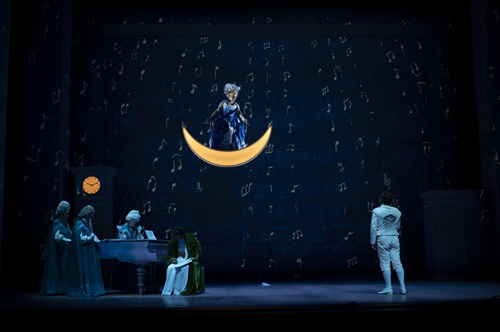
The Santander International Festival is celebrating its seventy-fifth edition with a programme worthy of the anniversary. During the first half of August, the Palacio de Festivales de Cantabria has already hosted opera, major orchestral concerts and piano recitals of exceptional distinction. The first four performances attended offered a revealing cross-section of the festival’s ambitions, from Mozart’s operatic humanism to the very different pianistic worlds of Daniil Trifonov, Elisabeth Leonskaja and Grigory Sokolov.
3.8.2026 – Javier Camarena, Kathryn Lewek, Franz-Josef Selig, Emily Pogorelc, Theodore Platt and others; Freixenet Symphony Orchestra of the Encuentro / David Afkham (conductor); Rolando Villazón (stage director)
Mozart – Die Zauberflöte
Few works could have been more appropriate for the opening of the Festival’s seventy-fifth edition than Die Zauberflöte. Rolando Villazón’s Salzburg production places the action during the final hours of Mozart’s life, with the characters emerging from the composer’s imagination and blurring the boundaries between reality, memory and theatrical fiction. The concept is visually striking and often intelligent, even if some symbols and alterations to the libretto do not always achieve complete dramatic clarity. Musically, however, the evening was outstanding. David Afkham conducted with admirable balance, transparency and natural dramatic flow, while the young Freixenet Symphony Orchestra of the Encuentro played with flexibility and refinement. Kathryn Lewek was a commanding Queen of the Night, combining immaculate coloratura with firm high notes; Franz-Josef Selig brought gravity and exemplary German diction to Sarastro; Emily Pogorelc offered a noble, lyrical Pamina; Theodore Platt was a warm and engaging Papageno; and Javier Camarena proved an elegant and committed Tamino. The remarkable consistency of the entire cast made the performance a splendid return of opera to the festival.
7.8. – Daniil Trifonov (piano), Mahler Chamber Orchestra / Daniel Harding (conductor)
Brahms – Piano Concerto No.1 in D minor, Op.15
Dvořák – Symphony No.8 in G major, Op.88
Daniil Trifonov’s Brahms was one of those performances that can define an entire festival. In the vast First Piano Concerto, Daniel Harding and the Mahler Chamber Orchestra preserved extraordinary clarity within Brahms’s monumental architecture, allowing the soloist to enter the orchestral texture rather than struggle against it. Trifonov’s pedalling was astonishingly clean and his palette continually changed colour, moving from orchestral density to chamber-like intimacy. The Adagio was remarkable for its inwardness and reciprocity between piano and orchestra, while the finale accumulated rhythmic and emotional energy with hypnotic force. Two contrasting encores revealed a lighter, more sensual side of the pianist. After the interval, Harding ensured that Dvořák’s Eighth Symphony was no mere appendix: lucid textures, buoyant rhythms and a firm sense of overall architecture produced an exhilarating reading in which intensity never came at the expense of transparency.
8.8. – Elisabeth Leonskaja (piano), English Chamber Orchestra / Marzena Diakun (conductor)
Haydn – Symphony No.44 in E minor, Trauer
Mozart – Piano Concerto No.12 in A major, K.414
Schubert – Symphony No.5 in B-flat major, D.485
The English Chamber Orchestra, Elisabeth Leonskaja and Marzena Diakun offered an evening of classical poise and Viennese eloquence. Haydn’s Trauer Symphony was disciplined and transparent, with firm rhythmic control, beautifully blended horns and noble string sonority, although a little more dramatic agitation might have heightened its Sturm und Drang character. Leonskaja then brought crystalline touch, grace and poetic dialogue to Mozart’s K.414 Concerto. The Andante seemed almost to suspend time, while the final Rondo had delightful freshness and agility. Her encore, the first of Schubert’s Drei Klavierstücke, D.946, was a model of intimate lyric introspection. Schubert’s Fifth Symphony completed the programme with admirable freshness: pastoral ease in the Andante, rhythmic vigour in the Menuetto and a luminous Allegro vivace. A Haydn encore rounded off a serene return journey to Vienna without leaving Santander Bay.
11.8.– Grigory Sokolov (piano)
Beethoven – Piano Sonata No.4 in E-flat major, Op.7; Six Bagatelles, Op.126
Schubert – Piano Sonata in B-flat major, D.960
Grigory Sokolov’s return to Santander confirmed once again his unique ability to transform the perception of musical time. In Beethoven’s early Op.7 Sonata, the Largo con gran espressione unfolded with breathing stillness, each phrase given its full dramatic weight, while the Six Bagatelles, Op.126 revealed the radically compressed world of the late composer. Sokolov treated each miniature as an individual universe, sharpening rather than softening Beethoven’s abrupt harmonic turns. The emotional summit came after the interval with Schubert’s final Piano Sonata, D.960. Rather than despair, Sokolov found in it a serenity poised at the edge of the abyss. The Andante sostenuto, taken to the threshold of audibility, became a lament of almost unbearable beauty; by the finale, pianist and audience seemed equally absorbed in the music’s inner world. Six generous encores by Brahms, Chopin and Scriabin extended the recital late into the night and completed an extraordinary demonstration of pianistic concentration, individuality and expressive depth.
These first four events have already shown the breadth of the Santander International Festival’s anniversary edition: ambitious opera, orchestral playing of the highest level and three radically different conceptions of the piano. The second half of the festival promises to be no less ambitious, with its programme ranging from the baroque world of Le Poème Harmonique and Sir John Eliot Gardiner’s Constellation Choir and Orchestra to major symphonic appearances by the Royal Stockholm Philharmonic under Alan Gilbert, with María Dueñas, and the Filarmonica della Scala under Riccardo Chailly, with Alexander Malofeev. Opera lovers can look forward to a gala with Kathryn Lewek and Piotr Beczała, while the festival will reach a particularly symbolic conclusion on 31 August with the first visit to Spain of the Bayreuth Festival Orchestra, conducted by Pablo Heras-Casado — a fitting climax to Santander’s seventy-fifth anniversary celebrations.
Darío Fernández