
 Spain Santander International Festival 2026 [2]: (DF)
The second half of the 75th Santander International Festival confirmed the breadth and ambition of an anniversary edition that ranged from 17th-century carnival theatre to Wagner’s monumental Ring. Across six performances, early music, symphonic repertoire, vocal virtuosity and the distinctive traditions of some of Europe’s most celebrated ensembles came together in the Palacio de Festivales de Cantabria. The following highlights also brought several of the festival’s most memorable evenings.
18.8.2026 – Anaïs Bertrand, Paco García, Martial Pauliat, Igor Bouin and others, Le Poème Harmonique, Vincent Dumestre (director), Cécile Roussat (stage director)
Carnaval Barroco – music by Jean de Maletti, Giovanni Battista Fasolo and others
Le Poème Harmonique’s Carnaval Barroco turned the Sala Argenta into an imaginary 17th-century Venice: no serene museum piece, but a noisy, sensual and irreverent world of masks, acrobats, beggars, lovers, commedia dell’arte characters and musicians. Vincent Dumestre and Cécile Roussat avoided documentary reconstruction in favour of something more immediate: the feeling of being drawn into the carnival itself. The small instrumental ensemble moved effortlessly between devotional music, popular song and dance, while the stage action grew organically from the same pulse. Fasolo’s songs occupied the fertile borderland between art and popular music, and the delirious Lamento del Naso, a parody of Monteverdi’s Lamento della ninfa, perfectly embodied the carnival’s inverted world. Acrobatic routines, juggling and the Cyr wheel never felt superimposed on the music; body, gesture and sound belonged to a single theatrical language. The result was both historically suggestive and vibrantly alive: early music restored to the people who once drank, laughed, prayed, desired and mocked one another to it.
20.8. – María Dueñas (violin), Royal Stockholm Philharmonic Orchestra / Alan Gilbert (conductor)
Mozart – Overture to Die Zauberflöte
Bruch – Violin Concerto no. 1 in G minor, Op.26
Wilhelm Stenhammar – Serenade in F major, Op.31
Wagner – Overture to Tannhäuser
The Royal Stockholm Philharmonic’s visit offered a finely judged journey from Mozart to Wagner, with a particularly welcome excursion into Swedish repertoire. Alan Gilbert’s Mozart was transparent and rhythmically alert, and María Dueñas confirmed the individuality of her artistry in Bruch’s First Violin Concerto. Playing the 1718 ‘Michelangelo’ Stradivarius, she relied less on sheer volume than on personal phrasing, intelligence and carefully graded tension. The Adagio unfolded without added sentimentality, while the finale combined bite, precision and lightness. Two contrasting encores showed further sides of her personality. The evening’s real discovery, however, was Stenhammar’s Serenade, music the Swedish orchestra seemed to speak as its native tongue. Flexible strings, characterful woodwinds and secure brass brought out its colour, elegance and subtle shifts of mood, with the Notturno especially memorable. Wagner’s Tannhäuser Overture was less compelling dramatically and occasionally overbalanced at the close, but the concert remained one of high distinction, crowned by Stenhammar’s rarely heard and splendid score.
21.8. – Hilary Cronin and Sam Cobb (sopranos), Jonathan Hanley (tenor), The Constellation Choir and Orchestra / Sir John Eliot Gardiner (conductor)
Brahms – Schicksalslied, Op.54
Mendelssohn – Symphony No.2, ‘Lobgesang’, Op.52
Sir John Eliot Gardiner returned to Santander with a programme whose intelligence became increasingly apparent as the evening unfolded. Brahms’s Schicksalslied and Mendelssohn’s Lobgesang both explore a passage from darkness towards light, though by very different routes. Gardiner made that shared trajectory the interpretative centre of the concert. In Brahms, The Constellation Choir and Orchestra combined transparency, disciplined diction and a beautifully integrated balance between voices and instruments. The orchestral postlude was the finest moment: not a triumphant resolution, but the distant possibility of reconciliation after Hölderlin’s despair. Mendelssohn’s vast ‘symphony-cantata’ benefited even more from Gardiner’s ability to clarify architecture and counterpoint. The trombone motto, the Lutheran chorales and the gradual emergence of the word from the instrumental texture were made unusually audible. The dramatic question ‘Hüter, ist die Nacht bald hin?’ and the answering proclamation ‘Die Nacht ist vergangen’ produced a genuine eruption of light. Gardiner avoided rhetoric and massed heaviness; clarity itself became the source of eloquence.
22.8. – Kathryn Lewek (soprano), Piotr Beczała (tenor), Bilbao Symphony Orchestra / José Miguel Pérez-Sierra (conductor)
Arias, duets and orchestral excerpts by Verdi, Donizetti, Bizet and Puccini
The Santander International Festival’s operatic gala brought an unquestionable public triumph and, more interestingly, the chance to observe two very different vocal instruments. Piotr Beczała’s voice has grown broader and weightier over the years, losing some youthful sheen but retaining a richly timbred core, secure projection and a brilliant upper register. His breath control remains excellent, even if a tendency to remain between mezzo-forte and forte can limit dynamic variety. ‘Che gelida manina’ and the Carmen excerpts showed his present strengths particularly well. Kathryn Lewek, heard only seventeen days after her Queen of the Night, offered the opposite profile: flexibility, precision, immaculate intonation and exceptionally refined dynamic control. ‘Regnava nel silenzio’, ‘Caro nome’ and ‘Sempre libera’ displayed coloratura that never became merely athletic, while Micaëla’s aria revealed a fine legato and subtle tonal shading. The Bilbao Symphony under Pérez-Sierra accompanied efficiently, though with occasional excess of orchestral weight. Three encores eventually transformed the gala into the collective celebration of song that such evenings are designed to become.
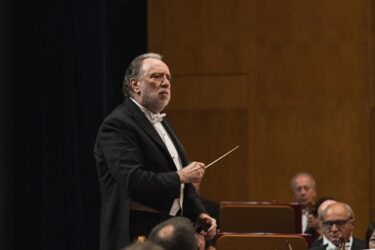
28.8. – Alexander Malofeev (piano), Filarmonica della Scala / Riccardo Chailly (conductor)
Rachmaninov – The Rock, Op.7; Piano Concerto No.4 in G minor, Op.40
Tchaikovsky – Symphony No.4 in F minor, Op.36
An all-Russian programme revealed both the precision of the Filarmonica della Scala and Riccardo Chailly’s ability to make orchestral music breathe. In Rachmaninov’s early The Rock, Chailly favoured transparency over added melancholy, allowing winds and silky strings to expose the young composer’s already sophisticated ear for atmosphere. Alexander Malofeev then proved an ideal advocate for Rachmaninov’s difficult Fourth Piano Concerto: clean attack, firm pulse, angular articulation when required and virtuosity without display. He and Chailly clarified the score’s fractured rhythms and modernist discontinuities without pretending to smooth them away. After the interval came the evening’s summit. Chailly approached Tchaikovsky’s Fourth Symphony with spacious tempi and a sense of theatrical breathing inherited, perhaps, from La Scala’s operatic tradition. The second movement sang, the pizzicato Scherzo became a display of collective virtuosity, and the finale combined tremendous force with unusual definition. Even at the loudest climaxes, inner lines remained audible. It was not opera turned into symphony, but a reminder of just how much theatre can inhabit a symphonic score.
31.8.2026 – Catherine Foster (soprano), Klaus Florian Vogt (tenor), Nicholas Brownlee (bass-baritone), Bayreuth Festival Orchestra / Pablo Heras-Casado (conductor)
Wagner – excerpts from Der Ring des Nibelungen
The festival ended with an event of genuine symbolic weight. In 2026 Bayreuth celebrates 150 years since its first festival, exactly twice Santander’s seventy-five; 1951, the birth of the ‘New Bayreuth’ under Wieland and Wolfgang Wagner, stands precisely halfway between the two dates. A selection from the Ring therefore made an especially fitting conclusion. Pablo Heras-Casado offered a Wagner less heavy and monolithic than tradition can suggest; flexible in tempo, sharply articulated and consistently concerned with dramatic function. The Entry of the Gods into Valhalla combined imposing brass with transparency; Wotan’s Farewell, nobly sung by Nicholas Brownlee, unfolded with elegiac breadth; and the Forest Murmurs found unusual freshness and space. Klaus Florian Vogt’s pale, penetrating timbre and exemplary legato made his Siegmund and Siegfried unmistakably personal, while Catherine Foster brought stamina, bright upper notes and dramatic authority to Brünnhilde. The Funeral Music was perhaps the supreme orchestral demonstration: enormous power without saturation, with Wagner’s network of motifs heard as architecture. In the Immolation, the whole dramatic arc finally seemed present. Weight, transparency, violence, lyricism and, above all, theatre: a fitting close to the anniversary Santander International Festival.
Taken together with the first half of the month, these performances confirmed the exceptional range and consistently high level of Santander’s 75th edition. The Bayreuth evening supplied a suitably historic final image to an anniversary festival that had moved confidently from early music and opera to major symphonic repertoire.
Darío Fernández