
 Italy 103rd Arena di Verona Opera Festival 2026 [2] – Verdi, Nabucco: Soloists, Ballet, Chorus and Orchestra of Fondazione Arena di Verona / Sebastiano Rolli (conductor), Verona Arena, 28.8.2026. (DM-D)
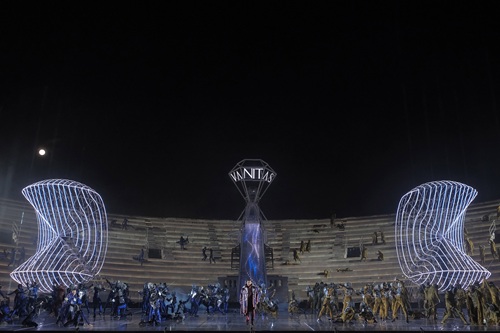
For this year’s performances of Nabucco, the Fondazione has revived the production by Stefano Poda, first seen here in 2025. Poda represents a Gesamtkunstwerk approach and is thus in charge both of directing and of all the design elements, including choreography. The website credits Paolo Gianni Cei, as assistant for directing, light and choreography. To the sides and behind the orchestra pit extending to the arena’s original stone steps at the back of the stage, the stage was formed of an even, shiny surface, which at times served as projection area for abstract flashing patterns. The arena’s steps were left bare. In the middle, a metal staircase led all the way from the back of the sloping shiny stage to the very top of the arena, where a massive tower extended into the night sky, with the word ‘Vanitas’ shining brightly in LED of different colours. Towards the back of the sloping stage, on each side, in perfect symmetry to the overall space, were two LED sculptures which turned slowly, were lit in different colours, in each case only one at a time, revealing different intricate patterns and shapes as programmed. For the reconciliation of opposing forces at the end of the opera, the two separate sculptures merged.
Within this spectacular display of light in this intricate design of the arena space, the two opposing forces were represented by different sets of costumes. In one group (the Hebrews of the opera) the higher rank of the clergy wore formal black and white, while the lower classes, the enslaved masses, wore dusty sand coloured, rough garments. For the other group, the Babylonians, the elite wore costumes dominated by blue, while their masses wore the most futuristic outfits of the production, which were fitted with LED – when turned on, they displayed patterns on their headdresses and long-cloaked garments.
The chorus members, dancers and extras who assembled on the stage amounted to around 400 altogether. They were brought on in their groups (of Hebrews or Babylonians, of inferior or superior ranking in the respective group’s internal hierarchy), or left as a group, on numerous occasions during the production, making efficient use of all the arena’s numerous entrance ways in the stage area. On the smooth sloping stage floor, and even on the metal staircase, the footwear that they had been supplied with did not create much by way of distracting sound. At times, the groups were separated in terms of left or right, sometimes back or front, frequently shifting between the two within a scene, and also frequently creating spaces where the leading characters could be caught and foregrounded by additional lighting.
Some of the leading roles were given outfits that clearly and immediately identified them as the specific characters they represented, but this did not work equally for all. Especially where the costumes changed across the performance for the leading roles, confusion was possible.
Overall, the concept offered by Poda was consistent within itself, it told a cogent story not too much at odds with the libretto, and it was visually impressive and exciting within or because of its novelty.
Sebastiano Rolli conducted the score with authority and assurance, choosing moderate tempi, differentiating gently between the massive sound accompanying the large crowd scenes, and the more intimate moments of focus on one or more individual characters/singers. Rolli emphasised the varying rhythms and took care for the music not to be disturbed (at least not to its detriment) by the sound created for the many entrances and exits of the up to 400 people on the stage. Roberto Gabbani led the chorus in a subtly moving account of the famous pieces of this opera.
Luca Salsi sang the title role, ensuring that Nabucco never remained a stereotypical dictator-ruler, himself in turn governed by the vanitas evoked by the words towering above the set. Instead, Salsi differentiated admirably between initial self-assurance, which was well-grounded in the success of his rule, and gradual decline into over-estimation of his power(s). He further differentiated between descent, full-blown-madness and equally gradual, never sudden, return to the better man he was able to become. Salsi was able to mould and shape his voice to express this range of mental states, this spiritual journey, with a high level of precision. There was the assured voice of grounded experience, the more hectic rendering of hubris, the agony, the enhanced vocal pressure of madness (without allowing the voice to ever produce anything that sounded ugly), again some more vocal agitation to express recovery, and finally the particularly long, sustained legato passages that demonstrate Nabucco’s transfiguration. Such a wide range of vocal expression as on display from Salsi is rare indeed.
Olga Maslova was equally outstanding as Abigaille. Her voice encompasses the full range composed for the role, from alto to coloratura material, equally well, and was thus effortlessly able to carry off the many shifts between ranges that make Abigaille such a demanding role. In the lower registers, Maslova’s sounded supple, flexible, sonorous and powerful, and from there she was able to soar or suddenly shift to the highest exposed notes, as needed. In the top range, her voice was just as blooming and rounded. In many of the passages where she sang with the chorus, her voice dominated and rode that chorus of several hundred voices with complete ease, and with relish, particularly in the highest notes, which her breath control allowed he to hold particularly well.
Anna Werle made the smaller role of Fenena fully her own. Her voice was appropriately different from Maslova’s, so even if costume did not immediately define her in the crowd, her voice certainly did. Werle’s voice was strong but gentle, never forced, fully embodied, visceral in the best sense of the word, earthed, grounded. Neither did Werle (need to) shy away from the occasional rise to soprano material. Michele Pertusi was a very dignified Zaccaria, both in the way he acted the role and particularly how he sang it. It became the voice of calm, of unambiguous, undoubted authority that is widely used and highly appreciated. Pertusi’s voice was suitably big both for the role and the venue. Paolo Lardizzone made the most of the underwritten tenor part in this opera, Ismaele. He shifted gently between more heroic and more lyrical-romantic passages, as implied by both plot and score, and the voice sounded free and clear throughout, carefully moulded without pressure. Gabriele Sagono was very good as the High Priest, his sonorous voice appropriately different from Pertusi’s. Matteo Macchioni provided strong support as Abdallo.
Daniel Meyer-Dinkgräfe
Production:
Director, Set, Costume, Lighting Design, Choreography – Stefano Poda
Chorus master – Riberto Gabbiani
Cast:
Abigaille – Olga Maslova
Fenena – Anna Werle
Ismaele – Paolo Lardizzone
Nabucco – Luca Salsi
Zaccaria – Alexander Vinogradov
High Priest of Baal – Gabriele Sagona
Abdallo –Matteo Macchioni
Anna – Elisabetta Zizzo