
 United Kingdom ‘Opening Night: Built for the Hallé: Celebrating 30 years of The Bridgewater Hall’: Sir Stephen Hough (pianist), The Hallé / Kahchun Wong (conductor). The Bridgewater Hall, Manchester, 24.9.2026. (PC)
Liszt – Les préludes
MacMillan – Symphony No.6 (world premiere)
Beethoven – Piano Concerto No.5, ‘Emperor’
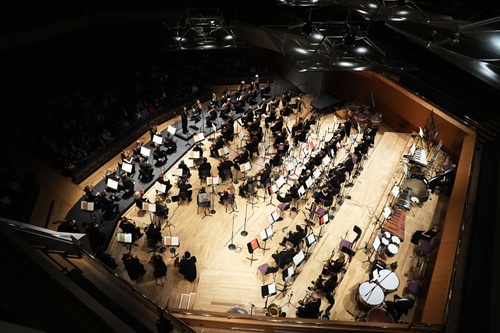
Directed by their principal conductor Kahchun Wong, The Hallé’s opening concert of the 2026/27 season marked thirty years of the orchestra’s home venue, The Bridgewater Hall, Manchester. The programme featured the world premiere of an impressive new symphony by James MacMillan, co-commissioned by the orchestra, and the consummate artistry of Stephen Hough in Beethoven’s final piano concerto, both ingredients ensuring this was an event to savour.
The programme began with Liszt’s Les préludes. Dating from the mid-19th century, this symphonic poem remains something of a rarity in today’s concert programmes. Kahchun Wong shaped the score fastidiously and with great affection, giving each episode of the narrative sufficient space and time to make an impact and the commitment and the dedication of The Hallé was never in doubt. In the piece’s quieter moments, the orchestra found poetry in the writing and the bright, lively woodwind playing in the arcadian section was an especial pleasure.
There followed the first performance of James MacMillan’s Symphony No.6 (2025). As the composer acknowledged in a pre-concert talk, he has found the symphonic form to be the most appropriate channel for his deepest musical thoughts. He is clearly still inspired by the breadth of utterance required to create a successful example in the genre and his latest contribution to the medium has the urgency and immediacy of a profoundly personal statement. Taking his cue from Elgar’s Enigma Variations with its character portraits of ‘friends pictured within’, MacMillan begins his symphony with four short miniatures, each portraying a close, and now deceased, family member and each scored for a different orchestral section. An extended and much more substantial fifth movement develops the material presented in the previous vignettes.
For woodwind alone, the opening miniature featured an introspective idea in the flutes’ lower register, taken up by the alto flute. When the material passed to other instruments, notably the oboes, the purity of the music’s Sibelian, open-air character was underlined. Scored for percussion, timpani and piano, the airy second movement was fleet-footed and enigmatic. I was reminded of the ‘phones and spiels’ in the finale of Vaughan Williams’s Eighth Symphony, a work premiered by The Hallé seventy years ago and whose two central movements are composed for discrete orchestral sections, coincidentally. The swift third movement of MacMillan’s symphony, scored for brass only, began with muted and remote fanfares and closed with a resounding, unmuffled flourish. Written for strings and harp, the fourth movement unfolded a freely expressive theme for cellos that ebbed and flowed naturally, beginning and ending in the instruments’ deepest regions. The synoptic finale explored the expressive potential of the material already presented in a wide-ranging movement of compelling colour, energy and contrast. There were climaxes of an almost tangible density, one memorably capped by a siren winding down. These impassioned junctures were juxtaposed with passages of poignant intimacy, scored simply for harp and piano, as if a door had been left open and listeners unexpectedly found themselves eavesdropping upon an ongoing private duologue. A sequence near the end of the work when, overlayed by a solo cello line, the four miniatures were recalled in reverse order, was particularly affecting, as the composer seemed to be bidding a fond farewell to the inspirational characters as well as the musical material set out in the symphony’s early stages. Supported by muted string chords, the alto flute then returned to pay its own respects. There was a final, shattering climax, in the aftershock of which the orchestra was left, twitching and unsteady, like a faltering pulse before a fade into intense silence.
In his Sixth Symphony, James MacMillan has taken deeply personal inspirations and sentiments and forged a richly rewarding and thoroughly convincing, large-scale public statement of considerable sweep and resonance. The Hallé and Kahchun Wong ably conveyed the work’s range and inventiveness and the players took full advantage of the many chances the music afforded them to shine both individually and as part of variously sized groups. The conductor was eager to give the piece sufficient credit, holding the score out to the audience during the prolonged and thoroughly deserved post-performance ovation.
After the interval, Sir Stephen Hough joined the musicians in a commanding account of Beethoven’s Piano Concerto No.5, ‘Emperor’ (1809). Thanks, in no small measure, to the pianist’s ability to refresh every gesture and phrase so they sounded newly minted, this was a memorable reading that made listeners appreciate anew the piece’s scope and invention. From the bold initial flourishes to the more inward-facing musings, the piano’s contributions to the substantial opening movement were utterly compelling, matched in warmth and limpidity by the orchestral input, especially in passages where individual players were in dialogue with the keyboard. Taken at a flowing tempo, the central Adagio was sufficiently spacious to cast a potent spell, the players seemingly reluctant to take their leave of its ineffably beautiful principal melody. Anticipated with an innately theatrical dramatic sense, the dancing Allegro finale had heft as well as vitality, Stephen Hough taking care to articulate the main theme with the utmost clarity. This elegant, cogent and humane interpretation of Beethoven’s great concertante work brought the evening’s music-making to a triumphant conclusion worthy of a celebration.
The concert was recorded by BBC Radio 3 and will be broadcast on Tuesday 6 October at 7.30pm.
Paul Conway