
 United States Juilliard Fall Festival 2026-27 – The New Series ǀ ‘Steve Reich at 90’: Juilliard musicians. Willson Theater at The Juilliard School, New York, 22.9.2026. (DS)
Steve Reich – Music for Pieces of Wood; Cello Counterpoint; Nagoya Guitars; Different Trains; Clapping Music
At Juilliard, Steve Reich’s 90th birthday was more than a musical celebration: it was a homecoming for a revered composition alum. Reich graduated in 1961 when the conservatory still lived at 122nd Street in the Morningside Heights neighborhood.
Appropriately, the first work on the program was Music Pieces for Wood, written that same year. It was far from sounding 65 years old in the limber hands of the Juilliard percussion players. The five performers came to the stage gradually, some with laughter-inducing theatrical expressions, others play-acting a show of worry that they might be late – the ultimate sin in any Reich work! Litao Dong, the lead clave player, maintained a sly grin that paired well with his fierce hold on the continuously developing rhythm. He injected sharp dynamism into the work that his fellow classmates followed.
Damian Woetzel, Juilliard’s president, was in attendance and introduced the concert as telling the story of Reich’s music. Woetzel announced that the composer was also present and that at an earlier gathering he had presented Reich with the Julliard President’s Medal (Reich received an honorary doctorate in 2009). Unarguably, Reich forever changed the course of American music, and it started at Juilliard. The moment felt golden.
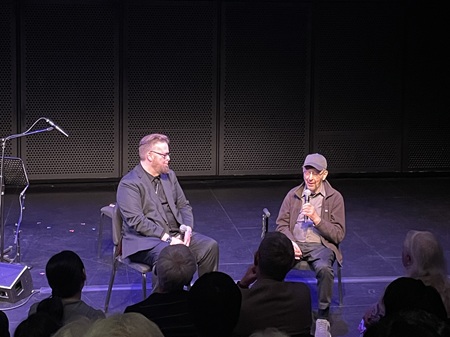
The intimate concert was part of Juilliard’s Fall Festival, planned in partnership with the school’s annual The New Series. It took place in the unassuming black box Willson Theater on the third floor of the school, set in a hallway past several dance practice rooms. The space holds barely 100 people, and those of us with tickets had the fortunate experience of hearing Reich speak afterwards with David Serkin Ludwig – artistic director of The New Series and Dean of the Music Division.
While Ludwig had questions prepared, he rightly let the master of rhythmic pacing jump between stories of his own choosing. Reich (in his signature baseball cap) shared thoughts on his great influences – like John Coltrane and Balinese music. He kept the momentum of anecdotes steady: the flow of his words pulled us to the edge of our seats in the hush that blanketed the space.
He talked about one of his earliest experiences with student chamber music: hearing the Juilliard String Quartet perform Beethoven’s Quartet No.15, Op.132, (the kind one ‘hopes to hear in one’s lifetime’ he remarked). Then, apt for a school setting, he praised his teacher at Mills College, the composer Luciano Berio, for pushing him to ‘write what you want’. It shifted him out of atonality and birthed his dedication to using ‘tonality in a radically paired down way’. Thus, the American minimalist movement was born.
The truly moving takeaway from the chat was Reich’s expression of appreciation for the young musicians who performed or took influence from his works, both at this concert and across his career. He told us that the featured work on the evening’s program had made him cry: Different Trains.
The Candide Quartet (comprised of Juilliard students) performed it with a vigor that took one’s breath away. In this small space, the work’s sheer volume along with how it powerfully melds human emotions – drawn from recorded excerpts of Holocaust survivor accounts – with mechanical sounds was overwhelming. The work also hinges on Reich’s own memories of traveling by train back and forth in the late 1930s between divorced parents on opposite coasts (from New York to Los Angeles, as we hear over and over in the work’s tape recordings). In the third movement, which opens in a fugal style, the players imbued an emotional vitality that made the work feel both classic and amazingly avant-garde. One could say the same of listening to Beethoven’s fugal third movement in his Op.132 String Quartet.
Despite the concert’s humble setting, it was a once-in-a-lifetime experience. Other works pulled the evening together. Elliot Lippy on cello performed solo with a recorded tape in Cello Counterpoint. Lippy’s interpretation highlighted the unusual symbiosis of rigidity drawn from the electronics with a ponderous quality of Shostakovich-like lyricism in his own playing. Nagoya Guitars, a brief duet, seemed particularly challenging as the natural resonance of guitar strings could cause sonorous chaos with the quick-changing rhythmic patterns. But the duo’s evident camaraderie got them through it splendidly.
The final work was Clapping Music, an audience favorite that is practically like a circus trick. No instruments needed, just two people clapping. Anyone could try this feat at home with the guarantee that no one will get hurt. But the rigor and training required to keep it going is not easy to come by. Dong and Justin Melvin performed it perfectly with a little extra sparkle, doubtless for whom they clapped – Reich, seated before them, listening appreciatively.
Daniele Sahr