
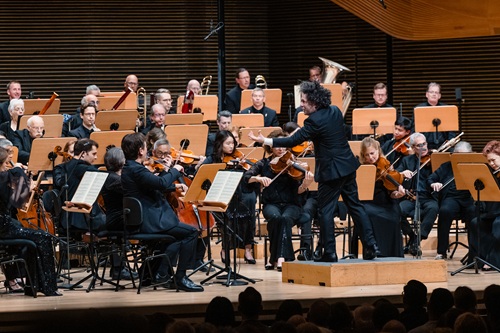
 United States León, Mahler: New York Philharmonic / Gustavo Dudamel (conductor). Wu Tsai Theater, David Geffen Hall, New York, 27.9.2026. (ES-S)
Tania León – Imágenes Mestizas
Mahler – Symphony No.5
If there was any doubt, Gustavo Dudamel has made his programming priorities clear from the outset of his tenure as music and artistic director of the New York Philharmonic: new music should enter into direct conversation with the central works of the orchestral repertory. One of his first subscription choices brought the world premiere of Tania León’s Imágenes Mestizas together with Mahler’s Fifth Symphony. The Philharmonic will also take this pairing on its forthcoming European tour.
The program offered more than simple contrast. León has long been part of the Philharmonic’s artistic life, while Mahler once served as its music director, giving the selection an added institutional resonance. Musically, too, the juxtaposition was suggestive: León’s score unfolds through quick shifts of color, texture and rhythmic profile, whereas Mahler’s Fifth traces one of the repertory’s most expansive journeys, from funeral march to exuberant finale.
Ending somewhat unexpectedly, with the sense that its 15-minute span could continue for a while longer, León’s composition is an excursion through a lush soundscape. According to the composer’s program note, its opening melody derives from a prayer she often heard during her childhood, addressed to Eleguá, the Nigerian deity of crossroads and doorways. Eleguá seems to open many paths in this music, leading toward Caribbean and South American percussion as well as whiffs of jazz in the assured interventions of principal clarinet Anthony McGill. The title, Imágenes Mestizas, is entirely apt for this profusion of colors, rhythms and influences, floating together as if suspended in a Petri dish and perhaps – or perhaps not – destined to settle.
Mahler’s Fifth has accompanied Dudamel for much of his career, and on Sunday afternoon that long familiarity was evident in a reading that balanced architectural command with immediacy. The Philharmonic musicians responded with evident enthusiasm throughout: attacks were clean, brass and strings remained finely balanced, and excitement rarely came at the expense of clarity.
Still, not every detail convinced. Some climaxes arrived before their full emotional weight had accumulated, while elsewhere the pacing occasionally relaxed a tad too much.
The opening funeral march moved with a genuinely processional tread, its lyrical departures contrasting with rather than interrupting the larger trajectory. Dudamel sustained a convincing continuity into the turbulent second movement, whose violence remained tightly contained even as the music urgently pressed forward.
The vast Scherzo was among the performance’s high points. The tightly coordinated strings provided considerable rhythmic definition. The Philharmonic’s recently appointed principal horn, David Cooper, played the obbligato with a beautiful, clean tone, remaining fully integrated into the orchestral texture without making the movement feel like an implicit horn concerto. Though the Scherzo might at times have benefited from a touch more instability and grotesquerie, Dudamel’s grasp of its sprawling design was never in doubt.
The Adagietto breathed naturally, with warmth but without indulgence. A slight restlessness kept it from feeling fully suspended in time. Here, the conductor’s decision to place the second violins across from the first paid particular dividends, clarifying the exchanges between the two sections. The same arrangement also lent extra definition to the contrapuntal writing in the Rondo-Finale.
The transition into the last movement was especially effective. Dudamel allowed the Rondo to emerge naturally from what preceded it. Its contrapuntal sequences had bite and presence, and when the grand chorale first heard in the second movement finally returned, it registered as a true culmination, not simply a spectacular arrival.
Mahler is very much in the air this season. Yannick Nézet-Séguin begins a complete symphonic cycle at Carnegie Hall with three different orchestras, while Deutsche Grammophon is poised to release in October Andris Nelsons’s traversal with the Vienna Philharmonic. After this successful Fifth, how long will it be before Dudamel and the Philharmonic undertake the cycle themselves?
Edward Sava-Segal