
 United Kingdom Neil Cox: Jonathan Hope (organ). Gloucester Cathedral, 29.9.2026. (JQ)
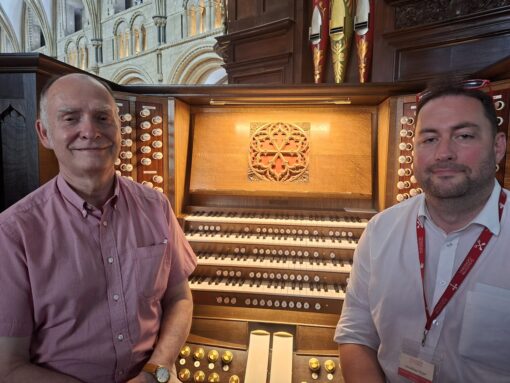
Neil Cox – Four Ikons of the Archangels (2013)
When I reported on the first in the series of organ recitals for 2026/27 recently (review here), I mentioned that in addition to those recitals the cathedral will be hosting a series of Organ Meditations. These will be specific to a Feast or season and will include such works as Messiaen’s La Nativité du Seigneur and Dupré’s Symphonie-Passion. I went along to the first of these Meditations not intending to write a review because this was not exactly a concert. However, the single work which was performed is not too well known and both the work and performance were so remarkable that I was glad I had taken my notebook with me on the off chance.
The Church of England celebrates the Feast of St Michael and All Angels on 29 September, so today was a highly appropriate occasion on which to hear – in my case, for the first time – Neil Cox’s Four Ikons of the Archangels. The work was composed in 2013 and was premiered that year by Daniel Cook on the mighty organ of Westminster Cathedral. In the piece, Cox paints a musical picture of the four highest Archangels, Gabriel, Michael, Raphael and Uriel, focusing on their individual roles in the Heavenly Host. The work is quite compact: the performance was about 29 minutes, which included a spoken introduction and meditation before each movement. These were read by Canon Craig Huxley-Jones, the Precentor of Gloucester Cathedral. I thought these spoken passages added to the performance; it was only afterwards that I learned that they had been written by the composer.
First we heard Prelude: Gabriel, the might of God. Gabriel was the Angel of the Annunciation; as such, he is God’s messenger. Right at the start we heard a sinuous melody, played without any accompaniment. I believe that references are made to this melody in all four movements. Voiced quite gently, without any harmonic support, it had a mysterious quality and seemed to me, on a first hearing, to have an Eastern character. When the tune was harmonised, the music had something of a French accent, I thought. Jonathan Hope’s performance was highly atmospheric and he built the music from its subdued opening to a radiant climax during which the sinuous theme – Gabriel’s trumpet sounding? – rang out like a clarion call. At the very end, as the music subsided, I was struck by the soft, cavernous sounds coming from the pedal division.
Next came March: Michael, his sword and shield. The Archangel Michael is renowned as the warrior angel, who led the angelic army into battle to crush Satan and his rebellious cohort of angels. That battle is an event which Cox explored in a much earlier choral work, War in Heaven (1980); that was the first piece by him that I heard when it formed part of an important concert in Coventry Cathedral in 2012. Unsurprisingly, this piece presented a striking contrast with its predecessor. Very soon after the music began we could hear the quiet, remorseless tread of the march on the pedals. Hope managed to convey an image of an army approaching from the distance. Soon, combat was joined; here, the music was loud, aggressive and dramatic. Hereabouts, Hope unleashed the full power of the Nicholson organ to thrilling effect. The battle won, the army receded from our hearing.
Another fine contrast was provided by the third movement: Raphael, the Healer. In the spoken introduction, we were reminded of the role of Raphael, who brings healing and peace; we learned that Cox had portrayed this archangel in a ‘slow, hypnotic dance’. The music was balm after the martial rigour of the previous movement. I thought Hope’s calm and graceful playing was ideally sensitive and I found this movement just as compelling as the previous movement, though in a completely different way.
The last movement is Toccata: Uriel, with the fire of God. This movement, we were told, is marked to be played ‘with a relentless and terrifying energy’. Although the movement begins quietly, this is deceptive. It soon became apparent that Hope intended to obey the composer’s instruction to the letter. In an elemental performance, he used the various divisions of the organ thrillingly, not least when he played the short quieter episodes; these came across as full of suppressed tension. This is exciting and hugely dynamic music and the performance built up a real head of steam. It was noticeable that even in the loudest passages plenty of inner detail was audible; that is a tribute not just to the performer but also to the skill and understanding with which this new organ has been designed and built. Hope unleashed the awesome full power of the Gloucester organ to tumultuous effect; the final chord was simply immense and it resonated superbly in the cathedral’s big acoustic space.
Afterwards, there was no applause. This surprised me somewhat because both work and performance richly deserved it. Perhaps others in the audience were as unsure as I was whether applause was appropriate. Perhaps at future Meditations the audience should be told that applause is welcome?
I was thrilled to hear Four Ikons of the Archangels for the first time and I fully intend to seek out what is, so far as I know, the only recording of the work. This was made by Simon Hogan on the organ of Southwell Minster; it is available from Priory Records. Neil Cox has written a thrilling and compelling work which enables an organist to display the full potential of the organ on which he or she plays it. I hope other organists will take it up because the work deserves to be widely appreciated. Though the music was new to me it was readily apparent that it received a magnificent, all-encompassing performance from Jonathan Hope.
Hope will be at the console for the next performance in this series: Messiaen’s La Nativité du Seigneur on 13 December. Details of that and all the other future organ performances can be found on the Gloucester Cathedral website (here).
John Quinn