
 United Kingdom Elgar, Hine, Williams, D’Angelo: Adrian Partington (organ). Gloucester Cathedral, 23.9.2026. (JQ)
Elgar – Sonata in G, Op.28 (1895)
William Hine – Voluntary in F major
arr. Charles Lee Williams – The Chimes of Gloucester Cathedral
James D’Angelo – Fanfare Fantasia
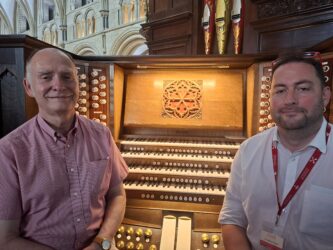
Prior to the failure of the old organ in Gloucester Cathedral, recitals were quite a regular occurrence. Now that the new Nicholson organ has been installed, recitals have recommenced and a series of ten has been announced. These will take place between now and July 2027 and Adrian Partington, the Gloucester Cathedral Director of Music, launched the series. He had chosen for his programme music which had strong connections with the cathedral. In a pleasing innovation, the recital was preceded by a short discussion between Partington and Jonathan Hope, the Assistant Director of Music (Organ), in which they talked about the music. This was something I welcomed very much because with the exception of Elgar and his sonata, all the featured composers and their music were completely unknown to me.
The programme began with Elgar’s Sonata in G, composed in 1895. Though Elgar was a Worcester man – and I believe that the sonata was first performed by Hugh Blair, the Organist of Worcester Cathedral – there is a very strong Gloucester connection. Not only was Elgar a frequent visitor to the city for the Three Choirs Festival but probably the most celebrated recording of the Organ Sonata was made in 1965 in Gloucester Cathedral by Herbert Sumsion (1899-1995) who was Organist of the cathedral from 1928 to 1967. As Partington reminded us, Sumsion’s recording was made in a single ‘take’. Of course, that recording was made on a very different Gloucester organ; tonight, we heard it on the new instrument, made by Nicholason and Co who, fittingly, are based in Elgar’s home city of Worcester. I was immediately struck by the splendid, proud way in which the opening of the first movement (Allegro maestoso) was presented; here, and elsewhere, the richness of the organ’s bass was very apparent. The gentler second subject was played in a most appealing way; I suspect flute and/or clarinet stops were deployed. As the movement unfolded, the skill both of the organ builders, and of Partington in his choice of colours and sonorities, was very apparent; the music was presented as if with an orchestral; palette. (Though Elgar never so much as considered, so far as I know, orchestrating the work, Gordon Jacob made an orchestration in the mid-1940s which deserves to be better known.) Partington brought the movement to a splendidly majestic conclusion.
The second movement (Allegretto) offered good contrast. It is much more subdued and somewhat wistful in character. I admired the delicacy both of Partington’s playing and of the sounds which he conjured from the organ. To be honest, I don’t think this movement is all that interesting, certainly in comparison to its predecessor, but the performance was. The third movement (Andante espressivo) was taken attacca. This is a pensive movement and rather lovely. The performance was imaginative and poetic; an attractive range of colours was drawn from the organ. In the Presto (comodo) finale Elgar is in cheerful, confident mood. The main body of the music is ebullient but midway through there is a more reflective episode, nicely delivered here. Thereafter, Elgar – and Partington – built the movement to a flamboyant conclusion, which sounded marvellous on this organ, especially the deep pedal sonorities at the very end. Introducing the piece, Partington had referenced the symphonic nature of the sonata; he told us that this composition was Elgar’s first attempt at symphonic thought. His performance had sweep and conviction, amply demonstrating the symphonic quality of the work.
Next, we went back in time to hear music by William Hine (1687-1730). Hine was Organist of Gloucester Cathedral between 1710 and 1730 and, in that capacity, we were told, he was one of the founders of the Three Choirs Festival, the origins of which date back to 1715. Hine had a somewhat colourful past; he was sent down from Magdalene College, Oxford for some unknown misdemeanour. Eventually, he made his way to Gloucester where it seems he acted as assistant to the Organist before being appointed to the job in his own right. It appears he was well thought of; at some stage, the Dean and Chapter gave him a pay rise of £20 per annum without being asked to do so! His Voluntary in F major is a piece which plays for about 12 minutes. It is divided into six short sections, which play without a break. Helpfully, these were detailed in the programme; in the various sections Hine exploited different aspects of the organ, including Diapasons, Flute stop and Cornet, bringing the Full Organ into use only at the end. The music was pleasing without being particularly memorable. However, I found its inclusion valuable: up to now, I have only heard the new organ in Romantic and 20th-century music; this witty performance of Hine’s piece showed that the instrument is perfectly capable of doing full justice to 18th-century music.
We came forward to the late 19th- or early 20th century to hear a piece by Charles Lee Williams (1853-1935). He was Organist of Gloucester Cathedral between 1882 and 1897. He retired citing ill-health, though Partington suggested to us that his retirement might have been premature: not only did he live for some 38 years afterwards but also a photograph (taken with Elgar) shows him in 1928, attending the funeral of his successor at Gloucester, Herbert Brewer. Williams’s piece The Chimes of Gloucester Cathedral is rather clever. By way of background, the Cathedral bells are rung three times every day; nowadays, it is all done using electric hammers and a computer control but in Williams’s time there was, I believe, a contraption known as a Chime Machine; I think it still exists. Williams’s piece uses four tunes which various 18th-century musicians and academics were invited to compose for the Chime Machine. So far as I could tell on a first hearing, Williams wove the four tunes into a seamless whole, lasting just under ten minutes. The piece may not be great music but it is attractive and enjoyable. Partington’s registrations and accomplished playing brought the music very much to life.
To conclude, we heard Fanfare Fantasia (2009) by James D’Angelo (b.1939). I had not encountered this American-born and educated composer’s music previously. He settled in England some time ago, taking an academic post at Goldsmith’s College in London. In recent years, I understand he has taken up residence in Gloucestershire. Prior to the recital Partington told us that D’Angelo is an authority on Hindemith. On a first hearing, I didn’t detect any Hindemith influences in Fanfare Fantasia – there may not be any – but I really enjoyed the piece. It plays for about nine minutes and the music – and Partington’s playing of it – grabbed my attention from the outset; the piece has an arresting, brilliant start which was enhanced by an exciting use of reeds. As the piece progressed, it was very noticeable how the different elements of the organ were cleverly used to provide intriguing contrasts. The music – and this performance – had terrific energy and, at times, a decidedly jazzy air. The closing pages were particularly exciting and the choice of stops resulted in one or two sounds which I can only describe – in a wholly complimentary way – as brazen. In the last few bars, I thought I could sense exactly what major key chord we were going to hear at the very end but the ingenious harmonic progression through which D’Angelo got to that chord kept me guessing. This was a highly stimulating way to end the recital.
At the end of the concert, we were told that Regent Records are planning to make the first commercial recording using the new Nicholson organ in early 2027. Adrian Partington will record a programme consisting of music of music associated with Gloucester Cathedral, including this evening’s repertoire.
This fine recital launched the 2026/27 series in great style. The next recital (14 October) will be given by Rachel Mahon, the organist of Coventry Cathedral. Subsequent recitals will include appearances by James Anderson-Besant (Truro Cathedral), Katerine Dienes-Williams (Winchester), Carolyn Craig (Wells) and Ashley Grote (Norwich). Mention should also be made of a series of Organ Meditations at which either Adrian Partington or Jonathan Hope will play an organ work suitable to the Feast or season. Three masterpieces by Messiaen will feature, as well as Dupré’s Symphonie-Passion. Hope inaugurates the sequence on 29 September, the Feast of St Michael and All Angels, with a performance of the one work in the list that I don’t know: Four Ikons of the Archangels (2013) by Neil Cox. Based on my past encounters with Cox’s music, I am eager to hear it.
John Quinn