 United States Verdi, Simon Boccanegra: Soloists, Chorus and Orchestra of San Francisco Opera / Eun Sun Kim (conductor). War Memorial Opera House, San Francisco, 22.9.2026. (HS)
A labor strike by the orchestra delayed San Francisco Opera’s opening by 10 days, but when the curtain finally rose the orchestra was the engine that delivered the passion and musical vivacity in Verdi’s Simon Boccanegra. Conductor Eun Sun Kim brought out all the instrumental energy one could want and achieved pinpoint balance with a cast of superb voices.
Unfortunately, a misguided production drained some of the juice from the music and almost all of the opera’s tale of messy politics and a too-late healing of nasty family secrets.
The strike, which pulled the plug at the last hour on the scheduled opening night of 12 September, was settled with a four-year contract (ratified just in time for the delayed opener to go on). If the orchestra wanted to prove that it was worth it, the sounds from the pit underlined how important their contribution always is. Verdi’s music, in the 1881 revision that reflected the composer’s first work with Arrigo Boito as librettist (a combo that later produced Otello and Falstaff), emerged brilliantly.
The sounds from the pit told the story so much better than the production and direction, first seen two decades ago in Hamburg. Claus Guth, the original director, and revival director Katherine M. Carter only made the confusing narrative less clear. Characters wandered the stage and seldom faced or touched each other, even at dramatic moments such as when the title character discovers he has found the daughter lost for 25 years since childhood.
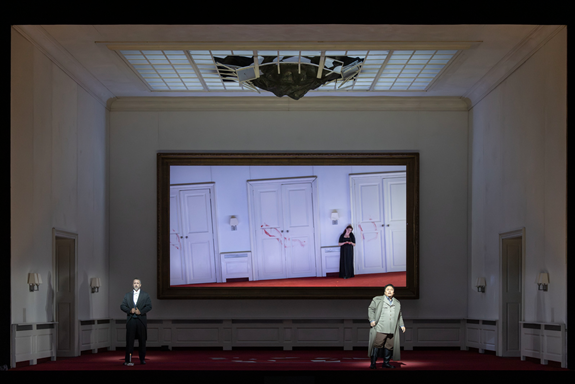
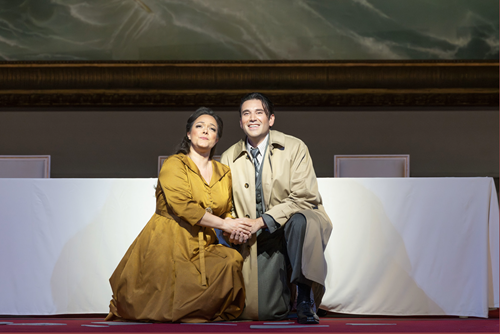
Updating the opera from 14th-century Genoa with modern dress was intended to emphasize the relevance to our times of this very human story. There were a lot of gray trenchcoats. Before the music started, a pantomime of Simon’s death suggested the action of the opera was a series of flashbacks, but that was clumsily done. Why did everyone move extra slowly, often backing out, even when suggesting a rewind didn’t fit? Why an utter lack of human contact? Why a setting of a bare room with a few doors and a meteor hanging over it? All of this was slow and heavy-handed and dragged down the drama.
Characters plodded by in a framed area at the back of the stage. They seemed to represent Boccanegra’s memories though sometimes characters had just been up front. (And they didn’t interact ‘in the frame’ either.) The characters mostly ignored each other which stripped away any visual support for music that is very much about human communication. This opera’s narrative is famously complicated and piling on more confusion didn’t help.
My daughter, who was a theater major at university, simply closed her eyes for much of the evening to shut out the production and reported that the music sounded better. She was right and there was plenty to appreciate.
In the title role, Mongolian baritone Amartuvshin Enkhbat (who delivered a memorable Rigoletto last season) produced the long, supple lines and plush textures that Boccanegra’s music requires. Tirelessly, he created a solid center for the voices around him. Italian soprano Eleonora Buratto as Amelia made a company debut to cherish. In Buratto’s arias her glorious vocal clarity and expressiveness rose above the woebegone direction, and she had the power to stand out in the big ensembles.
As Jacopo Fiesco, bass-baritone Christian Van Horn (a San Francisco regular who most recently sang Escamillo in 2024’s Carmen) created a noble counterpart to Boccanegra with fluid and insinuating vocal lines. In his company debut, Las Vegas-born Joshua Gurrero delivered vocal beauty with his lyric tenor to bring life to Gabriele Adorno, Amelia’s suitor.
Baritones Aleksey Bogdanov (Paolo Albiani) and Alder Fellow Gabriel Natal-Báez (as Pietro, his sidekick), vigorously voiced the buildup to their plot to murder Boccanegra. The chorus was the usual vital cog in the proceedings, especially in the Council Chamber Scene which crackled with drama and musical precision. It was the evening’s highlight, the combined efforts of Kim, the orchestra, the chorus and the soloists transcending for 20 minutes all the negative aspects of the production. They delivered a sensational conclusion to Act I.
If only the rest of the direction had helped instead of hindered, this could have been an unforgettable Simon Boccanegra.
Harvey Steiman
Featured Image: Christian Van Horn (Fiesco) and Amartuvshin Enkhbat (Boccanegra) confront each other without looking as a meteor looms © Cory Weaver/SFO
Production:
Original director – Claus Guth
Revival director – Katherine M. Carter
Production design – Christian Schmidt
Original lighting design – Wolfgang Göbbel
Revival lighting design – Justin A. Partier
Chorus director – John Keene
Cast:
Simon Boccanegra – Amartuvshin Enkhbat
Amelia/Maria – Eleonora Buratto
Jacopo Fiesco – Christian Van Horn
Gabriele Adorno – Joshua Guerrero
Paolo Albiani – Aleksey Bogdanov
Pietro – Gabriel Natal-Báez