 Ireland Wexford Festival Opera 2026 [3] – Rossini, L’equivoco stravagante: Soloists, Chorus and Orchestra of Wexford Festival Opera / Riccardo Bisatti (conductor). O’Reilly Theatre, National Opera House, Wexford, 25.10.2026. (RB)
The last of the operas to be staged at this year’s Wexford Festival Opera was Rossini’s L’equivoco stravagante (The Bizarre Misunderstanding). It is a frothy, fast-paced, playful exploration of class pretensions and the lengths people go to for love. It was the composer’s first large-scale opera, written when he was just 19, but it vanished from the repertoire after falling foul of the censor. The public were allowed to vote this year on the opera they would most like to see performed at Wexford and this opera came out as the audience favourite, so expectations were high.
The plot involves a wealthy farmer, Gamberotto, who wants his bookish daughter Ernestina to marry the wealthy but dim-witted Buralicchio. Ernestina loves the penniless Ermanno and the latter is determined to get rid of the competition. He joins forces with the wily servant, Frontino, to thwart the unwanted match. Frontino forges a letter which he shows to Buralicchio: it states that Ernestina is actually a man, Ernesto, who was castrated in childhood and raised as a woman. It goes on to state that Ernesto deserted his army regiment and sought refuge in his father’s house. Buralicchio is no longer keen on the idea of marrying Ernestina (or could it be Ernesto?) and, needing to find a way out of this predicament, promptly reports the matter to the regiment. The resulting whirlwind of confusion, plotting and comic intrigue eventually unravels, and the opera ends happily with the lovers united.
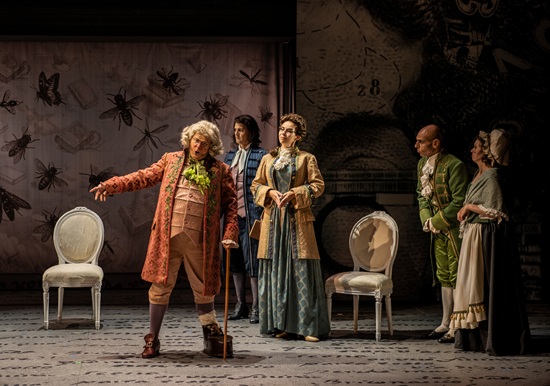
Gaetano Gasbarri’s original libretto sets the opera in early 19th-century rural Italy. The action takes place in and around Gamberetto’s house and country estate. Max Hoehn’s production wisely sticks with this period and setting and uses a wide variety of theatrical devices to maximise the comic potential of the work. Hoehn translated the original Italian himself, and his surtitles brought out risqué double entendres and scandalous exchanges. A lot of the pointed one-liners were genuinely very funny. At various points dainty white clouds descended from the ceiling underlining the camp, fey nature of the material. When Ermanno was chased out of the house and lying on the ground feeling disconsolate and sorry for himself, a noose descended from the ceiling instead. Gurgen Baveyan’s Buralicchio also treated the audience to some riotously funny dance moves. Fluid scene changes kept the action moving and the convoluted narrative clear.
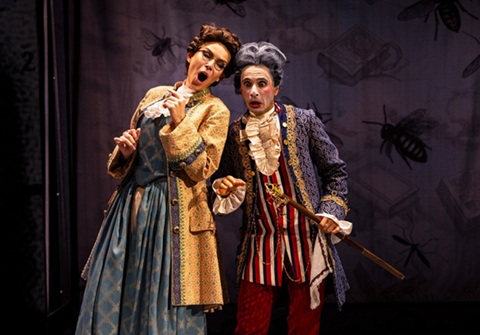
Darko Petrovic’s sets were artistic, imaginative and highly cultivated. Classical elegance permeated the set but there was also a gentle underlying sense of subversive comedy. The front curtain had a male Mozartian figure painted on it, complete with powdered wig and frocked coat, but a female visage was superimposed on the face. When the curtain opened the audience were greeted with a giant portrait of a woman’s head with letters scattered around her hair representing the scholarly Ernestina. The structure opened to reveal a library full of books with Classical statues scattered around the room and an upper balcony. Massimo Carlotto’s costumes were appropriate for the early 19th-century setting while also helping to enhance the comedy. Stefan Astakhov wore an enormous shoe to help with his gout and had to be wheeled around everywhere. Maria Barakova’s Ernestina was a very serious, bookish young lady in the opening scenes and wore a wig, gown and spectacles. This gave her a slightly androgynous look, which was enhanced even further when she took to wearing britches, much to Buralicchio’s alarm. The foppish Buralicchio was dressed in a brightly coloured frocked coat, striped waistcoat and red trousers.
Russian mezzo-soprano Maria Barakova was extremely impressive in the role of Ernestina. She navigated the transition from intellectual bluestocking to love-struck heroine in a seamless and highly convincing way. Barakova was not afraid to show the feisty side of the character stamping her foot at various points and ditching Buralicchio when she finally decided he was not her type. She navigated Rossini’s vocal fireworks with virtuoso aplomb, moving from dazzling coloratura to exquisite lyricism and powerful top notes. She also proved to be a first-rate team player, blending well with the other characters in the duets and ensemble numbers. Sebastian Mach did a reasonably good job depicting the love-struck Ermanno although his commitment to the relationship with Ernestina did not always seem completely convincing. He has a naturally lyrical voice, and he brought a lovely vocal bloom and tone colours to his second-act aria. However, the tone sounded rather thin and I would have welcomed greater vocal heft.
Stefan Astakhov (Gamberetto) and Gurgen Baveyan (Buralicchio) are both experienced bel canto performers, and they gave a masterclass in how to perform Rossini’s opera buffa. Both displayed excellent comic timing and both showed themselves adept in Rossini’s quick-fire patter. Astakhov’s Gamberetto was full of puffed-up self-importance and seemed intent on finding a suitable match for his daughter regardless of what she thought. The comic exchanges with Barakova’s Ernestina were brilliantly handled and there was some well-judged physical comedy as he shuffled around the stage with his enormous shoe. He clearly has a very powerful voice, and his handling of the technique Rossini required from him was dazzling. Baveyan proved equally adept in the role of Buralicchio. He proved to be the ultimate vain dandy as he minced and pouted his way across the stage. The dance moves and some of the facial expressions when learning the news that Ernestina might in fact be a man were very funny. He displayed enormous vocal agility, and he was able to match Astahkov in rapid patter and coloratura. Both performers were superb in the ensemble numbers, blending well with the others and keeping the vocal lines tight.
Carlos Natale and Kelli-Ann Masterson both acquitted themselves well as the scheming servants Frontino and Rosalia. Both executed their arias well and I particularly enjoyed Natale’s mischievous attempts at manipulation. The male contingent of the Wexford Festival Chorus appeared in the first half as rustic peasants and in the second as soldiers. They were superb in the rapid-fire ensembles, and they produced some spirited robust singing.
Riccardo Bisatti and the Wexford Festival Opera Orchestra brilliantly brought Rossini’s exuberant score to life. The Overture was bright and brilliant and there was some very fine playing from the woodwind and horn. Bisatti provided a flexible accompaniment to the singers, and I liked the exchanges between the soloists and woodwind. In one or two instances, the balance between the singers and the orchestra was not quite right and some of the patter was lost. Bisatti proved expert at whipping things up in the finales; it was impossible not to be swept up in the energy and brio of the performances.
Given that this opera was written when Rossini was only 19, I was amazed at what a mature work it is. It contains all the elements that one would expect in a Rossini opera, including glorious lyricism, brilliant coloratura, exhilarating finales and sharply drawn comic characters. Wexford Festival Opera are to be congratulated on making such a convincing case for this work. Overall, this was a highly enjoyable, exuberant, winning performance showing Rossini opera at its best.
Robert Beattie
Featured Image: Wexford Festival Opera’s L’equivoco stravagante © Padraig Grant
Production:
Stage director – Max Hoehn
Set designer – Darko Petrovic
Costume designer – Massimo Carlotto
Lighting designer – Daniele Naldi
Chorus master – Andrew Synnott
Cast:
Ernestina – Maria Barakova
Gamberotto – Stefan Astakhov
Buralicchio – Gurgen Baveyan
Ermanno – Sebastian Mach
Rosalia – Kelli-Ann Masterson
Frontino – Carlos Natale