
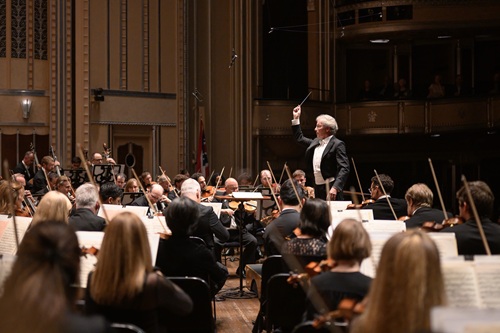
 United States Various: Cleveland Orchestra / Franz Welser-Möst (conductor). Mandel Concert Hall at Severance Music Center, Cleveland, 24.9.2026. (MSJ)
Liszt – Orpheus (Symphonic Poem No.4)
Martinů – Symphony No.2
Brahms – Symphony No.2 in D major, Op.73
Encore: Johann Strauss II – ‘Entr’acte’ from Eine Nacht in Venedig
We now know at exactly what moment the Cleveland Orchestra’s management officially lost the support of the Cleveland public in the current contract dispute. The lights went down in Severance Music Center before the program began, and the door opened stage right for concertmaster Joel Link to enter and cue the orchestra to tune. In the pause before clapping could start, a voice came bellowing from the upper balcony: ‘Give the musicians what they’re asking for!’ The crowd erupted in applause and cheers and refused to stop until Link had the players stand for a bow. Following that incident, either Link forgot to cue the orchestra to tune or someone backstage hustled Franz Welser-Möst onstage before any further disruption could break out. The concert began.
This was classic Welser-Möst/Cleveland. They opened with a lithe and elegant performance of Franz Liszt’s fourth tone poem, Orpheus, with Trina Struble’s harp cascades representing that mythical god of music. Although Liszt was a legendary pianist, his skills as an orchestrator were arguably not at the same level. Fortunately, the trademark inner clarity of the orchestra and the conductor’s ability to avoid losing momentum in passing details united to give lyrical voice to this attractive work. Even without tuning, the orchestra’s sound was radiant and poised.
Next up, after a pause for that belated and seemingly unneeded tuning, was Bohuslav Martinů’s Symphony No.2. This concert marked the work’s first return to the Severance stage since Erich Leinsdorf conducted its premiere here on 28 October 1943, and it comes on the heels of a similarly rare appearance of Martinů’s Third last season, under the direction of guest conductor Jakub Hrůša (review here). Let us hope this foreshadows appearances in coming seasons of the great Czech composer’s other four symphonies, all of which are written at the same high level of inspiration. It has taken many decades for Martinů’s layered mixtures of contrasting styles to come into focus, but now that audiences have digested the likes of Mahler, Bartók and Stravinsky, Martinů is easily in the average listener’s grasp. The Symphony No.2, in particular, is a great entry point to Martinů’s teeming imagination. It is a piece where one phrase might be as sweet as something out of a Dvořák Slavonic Dance, while a striking, angular phrase might emerge from beneath it, sounding like it could have been written yesterday.
The first movement included a particularly sweet phrase in the violas, playing in thirds, before mysterious and shadowy ones swirled up around it. Near the end of the slow movement, the gently glowing textures were pierced by Paul Wyse’s crisp piano notes, one of those moments where Martinů suspends the listener in conflicted emotions. The final two movements even showed hints of jazz which Martinů had actively used in some of his earlier works. The finale built up a delightful head of stream and it received a warm welcome home from the crowd.
After intermission came the beloved Symphony No.2 of Johannes Brahms. There may be other conductors who indulge more in this bucolic symphony’s lovely details, though it is easy to sap its momentum with such meandering. Welser-Möst keeps it poised and flowing enough that even taking the optional first movement repeat felt welcome. Led by solos from Nathaniel Silberschlag (horn) and Frank Rosenwein (oboe), the orchestra played with a masterful ease that also caught Brahms’s characteristic melancholy lurking just beneath the surface, emerging briefly in transitional passages of the slow movement. The third movement interlude/scherzo danced lightly, and the finale proceeded as a proper Allegro con spirito instead of the portly trudge so often heard. The momentum was irresistible toward the end, leading to a standing, cheering ovation, which was answered with a brief, sweet encore.
The question now: will the tour for which that encore was prepared take place? The musicians declared a strike to begin shortly, after seven weeks of contract negotiations have reportedly failed to resolve disputes between management and players. The management quickly canceled a scheduled run-out performance in Ann Arbor and a second one in Cleveland. They posted a statement on social media that included this comment: ‘While we are disappointed by the union’s decision to strike, The Cleveland Orchestra administration remains committed to negotiating in good faith and reaching an agreement that is fair to all. Despite our clear statement at the negotiating table that the latest offer we presented was far from being our final offer, the union refused to present a counterproposal on salary and instead decided to strike’.
Perhaps, with the public response at the concert in mind, they also limited who could comment on that social media post. Much of Cleveland’s manufacturing base may have left over the decades but it remains at heart a union town.
The orchestra previously went on strike in 2010 but that dispute was settled within twenty-four hours. We will see how the current situation proceeds and update as the situation develops. A European tour by the orchestra is still scheduled to begin on 2 October at the Elbphilharmonie in Hamburg.
Mark Sebastian Jordan
The orchestra also went on strike in 1970 and again in 1980. Until 1980, the tour per diem was less than the hotel bills. In other words touring was SUBSIDIZED by the working musicians. This attitude of management and trustees persists today, as the scheduling is comparable to the Berlin Philharmonic and the Vienna Philharmonic, which have many more members. Larger membership means a rotating personnel so that individual musicians have time for physical recovery and preparation for future concerts.
Losing money compared to the rate of inflation, less management contribution to pensions, reduced health care — this is incompetence on the part of management and trustees.
We should be asking — how do the members of an arts organization accomplish culture change in the management and trustees? This is the ultimate task at hand.
Update: A new contract agreement was reached late Sunday, September 27. The European tour is still on!