 United Kingdom Oxford International Opera – Puccini, Tosca: Soloists, Oxford International Opera Chorus, Radley College Choristers, Oxford Philharmonic Orchestra / Marios Papadopoulos (conductor). New Theatre, Oxford, 24.9.2026. (CR)
Although Oxford International Opera makes its debut with this production of Tosca, the company springs from the impetus of that city’s resident Philharmonic Orchestra which has given operatic performances in the past. From memory, there have been concert performances of Fidelio and Don Giovanni, and the ensemble played its part in a staging of Così fan tutte. Marios Papadopoulos conducts a generally sturdy, dependable account of Puccini’s score, the measured and heaving way with the foreboding chords at the beginning which represent Scarpia’s menace setting the mood and pace here. A solid weight of sound tends to convey tragic inevitability in place of more thrusting, searing drama in the moment. A touch more urgency at one extreme, and more nuanced tenderness at the other would be welcome.
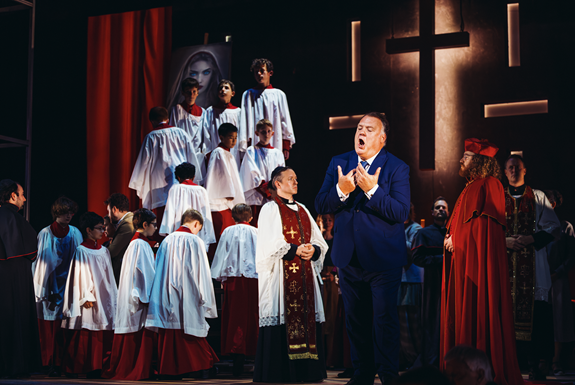
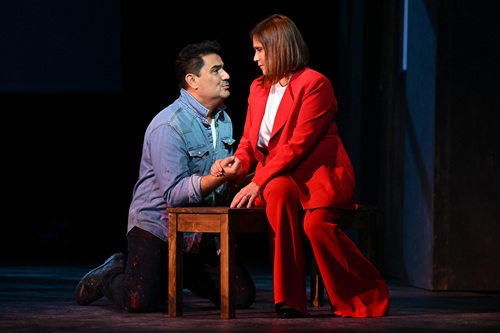
The production itself is less than exciting. Director P Burton-Morgan claims it’s ‘unapologetically contemporary’. But it is contemporary in a way that was dramaturgically fashionable fifteen or twenty years ago where the characters are reinterpreted (reduced or demeaned one could say) as ‘ordinary people’ and look as though they have just wandered in off the rather grubby George Street where Oxford’s New Theatre is located – Cavaradossi in denim and trousers, that reminds more of the 1990s than even this century, and Tosca and Scarpia in their best M&S suits. The latter’s staid dark blue jacket and trousers, sported with a red tie, does rather resemble Trump’s usual business appearance, so perhaps we are supposed to make the comparison. But there are no MAGA baseball caps or any other allusions to the orange-coloured monster, so the connection is subtle if it exists at all. Scarpia’s pulling out his mobile phone at any opportunity is also a cliché masquerading as an idea, since it sheds no illumination on the drama at all. The master of a surveillance regime in the modern age would surely now deploy something more hi-tech. The same bland basic set, with only minor modifications for each change of scene, doesn’t open up very imaginative conceptual vistas either in this opera which above almost all others is so famously set in particular locations.
The last act comes as the nadir, with gestures that can only be regarded as gimmicks. The Shepherd boy strolls on with a balloon, as though he has lost his way home from a birthday party with a doggy bag in his rucksack – there is no obvious reason why or how he should have negotiated his path up through the ramparts of a heavily guarded fortress. When his balloon is later seen floating up outside the window after Cavaradossi’s execution, the effect is pathetic in the ordinary meaning of that adjective, not the literary one. I recall that in the aforementioned Così fan tutte (review here) Polly Burton-Morgan (as she then was) used the same motif – so a fixation with balloons evidently persists over time. Another unexplained and superfluous entrance comes from the solo clarinettist for ‘E lucevan le stelle’, who is not revealed as any particular character or concept, but simply leaves as inexplicably as she arrived. To cap it all, Tosca’s cascade into oblivion is staged as her disappearing through the door of those ramparts in a blaze of disco lights flashing in a bolt of darkness. Intellectual snobs deplore the opera’s sensationalism, but it is an integral fact of the drama, and the climax certainly needs something arresting – an inadvertent bounce from a misplaced trampoline would have been less anti-climactic than this.
Carmen Giannattasio is no-nonsense in the title role, slightly strident vocally around the edges but, curiously, softening her tone only for an engagingly intimate ‘Vissi d’arte’ which seems as though placed musically in inverted commas as a result. Saimir Pirgu is a somewhat throaty Cavaradossi rather than completely ringing out, though fortunately his ‘Recondita armonia’ is enthused and undisturbed, unlike the theatrical tampering with ‘E lucevan le stelle’ already noted. The rough drawl within Bryn Terfel’s voice at this stage in his career suits the part of Scarpia who hardly needs to float a lyrical, sensuous line. Jamie Woollard is conspicuous in the other bass-baritone role of Angelotti, however brief, for the rich grain of his singing, while Sion Goronwy’s Sacristan and Colin Judson’s Spoletta are more whimsical.
In sum, this would pass as a perfectly serviceable – if banal – provincial production of Puccini’s demanding, challenging work which retains some capacity to enthral whatever the circumstances in which it is presented. But ‘international’…
Curtis Rogers
Featured Image: Tosca (end of Act I) featuring Sir Bryn Terfel as Scarpia © Alex Brenner
Production:
Director – P Burton-Morgan
Set and Costume designer – Anthony Lamble
Lighting designer – Mark Jonathan
Cast:
Tosca – Carmen Giannattasio
Cavaradossi – Saimir Pirgu
Scarpia – Sir Bryn Terfel
Angelotti – Jamie Woollard
Sacristan – Sion Goronwy
Spoletta – Colin Judson
Sciarrone – Blaise Malaba
Jailer – Robert Winslade Anderson
Shepherd boy – Misha Gerko