
 Italy 103rd Arena di Verona Opera Festival 2026 [3] – Verdi, La traviata: Soloists, Ballet, Chorus and Orchestra of Fondazione Arena di Verona / Francesco Ivan Ciampa (conductor), Verona Arena, 29.8.2026. (DM-D)
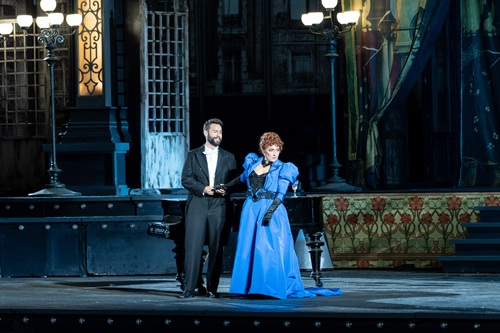
The production of La traviata was the new production at the Arena di Verona for 2026, opening on 12th June. It was the first production for the arena by Scottish director Paul Curran (b.1964). He chose the Moulin Rouge as the setting for the opera, probably inspired by his work, as assistant to Baz Luhrman in the early stages of work on Luhrman’s film Moulin Rouge, following assistance on several other projects, including opera. Juan Guillermo Nova’s set and Stefano Ciammitti’s costumes created a suitably grand Moulin Rouge environment befitting the size and conditions of the stage. The elements of the set could also be shifted, during full intervals and a scene change break in the second act, efficiently to transform into Violetta’s residence in the countryside. It was impressive how well the set accommodated both the vast number of chorus members without ever appearing cramped, while using the entire stage area for the intimate scenes ‘at home’ without allowing the events of characters to feel isolated or lost in a vast space. Fabio Baretti’s lighting design contributed to this imaginative use of the space. In addition to creating areas within that space, the lights sometimes changed colour and perspective noticeably in an instant to foreground sudden events or mood swings.
Francesco Ivan Ciampa avoided a sentimental approach to the score, but rather than choosing brisk and robust tempi, what we heard was quite sustained and solemn, sometimes close to losing momentum. He provided solid support to the singers.
Rosa Feola sang Violetta. She has a very beautiful voice, and was able, with the exception of a few slightly tight top notes in the first act, to give a very impressive demonstration of that voice’s range and expressiveness across the many shades of moods Verdi has composed for her character. She was girlish, playful at first, then a more mature woman; initially at home in the Moulin Rouge environment and later estranged by it. She was also fervently angry, more than self-pitying, at her fate in her Act III outburst. Feola expressed all that, and more, predominantly with her voice, in addition to fine acting. The almost still full moon became visible above the arena when Feola launched her ‘E’ strano! E’ strano!’
Adam Smith sang Alfredo. In Act I he was suitably dashing not only in appearance but also of voice, sounding open and perhaps a little less ardent than I have heard the role from other tenors. That hesitancy received some context, perhaps, in Act II, where the voice was quite weak, sadly, with several cracks even at some moments when the vocal demand was not exceptional. Fortunately, for Act III, Smith regained more confidence, comparable to Act I, but with the delivery of Act II in mind there was an underlying worry underneath the listening experience. An indisposition was not announced. The performance was overall below the achievement I would have expected or hoped for based on the online material available, and I hope to be able to hear him again when he is in command of his full vocal capacity.
In this performance, Ludovic Tézier did not quite reach the level one expects from him. Some of the legato so important for the role of Giorgio Germont was not achieved, with many instances that came closer to staccato instead, and at the end of a good number of lines, he pushed his voice audibly to a stop, blurring the pitch as a result, rather than ending the sound on pitch and more effortlessly. At other times, it was more obvious why he holds his very high level of international renown: where the legato worked, it was wonderful: burnished and sonorous in tone, with long-sustained arcs.
Anna Werle was a particularly strong Flora, making her smaller role appear much larger than it actually is. Her voice was full-bodied and rich in colour. Francesca Maionchi was equally impressive as Annina. Under the leadership of Roberto Gabbiani, the chorus were suitably lively party guests at the Moulin Rouge, while Carlo Bosi, Nicolò Ceriani, Jan Antem, Gabriele Sagona, Andrea Vincenti and Carlo Bombieri sang the smaller roles of named guests at the Moulin Rouge full of vigour and commitment.
Daniel Meyer-Dinkgräfe
Production:
Director – Paul Curran
Set design – Juan Guillermo Nova
Costume design – Stefano Ciammitti
Lighting design – Fabio Barettin
Choreography – Kyle Lang
Chorus director – Roberto Gabbiani
Cast:
Violetta – Rosa Feola
Alfredo – Adam Smith
Georgio Germont – Ludovic Tézier
Flora – Anna Werle
Gaston – Carlo Bosi
Baron Douphol – Nicolò Ceriani
Marquis d’Obigny – Jan Antem
Dr Grenvil – Gabriele Sagona
Annina – Francesca Maionchi
Giuseppe – Andrea Vincenti
Flora’s servant – Carlo Bombieri