 United Kingdom English National Ballet’s Rhythm Riot (choreography by George Balanchine, Jae Man Joo and Micaela Taylor): Dancers of English National Ballet, English National Ballet Philharmonic / Maria Seletskaja (conductor). Sadler’s Wells, London, 24.9.2026. (JO’D)
A late work by George Balanchine and two world premieres make up this triple bill of dance. The theme, according to English National Ballet’s Artistic Director, Aaron S. Watkin, is ‘rhythm itself’. On the opening night each piece was greeted with an enthusiasm that grew as the evening progressed.
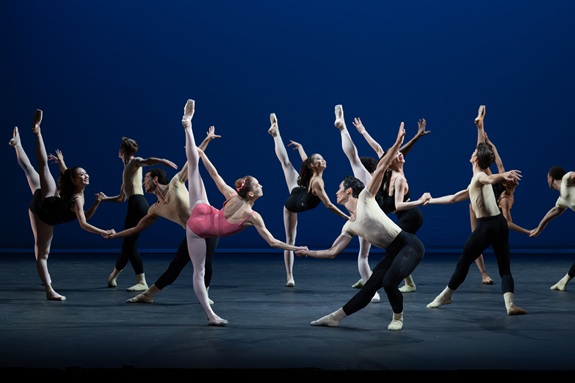
Symphony in Three Movements (1972), new to the English National Ballet repertoire, is set to music of the same name composed by Igor Stravinsky between 1942 and 1945. English National Ballet Philharmonic performs it under the baton of Maria Seletskaja. Balanchine seems to look back at his own work of previous decades (Apollo, Serenade, The Four Temperaments, Jewels) to combine its different elements into an urgent, complex ‘leotard ballet’. Principals, demi- soloists and corps de ballet (a little hesitant, once or twice, on this opening night) interweave in ways for which thrilling is often the only word. Ksenia Ovsyanick, who exists, as a dancer, on a different plane, makes a welcome return as an Associate Guest Artist of the company. Daniel McCormick, as always, and newcomer, Rodrigo Pinto, also stand out.
Micaela Taylor’s Bow Out replaces Balanchine’s brightly lit neoclassicism with hip-hop in semi-darkness. Wearing white tie and tails, against a setting with touches of Art Deco, a collective of dancers presents itself en face. The piece takes its inspiration from a dance number by The Nicholas Brothers in the 1943 film, Stormy Weather. The pace is for the most part fast, the movement energetic. The programme notes refer to the choreographer’s ‘Expand Practice’: ‘moving out from our core and using all the shapes we can make.’
As well as making shapes, the dancers show stylized expressions of emotion (à la Crystal Pite), snap their fingers, scream, and line up (à la Pina Bausch) to divest themselves of their tailcoats in turn. There is the sound of tap dancing on the soundtrack and a snatch of ‘Get Happy’ (though not the version sung by Judy Garland). Occasionally, in the pénombre, dancers engage with each other, most interestingly in a ‘trio’ performed by Aitor Arrieta, Swanice Luong and Sacha Venkatasawmy.
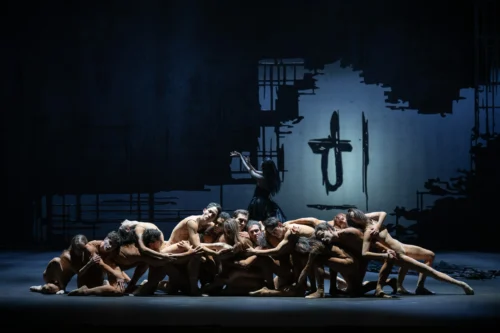
English National Ballet Philharmonic and Maria Sletskaja return for Jae Man Joo’s Auguries of Innocence (a reference to the work of William Blake). To Musica Dolorosa, for strings, by Pēteris Vasks, it begins in almost complete darkness through which the whitened face, shoulders and arms of Sangeun Lee become visible. ‘The Weaver of Souls’, she is accompanied by writhing, twisting, hunched figures who inhabit, the backdrop suggests, a post-war, post-disaster, post-apocalyptic world of despair. For a second section, set to a recording of drums, the stage becomes a square of light on which figures in black enact a ritual, perhaps of death or sacrifice.
A circle of softer light occupies the centre of the stage in the final section, for which the orchestra plays Vasks’s Musica Serena. Into the circle step Daniel McCormack and Ksenia Ovsyanick, dressed to look naked, for a pas de deux of skillfully executed but ungainly movement that is far removed from the Balanchine with which the evening began. They are joined by more couples. Adams and Eves of this post-apocalyptic world? Sangeun Lee, whose commanding presence anchors the piece, walks slowly around them in a dress with a black train before they arrange themselves into a downstage group, and look out at the audience.
John O’Dwyer
Featured Image: Ksenia Ovsyanick and Rentaro Nakaaki performing Symphony in Three Movements © Photography by ASH
Symphony in Three Movements
Choreography – George Balanchine
Music – Igor Stravinksy
Costume design – Karinska
Lighting design – Ronald Bates
Dancers – Swanice Luong, Daniel McCormick, Ksenia Ovsyanick, Rentaro Nakaaki, Emma Hawes, Rodrigo Pinto (Principal Couples); Eileen Evrard, Henry Burgess, Yihan Qin, Antonio Cortese, Taela Graff, José Maria Lorca Menchón, Anri Sugiura, Zai Calliste, Anna Nevzorova, Jakob Wheway Hughes (Demi Soloist Couples) and Artists of the Company
Bow Out
Choreography – Micaela Taylor
Music – Phillip Patrick Harper Bucknor a.k.a. Tru;
Tap Dancer (recording) Scott Kellery Thomas
Set and Costume design – Candice Mac
Lighting design – Jessica Hung Han Yun
Dancers – Jaime Almaraz Baizàn, Thiago Silva, Gustavo Carvalho, Thalina Chapin, Noam Durand, Haruhi Otani, Sacha Venkatasawmy, Haru Yukoo, Aitor Arrieta, Swanice Luong and Artists of the Company
Auguries of Innocence
Choreography – Jae Man Joo
Set and Costume design – Thomas Mika
Music – Musica Dolorosa and Music Serena by Pēteris Vasks;
Beopgogongyang drum music (recording) Venerable
Gogeum Sunim
Lighting design – Mark Henderson
Dancers – Sanguen Lee, Gareth Haw, Minju Kang, Rentaro Nakaaki, Ken Saruhashi, Taela Graff, Ksenia Ovsyanick, Daniel McCormick, Emma Hawes and Artists of the Company