
 United Kingdom 103rd Arena di Verona Opera Festival 2026 [4] – Verdi, Aida: Soloists, Ballet, Chorus and Orchestra of Fondazione Arena di Verona / Francesco Ommassini (conductor). Verona Arena, 30.8.2026. (DM-D)
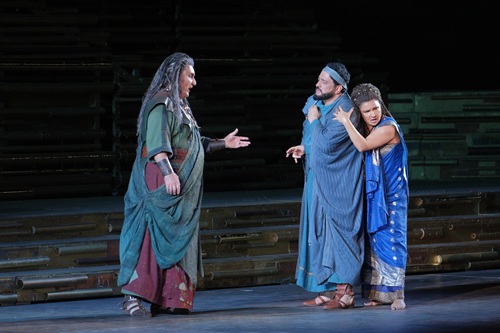
This production of Aida by Franco Zeffirelli was premiered in 2002. While he had developed the monumental Arena production of Turandot with two productions of the monumental kind for the La Scala in Milan and the MET in New York, in 2001 he had directed Aida in one of the smallest opera houses in the world, in Verdi’s birthplace, Busseto, thus developing on the path from minimal-essential to monumental. His Aida production has been revived at the Arena for 10 seasons between 2002 and 2022.
As with his Arena Turandot, the space, with its elaborate set, designed by Zeffirelli himself, and with the meticulously detailed costumes by Anna Anni, was used efficiently and imaginatively. Crowd scenes were carefully choreographed and never came across as cramped or chaotic. Zeffirelli’s work on characterisation and psychological depth for the Busseto production must have paid off as well, because the interactions between the opera’s central characters came across as integral parts of a very genuinely dense emotional plot, moving and gripping.
Anna Netrebko sang Aida. I had been aware of her since her appearance in the film The Princess Diaries of 2001 and have seen many broadcasts with her in the leading roles of her repertory. This was the first time I had seen and heard her on stage live. ‘Experienced’ is probably with hindsight a more appropriate term to capture the holistic nature of the event. Netrebko has an enormous stage presence, one that I have never before encountered at this level of consistent power in any other singer (Klaus Florian Vogt comes close), and only with actor Sir Paul Scofield. No form of recording can capture, let alone transmit this to listeners/viewers. It may relate to some discrepancies between accounts by those who experienced Maria Callas live on the stage and those who did not, or in the context of theatre, the differences of experience of Sir Laurence Olivier as Othello live or mediatised.
Some aspects of Netrebko’s voice may also be lost without the live dimension of the experience. It was striking how rounded and strong the voice carried through the arena even when Netrebko sang the most delicate piano. The voice was huge, and what was also striking in comparison with the mediatised voice was the way moulding and shaping the voice actually happened. They were not means, tools, or techniques learnt and applied to shape the voice in such a way that it delivers beautiful sound in a specific way. They were not means to an end but were instance upon instance of joyously playful consciously aware engagement with a voice at the singer’s full command. The most exceptional soprano voice today.
Yusif Eyvazov was at his own best as Radamès, demonstrating a very high level of commitment. He presented particularly long-sustained exposed high notes, which he seemed to almost literally throw into the Verona Arena. As sung by Clémentine Margaine, Amneris was a woman prone to vehement and near-uncontrollable emotions – one at a time, which was closed to anything else while it lasted: compromise was just not an option. Later regret at decisions with disastrous consequences will neither prevent further such decisions nor will they alleviate the overall suffering caused. Margaine was able to convey vocally both the range of emotions and their depth. With an emphasis on the lower register, her voice contrasted well to Netrebko’s. Mariano Buccino and Gianluca Buratto displayed sonorous and well-rounded bass voices as the King and as Ramfis, respectively, while Ludovic Tézier was very robust and strong as Amonasro.
The chorus under the leadership of Roberto Gabbiani was well rehearsed and delivered with conviction. Francesco Ommassini led the orchestra in a reading of the score that provided strong support for the singers and emphasised the grand scale of the work and its production.
Daniel Meyer-Dinkgräfe
Production:
Director and Set design – Franco Zeffirelli
Costume design – Anna Anni
Ballet coordinator – Gaetano Petrosino
Chorus master – Roberto Gabbiani
Cast:
Aida – Anna Netrebko
Radamès – Yusif Eyvazov
Amneris – Clémentine Margaine
Amonasro – Ludovic Tézier
Ramfis – Gianluca Buratto
The King – Mariano Buccino
A Messenger – Carlo Bosi
High Priestess – Francesca Maionchi