
 United Kingdom BBC Proms 2026 [27] – Beethoven, Scriabin: Augustin Hadelich (violin), Berlin Philharmonic Orchestra / Kirill Petrenko (conductor). Royal Albert Hall, London, 3.9.2026. (AV-E)
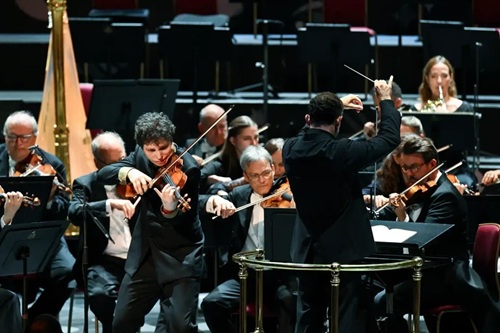
Beethoven – Violin Concerto in D major
Scriabin – Symphony No. 3 in C minor, ‘The Divine Poem’
While Kirill Petrenko and the Berlin Philharmonic delivered an orchestrally outstanding outing of Beethoven’s Violin Concerto, the music’s muscular vitality and vivacity were ultimately reined in by a sober, sombre soloist, Augustin Hadelich.
The strings stood out for the immense gravity of their physical presence. Bolstered by seven double basses anchoring the low end, the divided strings produced a sumptuously deep, heavy and thick-textured sonority — pleasantly recalling Furtwängler’s bass-weighted string sound.
An intriguing detail was the placement of the timpanist centre stage, which made excellent musical sense: the timpani do not merely announce the concerto at its opening but remain prominent and structurally important throughout. Here they were played with immaculate precision, their incisive contribution helping to articulate Beethoven’s rhythmic architecture. Petrenko maintained a firm forward-moving pulse and kept the larger structure under control, even if the performance occasionally felt more disciplined than spontaneous.
Yet Flora Willson, reviewing for The Guardian, wrote: ‘It’s the clarity that hits you first. The soft thuds of timpani that open Beethoven’s Violin Concerto landed from the back of the stage with the immediacy of taps on the shoulder, quietly urgent.’ As the timpanist was visibly positioned centre stage, I wondered whether the Royal Albert Hall’s cavernous acoustics might have distorted not only our perception of the sound but also warped our visual perspective.
Petrenko’s Beethoven was an unlikely hybridisation of contemporary trends and ‘old-school’ tradition. Harnoncourtian accents, sharply observed and crisply articulated, supplied the striking attack, anchored by a granite-like Klemperian heaviness. The woodwind were particularly distinguished, each paired section clearly audible in its own right while remaining perfectly integrated into the orchestral texture; this was some of the finest wind playing I have ever heard.
In the first movement, Hadelich’s micro-managed phrasing was often ornately fussy, with delicate nuances so minutely shaped that they seemed almost to dissolve on the spot. The luminous tone was exceptionally pure, but purity alone is not enough: this pristine performance lacked the command and projection one expects from the great interpreters of this concerto. The Kreisler cadenza was pleasantly played, however, with greater freedom and character than some of the surrounding performance.
The Adagio was the chief disappointment. Beethoven’s sublime central movement requires an inward stillness and spiritual concentration that never quite materialised. Hadelich approached the melody and variations with exquisite delicacy, but the refinement became too prissy, too carefully finished, where the music needs to breathe with greater serenity and conviction. Petrenko’s phrasing in the extended orchestral passage following the soloist’s entrance was insufficiently tranquil, and the lack of spiritual depth became particularly apparent in the variation accompanied by pizzicato strings. The sound was beautiful, the intonation immaculate, the nuances finely judged, but where was the heart? There were moments when Hadelich’s playing seemed so subtle and microscopically polished that the music threatened to evaporate rather than speak.
The finale was taken at a brisk pace, which was welcome after the tendency of some earlier generations of violinists to allow this movement to meander. Petrenko kept the music moving with admirable purpose, and Hadelich negotiated the movement with considerable fluency. Yet the second subject could have been moulded with greater rhetorical conviction; the lyricism was neatly presented rather than persuasively shaped. The concerto therefore ended with the orchestra displaying a level of presence, personality, and character that completely outshone the solipsistic solitary soloist; Hadelich’s insular interpretation was left sounding curiously diminished and detached.
For an obligatory encore, Hadelich offered a transcription of Robert Schumann’s Träumerei from Kinderszenen, an odd and rather unsettling choice that I found coy yet creepy. Again, the abrasive playing was over-refined to the point of razor-sharpness, its nerve-cutting precision mangling the mawkish music of its innocent repose.
Scriabin’s Symphony No.3, The Divine Poem, was faultlessly played by the Berlin Philharmonic but far too prissy and polite — manicured and reserved. Petrenko seemed intent on ‘civilising’ and sterilising music that needs something explicitly erotic, voluptuously volatile, and sensuously sexual: raucous ecstasy rather than coy reserve. The succulent score’s restless transitions and accumulating tension repeatedly lost their momentum when Petrenko laboriously dragged out the quieter passages, rendering the music mannered and almost static. Petrenko’s control became a constraint, smoothing away the volatility that gives Scriabin’s writing its distinctive sexual charge.
Rather than allowing the mutinous music to breathe organically through its changing ‘on heat’ and ‘off heat’ temperatures, the infantile interpretation repeatedly suppressed its own lurid lusting and yodelling yearnings, leaving the musical flow stifled and impotent rather than giving itself over to unbridled release.
The first movement, Luttes (Struggles), should create an unstable, subterranean sound world in which conflict continually generates fresh energy. Here, however, immaculate precision came at the expense of danger. The Berlin Philharmonic’s resplendent refinement and pristine playing were beyond reproach — but that was precisely the problem: raunchy and rugged ribaldry remained strangely remote. Its conflicts were too carefully curtailed and contained, its subdued climaxes reined in and softened.
In the second movement, Voluptés (Delights), the music should explode with excessive, ecstatic rapture. Instead, the performance became increasingly laboured in its restraint. Petrenko repeatedly broadened the quieter passages, allowing them to linger too long when the music needs continuity and transformation. The orchestral detail was sumptuous, with the Berlin strings and winds producing a luxuriant tonal surface, but beneath that surface the movement lacked erotic tension and feverish flow. What should have felt like a dangerous surrender to sensuality instead became an exercise in carefully managed orchestral refinement.
The final movement, Jeu divin (Divine Play), did little to dispel the prevailing perfunctory foreplay. This manic music is supposed to pulse with erotic electricity and rapturous release, yet Petrenko kept it on such a tight leash that even the climaxes never came to anything. The brass were impressive without sounding impassioned.
Seemingly suffering from erectile dysfunction, the orchestra seemed in need of Viagra: what should have been an uninhibited orgiastic eruption remained frustratingly limp and impotent, lacking the essential lift and thrust this sexy score demands. This was censored Scriabin: de-sensitised and de-eroticised.
Only in the closing bars did the orchestra finally erupt in a blaze of sound, reaching its final climactic release, yet the brief gaps between the three closing chords prompted premature applause, sabotaging the climax. The ecstatic audience were far more ‘aroused’ than the players, it seemed.
Alexander Verney-Elliott