 Germany Kaija Saariaho, Innocence: Soloists, Chorus of Theater Bremen; Bremer Philharmoniker, / Stefan Klingele (conductor). Theater Bremen, 13.9.2026. (DM-D)
The opera season 2026 / 27 at Theater Bremen opened with a production of Innocence, an opera in five acts by Finnish composer Kaija Saariaho (1952-2023). The opera received its world premiere in 2021 at the Aix-en-Provence Festival. That production toured widely between 2022 und 2026 and there are four reviews of these revivals in the Seen and Heard archives. The Bremen production is the fourth and most recent independent production in Germany. Compared with many other newly created operas, this large number of productions demonstrates the opera’s considerable success. The Bremen production demonstrates why that is the case.
The opera focuses on a wedding, where, unexpectedly for those present, events that happened ten years ago impact the celebrations. Waitress Tereza recognises the bridegroom’s parents as the parents of a student who, ten years ago, killed ten fellow students and a teacher in a gun attack at his school. Tereza’s daughter, Markéta, was one of the victims. The opera presents perspective on the events, memories of immediate survivors, relatives of the victim, and the parents and brother (the bridegroom) of the perpetrator. In due course, the role of a female friend of the perpetrator, Iris, receives further attention: she reveals that she planned the attack with the unnamed perpetrator, but decided last minute not to join the attack. Bridegroom Tuomas also reveals, for the first time since the events, his guilt of possibly having betrayed his brother: he, too, was part of the planning and should have shot all those attempting to escape – but did not. The Priest noticed some striking behaviour in the perpetrator but did nothing about it, a female teacher remembers reading worrying material in his essays which she failed to act on. After the attack does she start spotting signs of danger in every student contribution to classes. Ultimately, she is forced to abandon her profession. Many perspectives and positions are thus raised and explored. Some of the characters speak, some sing, some do both. The role of Markéta was conceived for a singer familiar with the Nordic form of joik singing. The orchestra accompanied the spoken text and sung libretto much in the sense of supporting or foregrounding the underlying emotional charge.
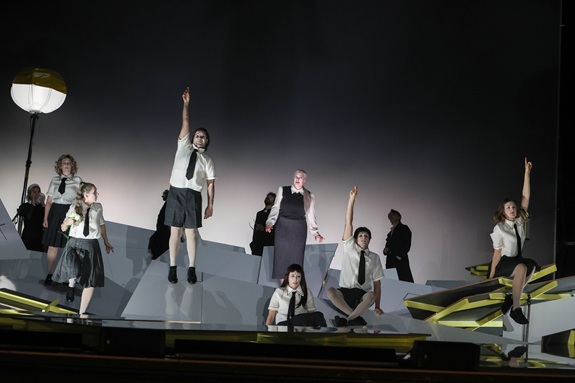
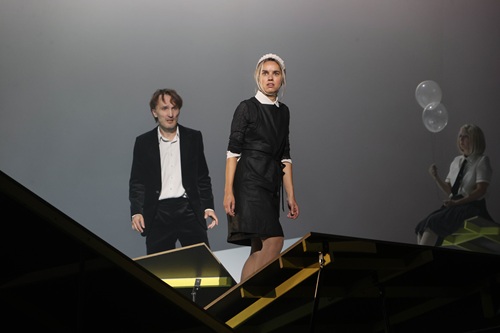
All roles, spoken and sung, were cast with trained singers – rather than selecting trained actors for the speaking-only roles. The voices with their spoken lines and the singing in the conventional operatic mode and, for the ghost of Markéta, joik utterances, were accompanied, supported, or contrasted, by the orchestra, which included a grand piano. Conductor Stefan Klingele held the sound together admirably. The set by Eva Veronica Born suggested a surface broken into many disjointed parts as if in the aftermath of an explosion. Those parts were in constant motion, turning on a revolve, moving up and down, a landscape of shards, with hardly an even surface, all tilting, forcing the singers to engage in acrobatic exercise, appearing or disappearing as if suddenly, embarking on running but having to stop short again suddenly. This landscape was foregrounded further through video of the floor as seen from the ceiling. The costumes by Sara Schwartz stood out well from the grey of the shards. Director Marco Štorman ensured a tight, controlled line of interactions of the characters, or foregrounded their isolation, supported by the choreography by Alexandra Morales.
The pivot for the opera was the character of Tereza, who observed events where she was not directly involved herself. It was another showpiece of singing and acting and a particularly towering stage presence from Nadine Lehner. Julia Grüter sang the role of Stela, the bride, in Nürnberg in the 2025/26 season, where she has been a member of the resident company since 2018. Her voice was suitably bright and well-focused. Sarah-Jane Brandon was intense as the mother-in-law, hiding behind the mother’s protective instincts. Michal Partyka as the father-in law was particularly strong in the shift from seeking to comply with the role of the head of the household to admitting his guilt at not having kept his gun safe enough for his son not to have been able to take it and commit the atrocity with his weapon. Fabian Düberg as Tuomas, the bridegroom and younger brother of the attacker, impressively conveyed how heartbroken his character had felt over all those years, with change only possible in the aftermath of the revelation of the past at the wedding party: only now does he realise, does he admit to himself that he loved and still loves his brother, and is not able to go through with the wedding while coming to terms with that insight. Nathalie Mittelbach was very moving as the teacher who had to abandon the career she loved. Jasin Rammal-Rykała had great moments as the Priest. Venla Ilona Blom contributed the striking joik singing as Markéta, a role she had already played in the 2025 production at the Dresden Semperoper. The final lines of the opera were hers, asking her mother calmly but urgently not to celebrate her birthdays anymore, to let her go. This was the glimpse of hope at the end of the opera.
Daniel Meyer-Dinkgräfe
Featured Image: Theater Bremen’s Innocence © Jörg Landsberg
Production:
Director – Marco Štorman
Set design – Eva Veronica Born
Costume design – Sara Schwartz
Choreography – Alexandra Morales
Lighting design – Christian Kemmetmüller
Video – Steffen Alphei, Nicky Fischer
Sound – Charel Bourkel
Chorus director – Karl Bernewitz
Dramaturgy – Frederike Krüger
Cast:
Tereza – Nadine Lehner
Stela – Julia Grüter
Patricia – Sarah-Jane Brandon
Tuomas – Fabian Düberg
Henrik – Michał Partyka
The Priest – Jasin Rammal-Rykała
Cecilia – Nathalie Mittelbach
Markéta (pupil 1) – Venla Ilona Blom
Lily (pupil 2, Swedish) – Laura Hilden
Iris (pupil 3, French) – Océane Paredes
Anton (pupil 4, German) – Valentin Fruntke
Jerónimo (pupil 5, Spanish) – Rodrigo Andrade
Alexia (pupil 6, Greek) – Ioulia Spanou