 Germany Verdi, Luisa Miller: Soloists, Chorus of the Stadttheater Bremerhaven, Bremerhaven Philharmonic Orchestra / Marco Comin (conductor). Stadttheater Bremerhaven, 19.9.2026. (DM-D)
On rare occasions, the moment the first sound of music emerges from the orchestra pit you realise that you are in for something special, an evening of flow, where everything is not only just right, but comes together to create something that is so much more than the sum of its parts. On many occasions, when the curtain closes, or the lights dim on the final curtain call, the world on the stage closes down, the performers return to their world of behind the curtain and the spectators return to the world of before or after the performance. On rare occasions, the music and the singing of the opera that has just ended linger in our ears. This opening night of Luisa Miller combined both these rare occasions.
Luisa Miller was the opera that the new General Music Director of the Municipal Theatre of Bremerhaven, Marco Comin, selected to launch his tenure. Under his baton, the music sounded incredibly alert, lively, and nuanced. Comin explored the full range of volume – I have hardly ever heard the Bremerhaven Philharmonic Orchestra play so gently and quietly, but without any sign of associating low volume with losing momentum. Comin did not shy away from full throttle playing either, but in those moments, or passages, there was always a distinction between instrument groups, rather than having all play at their most intense at the same time. Comin also demonstrated a keen awareness of the range of different rhythms Verdi composed for this opera. He took great care to support his singers, eliciting from them and the instrumentalists an unending flow of unified sound.
Timothy Edlin has been a member of the Bremerhaven company for the past season, and the role of Count Walter was his largest so far. He was able to sustain long arcs of legato just as effortlessly as singing, rather than shouting, the more dramatic material. His sonorous bass voice sounded well-rounded and mellifluous. The musical emphasis on his love for his son came across as genuine, a remarkable feat in view of the otherwise villainous nature of the character. Guest artist Ricardo Llamas Márquez sang Wurm, his bass-baritone well differentiated from that of Edlin. His voice was strong, robust, pithy, and equally able to sing out the vocal outbursts with as much vocal beauty as the legato material. Visiting artist Rajiv Cerezo Chugani, with a higher baritone, sang Miller, Luisa’s father, with a clear, elegantly burnished voice. Kellan Dunlap, new to the resident company, sang the small role of the farmer with a fresh, bright voice which made one want to hear more.
Weilian Wang, the lyric tenor of the resident company, sang Rodolfo. As with Edlin, he joined at the start of the last season and this was his biggest role so far in Bremerhaven – his voice has developed well over the year, and he was certainly ready for the challenges of the role. He demonstrated his ability to mould his voice elegantly over a wide range of volume, with impressive crescendo and diminuendo. He reached the highest notes with increasing ease and less pressure of breath, making the sound even more beautiful and sustained as a result. Resident singer Boshana Milkov was able to showcase the full range of her expansive, well-controlled alto voice as Federica. Visiting artist Luisa Tambaro sang Luisa, with strong lower registers and a very promising potential for the further development of the upper register.
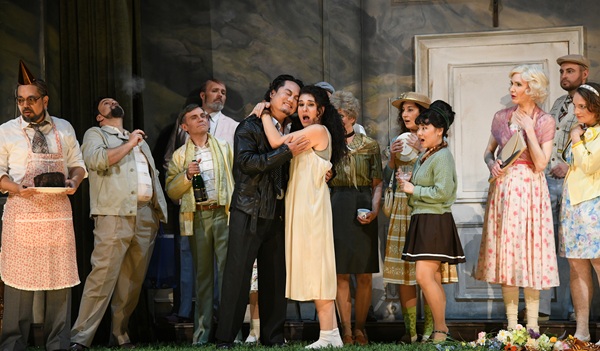
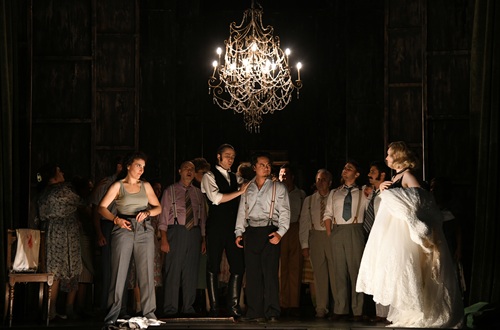
Philipp Westerbarkei, who directed intriguing productions of Macbeth and Turandot for Bremerhaven Municipal Theatre in 2023 and 2025, respectively (see the Turandot review here), placed the plot in a post-war period, in the room of a large house with blue-grey walls to the left and right. At the back, in between walls on either side, a curtain in the same colour as the walls opened for scene changes or was opened and closed by the singers to reveal a predominantly dark area with additional pieces of walls and props. In this space, playing areas overlapped, with characters entering the space as theirs, with the assumption that other characters were in their own, independent environments. Katharina Konopka’s lighting design lit the spaces directly and indirectly, focusing on highlighted areas rather than ever covering the whole stage. This selective use of light emphasised the stage as an object of more abstract art, while the costumes by Tassilo Tesche were realistic.
Westerbarkei’s detailed Personenregie focused on the at best very problematic relationship of the men towards Luisa. Rodolfo’s love for Luisa may have been genuine, but he still pursued it by deception. He had been engaging in sex with her and nobody in her environment took offence at this. Her father was true and honest within his established framework of life, but out of his depth once that framework was infringed. In the duet with Luisa in which they planned their escape together, Miller was dissuaded by a shocked Luisa from displaying increasingly awkward, transgressive behaviour, culminating in an attempted kiss on the mouth. Wurm was simply obnoxious towards Luisa (and everybody else, for that matter). The Count succeeded only superficially in believing his assumed love for his son, in particular when he claimed he had committed his earlier crimes for his son’s sake. He was also clearly flirting with Federica, suggesting that he would have loved to have her at least as his mistress. For Federica, in turn, Luisa hardly counted as a person in her own right given her low social status. In the midst of all those misogynistic male and indeed female positions, Luisa abided by the set of assumed rules that had governed her life for the longest of times, her duty towards her father. Only in the face of death did she make her own choice: she shot herself with a pistol before dying from the poison administered by Rodolfo! Westerbarkei related those details cogently – certain exaggerations might not even have been necessary.
Daniel Meyer-Dinkgräfe
Featured Image: [l-r] Rajiv Cerezo Chugani (Miller), Weilian Wang (Rodolfo), Luisa Tambaro (Luisa) and Minji Kim (Laura) © Heiko Sandelmann
Production:
Director and Set design – Philipp Westerbarkei
Costume design – Tassilo Tesche
Lighting design – Katharina Konopka
Chorus director – Kristina Pernat Ščančar
Dramaturgy – Markus Tatzig
Cast:
Count Walter – Timothy Edlin
Rodolfo – Weilian Wang
Miller – Rajiv Cerezo Chugani
Luisa – Luisa Tambaro
Wurm – Ricardo Llamas Márquez
Federica – Boshana Milkov
Laura – Heesu Kang
A Farmer – Kellan Dunlap