
 United Kingdom Rachmaninov, Mahler: Alexander Malofeev (pianist), Royal Scottish National Orchestra / Thomas Søndergård (conductor). Glasgow Royal Concert Hall, 19.9.2026. (GT)
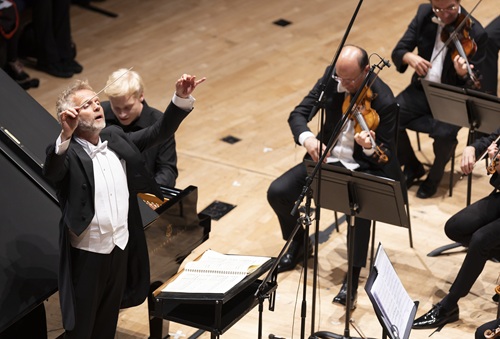
Rachmaninov – Piano Concerto No.4 in G minor, Op.40
Mahler – Symphony No.6 in A minor
Thomas Søndergård’s final season as Music Director will see him fulfilling his mission of performing all the Mahler symphonies. Following his launching the cycle several years ago, the new season opens and closes with two of Mahler’s greatest symphonies, thus marking a keynote in Søndergård’s tenure with the Royal Scottish National Orchestra. There has been a particularly exciting and powerful quality in his direction of the most dramatic symphonies by Brahms, Tchaikovsky, Mahler and Shostakovich. He is one of the finest orchestral and opera conductors in Europe, and his contribution to music performance in Scotland will be difficult to match in future years.
It was, however, an odd choice of works opening with the late romanticism of Rachmaninov, followed by one of Mahler’s most electrifying symphonies. The beauty of the eloquently flowing Russian melodies contrasted with the militaristic marches, all set against the angst in the tragedy of life and death of Mahler that made for a challenging evening.
Having been drafted over several years after leaving Russia in 1918 and only completed in 1926, Rachmaninov’s Fourth Piano Concerto was a failure at its premiere and was revised yet again without success; it was withdrawn until 1941, after which it eventually became popular in its third version.
For many years, this orchestra has enjoyed an affinity with Russian music, a trend which goes back to Sir Alexander Gibson and was enhanced by Neeme Järvi and Alexander Lazarev during their spells with these musicians. The first and third movements employ piano runs and cadenzas, while the most beautiful theme is in the Largo and reflects more than any other concerto’s influence on jazz and an affinity with Gershwin, especially the Rhapsody in Blue. The opening bars seemed a little discordant and without a beautifully romantic theme; it was easy to see why this piece is the least popular of Rachmaninov’s piano concertos, but soon Malofeev brought beauty and virtuoso style in the first of several brief cadenzas with the flow of richly embroidered notes on the keyboard; yet one could notice evidence of harmonies verging on modernism.
The strings, most notably, were in good form, bringing out all the luscious romanticism and colour of Rachmaninov’s concerto. The affinity between Søndergård and Malofeev was outstanding; most notably, one could see how the Russian was listening to the orchestra, with lovely passages between the piano and woodwinds especially. There were outstanding contributions from the flute of Katherine Bryan, Adrian Wilson on the oboe and the clarinet of Timothy Orpen. At the close, the soloist played a beautiful encore of an arrangement of Tchaikovsky’s ‘Grand Pas de Deux’ from The Nutcracker.
On this evening, the stage was lowered so that the musicians were on the same level as the audience in the stalls, allowing a quite different acoustic in the hall; ever since 1990, there have been issues with clarity and sound quality, and there have been changes, from removing the carpeting in the hall to changing the seating and over the years, the sound picture has improved. For the huge orchestral forces required for the symphonies of Mahler, it seems that there is now an excellent acoustic. It was fitting then that before the concert started, the orchestra were presented with the Royal Philharmonic Society’s award for Ensemble performance. The trophy itself seemed tiny, but the achievement by the orchestra as a band of virtuoso musicians has proved a huge achievement under Søndergård.
This was most notable in the opening bars, with the low strings in unison during the thrilling march, joined by the violins and the brass groups in the huge Allegro energico, ma non troppo. Søndergård adopted a brisk tempo, allowing the ideas to develop with tight phrasing and without indulging overly in the march-like themes. The level of the playing was magnificent; despite the overwhelming tragic mood of the music, elements of exciting, gripping ideas emerged from the woodwind and the brass, with some of the most beautiful inputs coming from the horn of Amadea Dazeley-Gaist, in the first of many magnificent contributions. And the off-stage cowbells brought a lovely mood of nature, added to by the two harps. Slowly but surely, the whole scope of Mahler’s tragic and momentous masterwork emerged, with the infrequent moment of happiness announced by the strings of the ‘Alma theme’, briefly a moment of well-being and hopeful reflection in this sombre symphony; but here the music-making was so intense and powerful, that in this glorious music – and before the close – the theme was reprised.
In the Andante moderato, the pace was taut, with fine solos from the woodwind group, and the quotation from ‘Nun will die Sonn’ so hell aufgehn’, from Die Kindertotenlieder emphasised the tragedy of the work especially so when heard on the strings but the theme emerged more dramatically as the horns closed the passage against the cow bells. The march-like rhythms returned in the Scherzo moderato yet switched to a more irregular rhythm and more pleasant mood, as Alma Mahler said it was like ‘the unrhythmic games of two children tottering in zigzags on the sand’.
The extended Finale, Sostenuto – Allegro energico, was a glorious switching of contrary moods and themes, mixing the marches from the opening movement of great optimism and excitement to the tragic pages of doom and of a human life fearing death – aided and abetted by two cataclysmic hammer blows – and for his survival in a world of dangers and threats. The contributions by the glorious brass, especially the trombones and trumpets, were magnificent, and the harmony of the harps and the celeste brought colour and gorgeous music-making before the threnody and the closure on the sudden chord in A minor, bringing this masterwork to a dreadful silence.
This concert was a magnificent opening performance and augurs marvellously for the season, which will close with Mahler’s Third Symphony in May 2027.
Gregor Tassie