 Germany Verdi, Rigoletto: Soloists, Saxon State Opera Chorus, Staatskapelle Dresden / Francesco Angelico (conductor). Semperoper Dresden, 24.5.2026. (MC)
For his three-act opera Rigoletto Verdi used a libretto by Francesco Maria Piave that was based on the 1832 play Le Roi s’amuse (The King Amuses Himself) by Victor Hugo. Verdi described the play as the greatest drama of modern times. Set in Renaissance Mantua the premiere of Rigoletto took place in 1851 at the Teatro La Fenice, Venice.
This ‘psychologically intense production’ was a revival of stage director Nikolaus Lehnhoff’s modern dress Rigoletto that was premiered at Dresden in June 2008. An acclaimed production, the verdict of Italian critic Elvio Giudici was ‘one of the most significant of recent times.’ That opening night Fabio Luisi was the conductor, and the starry cast featured Juan Diego Flórez as the Duke of Mantua and Diana Damrau singing Gilda. Describing Rigoletto as ‘a melodramatic and gothic drama’ Lehnhoff and his design team had created a dark, bleak and rather claustrophobic landscape. It was a production where the margins separated reality from the chimeric. Lehnhoff gave strong focus to the sexual debauchery of the Duke’s court leading to significant drama and tragedy. Although Lehnhoff’s Rigoletto attracted some debate at the time of its introduction it was nothing compared to the furore that met Jonathan Miller’s 1984 production that switched the action from the sixteenth century to the underworld of Mafia gangsters in 1950s Little Italy, New York.
Piave’s libretto after Hugo’s play concerns the hierarchy of Duke Mantua’s court. Rigoletto, a hunchback, hates his lowly rank as court jester yet knows his station. He tries everything he can to stop his daughter Gilda from being seduced by the Duke of Mantua an inveterate womaniser. Yet he is too late as Gilda is already in love with the Duke and has been kidnapped by his men. Sparafucile is hired by Rigoletto to assassinate the Duke and in all the confusion Gilda dies tragically.
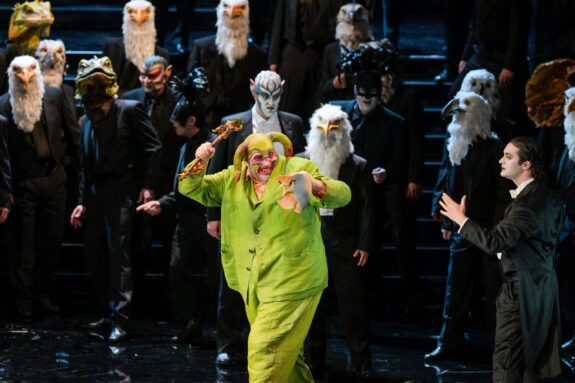
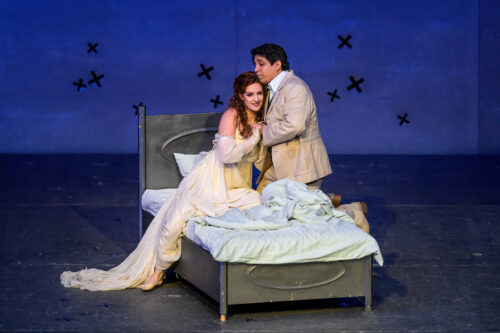
In keeping with the plot’s mystery and intrigue Raimund Bauer’s sets had been kept mostly dark including scary looking passages and trap doors. Nothing especially striking has stood out in the memory. Overall, the sets were rather basic and devoid of clutter for example Gilda’s light-blue painted bedroom was both elevated and raked. Perhaps the most modern looking aspect of the staging was the Ducal Palace Hall with the walls, floorspace and grand staircase all covered in a dark marble effect. Costume designs by Bettina Walter were not of Piave’s original 16th century Mantua, they reminded me of a mix of late 1900s fashion. In truth, everything about the production worked extremely well.
Ukrainian bass-baritone Oleksandr Pushniak took the role of Rigoletto the court jester and hunchback. In sterling form Pushniak was very much the lonely, careworn jester who persuasively cared only for his daughter Gilda. Full of anger and bitter resentment his biting humour was directed towards Count Ceprano who issued a curse. As jester the tall figure of Pushniak looked strange and awkward, heightened by his hunchback, wearing a lime green outfit with orange underclothes and a matching helmet with downward pointed horns. In this demanding role Pushniak’s baritone was durable with stamina and mightily effective. Especially successful was his third-act aria Cortigiani, vil razza dannata where an emotionally charged Rigoletto begged the Duke’s men to return Gilda to him.
Rigoletto doted on his young teenage daughter Gilda, sung convincingly by Marina Monzó, and throughout he strove to protect her. Since her mother’s death her father has kept her concealed from the world at home with him. Innocent and naïve in relationships with men Gilda wanted to be in love and fell head over heels for student Gualtier Malde, who was the Duke in disguise. Even in fear of her own life Gilda was willing to go behind Rigoletto’s back to see him. Valencia-born soprano Monzó as Gilda fitted the bill splendidly. Young and head over heels in love in her Act I aria Caro nome she is entranced over the name of her first love. Impressive throughout Monzó displayed her attractive voice, splendid breath control and one genuinely felt for Gilda’s predicament.
Charming, handsome and wealthy the Duke of Mantua is an unscrupulous womaniser. The role might have been made for Peruvian tenor Iván Ayón Rivas. In 2024 I saw Rivas as Gabriele Adorno in a concert version of Simon Boccanegra at the Bridgewater Hall, Manchester, so I knew what to expect. He’s a bundle of energy and a skilled actor with an accomplished voice. In Rigoletto it is the Duke that has the lion’s share of the arias. A charismatic performer Rivas was irresistible throughout especially with his two showcase arias Questa o quella expounding the pleasures of women, and La donna è mobile expressing how only foolish men trust women; two of the most famous of all opera arias.
An assassin for hire Sparafucile was taken by Italian bass Antonio Di Matteo who looked the part with long dark hair and black leather type clothing he looked suitably menacing. Di Matteo was in striking form in Sparafucile’s riveting duet with the tortured Rigoletto Quel vecchio maledivami. Another notable performance was from Bavarian born Christa Mayer as Maddalena. As Sparafucile’s sister she assists her brother in his scheming as bait for his deadly deeds. Mayer worked well with the other performers and displayed a splendid mezzo-soprano voice. Sounding great were the men of the Saxon State Opera Chorus and the Staatskapelle Dresden conducted by Francesco Angelico gave a first-rate performance.
At the conclusion of this Dresden revival of Nikolaus Lehnhoff’s Rigoletto it seemed like ages before anyone left the auditorium. The audience clapped and clapped during the curtain calls for a production that had captivated hook, line and sinker.
Michael Cookson
Featured Image: Oleksandr Pushniak (Rigoletto) © Semperoper Dresden/Sebastian Hoppe
Production:
Stage Director – Nikolaus Lehnhoff
Set design – Raimund Bauer
Costume design – Bettina Walter
Lighting design – Paul Pyant
Choreography – Denise Sayers
Chorus director – Jan Hoffmann
Dramaturgy – Ilsedore Reinsberg
Cast:
Duke of Mantua – Iván Ayón Rivas
Rigoletto – Oleksandr Pushniak
Gilda – Marina Monzó
Sparafucile – Antonio Di Matteo
Maddalena – Christa Mayer
Giovanna – Sarah Alexandra Hudarew
Count Monterone – Matthias Henneberg
Marullo – David Roy
Matteo Borsa – Jongwoo Hong
Count Ceprano – Metehan Köklü
Countess Ceprano – Roxana Incontrera
Page – Dalia Medovnikov
Court Usher – Friedrich Darge