 United Kingdom Wagner: Anja Kampe (soprano, Brünnhilde), Elizabeth DeShong (mezzo-soprano, Waltraute), London Symphony Orchestra / Sir Simon Rattle (conductor). Barbican Hall, London, 24.5.2026. (JPr) ****
Wagner – Excerpts from Götterdämmerung: Dawn and Siegfried’s Rhine Journey, Waltraute’s Plea to Brünnhilde, Siegfried Idyll, Funeral Music, Immolation Scene
Well it is the lot of this Wagnerian to bemoan how in virtually any concert involving excerpts from Wagner’s Götterdämmerung there is a ‘bleeding chunks’ problem because they will all begin with a glimmer of ‘Dawn’, a few moment from the duet between Siegfried and Brünnhilde before he sets off – seemingly on a jet ski – down the Rhine! (Leaving me to think about all the great Siegfrieds and Brünnhildes I have heard over the past fifty years.) So guess what, on a rare return of Wagner’s music to the Barbican Hall (with Tristan und Isolde to follow in July), dawn broke briefly at the start of what proved – with a single caveat – to be the start of some exceptional music-making. Since my live forays to concert halls are so rare these days I hesitate to suggest where Sir Simon Rattle and the London Symphony Orchestra’s foray into Wagner is placed in the pantheon of my better such experiences, but I believe it is high, very high.
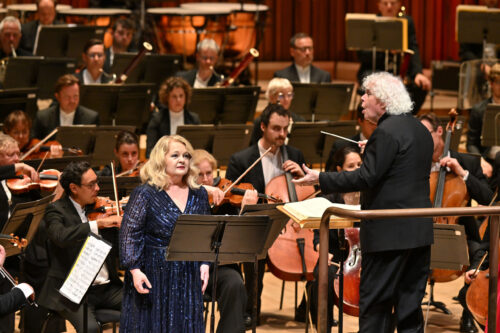
A huge orchestra made a mightily impressive sound as Siegfried was sent on his way and kudos to the soloist dismissing our hero’s – well mine anyway! – horn call during the ‘Rhine Journey’ with consummate ease. The music barely touched down at the Gibichung Hall long enough before we were off to Brünnhilde’s rock and the interesting idea to hear the entire scene with ‘Waltraute’s Plea to Brünnhilde’. The singers entered as the music began so any mood that had been created had not dissipated. Anja Kampe – also Rattle’s Brünnhilde in his ongoing Munich Ring cycle – is vastly experienced in the role though proved a great disappointment on this occasion. Kampe didn’t actually spoil anything because her voice was rather too small for the orchestra massed behind her and which often overwhelmed her. There was a lack of involvement with the text and, somewhat surprisingly, she gave the impression she was sight-reading the score in front of her; though I am sure that was not the case.
On the other side of Rattle on his podium, what a revelation mezzo-soprano Elizabeth DeShong proved to be in revealing an incredible vocal range from a superbly supported chest register to laser-bright soprano heights that Kampe seemed challenged by. I idly wondered how wonderful DeShong would possibly be as Brünnhilde herself. The singer – who I only knew from her Suzukis in Madama Butterfly and some other minor Met Opera roles – gave a masterclass as Waltraute demands the return of the cursed ring to the Rhinemaidens before warning about the impending twilight of the gods in Valhalla. The drama of this pivotal scene was underscored (!) by Rattle and his musicians: from Waltraute’s frantic arrival to the desolation of Valhalla and Brünnhilde’s rejection of Waltraute’s entreaties with her fervent declaration of how Siegfried loves her.
A small chamber-like ensemble played Wagner’s Siegfried Idyll that almost perfect synthesis of music from the third evening of the Ring cycle. It is something of an intimate symphonic poem which clearly inspired the Adagietto from Mahler’s Fifth Symphony. Wagner composed it in 1870 as a private birthday and Christmas present to his wife Cosima. The Siegfried Idyll is part lullaby and part ‘love song’ for Cosima and in its entirety a celebration of the recent birth of their son, Siegfried, born the year before. (Had he been born a year later the boy might have been called Götterdämmerung and not Siegfried as they named their children after the opera being worked on and already had daughters Isolde and Eva!) The musicians (the 13 Wagner scored the music for) were led by Benjamin Marquise Gilmore’s tender and eloquent violin and some exquisite nature-inspired woodwind. Rattle’s encouraging gestures were almost superfluous in a meticulously sculpted account which only occasionally threatened to become becalmed.
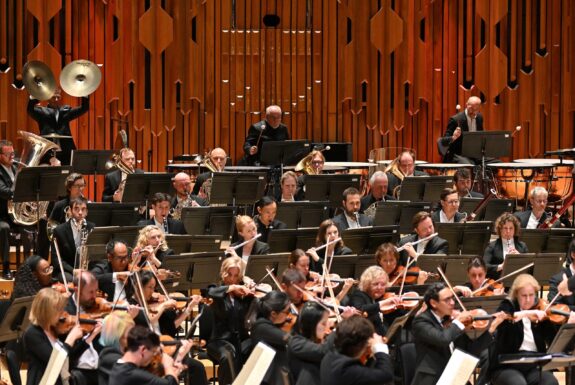
The LSO’s brass howled and growled excitingly, and the percussionists – as exciting to watch as to hear – enthusiastically brought thudding power, clashing cymbals and a thunderous volume to a memorable performance of Siegfried’s ‘Funeral Music’. Smoothly we entered the world-cleansing and cathartic Immolation Scene which Kampe got through on sheer willpower and top notes shouted on pitch. Her best section was the quieter, less vocally demanding, few lines ‘Alles, Alles, Alles weiss ich (to) Ruhe, ruhe, du Gott!’ and here Kampe brought to it an intriguing reflective intimacy.
During the entire concert whilst Rattle concentrated on a pleasing interpretative broadness, he was not at all content to let any of the orchestral showpieces linger very much and neither did he here. As the visceral excitement of the fearsome fortissimos of this cataclysmic scene ebbed away to the spiritual rebirth and new dawn of its ending, it was as if Wagner’s music had come full circle and I could have heard it all over again.
Jim Pritchard
The concert is to be repeated at the Barbican Hall on 28 May.
Featured Image: The percussionists of the London Symphony Orchestra © Mark Allan/LSO
Thanks Jim for the excellent review as always. I went to the second performance of this programme last night and pretty much agree with all you said, and felt it was maybe down to Rattle who said he was going to let his orchestra off the leash and the result was that it did swamp the singers. Likewise, DeShong was the discovery of the night for me, what a voice – not just the high notes, but she projected all the way across her formidable range. The only blot on the landscape for me was the appalling ‘hospitality’ at the Barbican at the interval – rude, chaotic and even by London standards outrageously priced.
An excellent concert. It would be good to have a ‘Die Walküre’ version.
Quite agree re-the cafes, etc. at the Barbican and their prices.