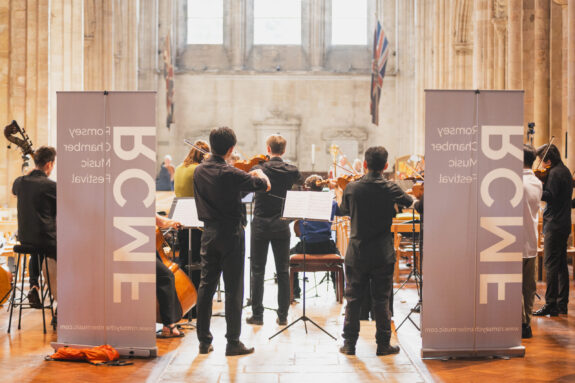
 United Kingdom Various, Elements – Romsey Chamber Music Festival 2026: Jaehong Kim (baritone), Siân Buckley, Luke Hsu, Alexia Huan, Laura Rickard, Kathryn Rickard, Emma Roijackers, Ruslan Talas, Diana Williams (violins), Jane Andrews, Anuschka Cidlinsky, Michael Perry, Kyunsik Shin, Coby Mendez, Louise Woods (violas), Rainer Crosett, William Harris, Lydia Hillerudh, Jemima Hughes, Angie Janssen (cellos), Jack Cherry, Carole Dowding (double basses), Emme Hensel, Sue Gibbons (flutes), Johan Löfving (theorbo). Romsey Abbey, 23.5.2026. (CK)
Vivaldi – Le Quattro Stagioni, interspersed with :
Jean-Féry Rebel – Les Élémens : Le Cahos
Hollis Taylor & Jon Rose – BEAK for string quartet and birdsong
Dvořák – Klid (Silent Woods), arr. for cello and string orchestra
Purcell – King Arthur: What Power Art Thou (Cold Song)
Sitting in Romsey Abbey with 250 other people, all of us waiting in a state of anticipation bordering on excitement for the musical feast to begin, I fell to wondering what it is that makes this chamber music festival so special. Two things, at least, are very clear. The nucleus of musicians who return each year are the Artistic Director Laura Rickard’s personal friends. When they play together they radiate what I can only call a group charisma: despite the many spectacular solo performances during the week, no one seeks individual star status. Other musicians are quickly drawn into this charismatic community and given their chance to shine.
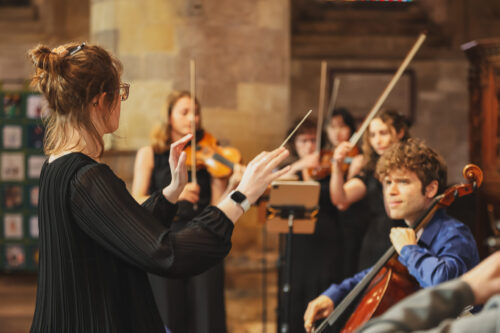
I have drawn attention to the other distinguishing feature of the festival before: Laura’s genius for imaginative programme planning. Great to kick off a programme themed around the four elements with Vivaldi’s evergreen (perhaps not quite the appropriate word) Four Seasons: but how about preceding it with pre-Creation Chaos – not an arrangement of Haydn’s irreproachably Age-of-Enlightenment Representation of Chaos, but the first movement of the French composer Jean-Féry Rebel’s Les Élémens (written when Haydn was five)? It begins with a 12-tone chord – not à la Schoenberg, but all of them scrunched together: the elemental chaos before God’s finger went to work. It is a thrilling, visceral noise: controlled – or rather unleashed – by Lydia Hillerudh, temporarily deserting her cello to conduct.
Rebel’s seven-minute movement goes on to depict the ordering of the elements ingeniously and in lively pictorial terms; a perfect preparation for Vivaldi’s Spring, with Ruslan Talas the graceful soloist (it was another good idea to entrust the solo role in each concerto to a different violinist; also, to have the appropriate sonnet read out before each performance). Talas was lively and lyrical in the first movement; in the Largo he spun a fine line against a solo viola, and in the finale his playing was elegant and full-toned.
Last year, memorably, the Abbey space was full of the tramp’s voice in Gavin Bryars’s Jesus’ Blood never failed me yet; on this occasion, in BEAK, it played host to the astonishing song of the Australian pied butcherbird, as recorded by boundary-breaking Australian musicians Jon Rose and Hollis Taylor, who also provide an inventive and sometimes imitative accompaniment for string quartet (played here by Emma and Laura, Kyungsik and Rainer: as Emma said in her introduction, ‘the bird becomes part of the ensemble’). There was also a striking video installation, brilliantly done, portraying primal Australian landscapes as a sequence of abstract patterns. I cannot hope to convey the quality of this performance in words: sorry, you had to be there.
Emma Roijackers was the soloist in Vivaldi’s Summer; a performance which vividly captured the music’s depiction of enervating summer heat and stillness, and its quicksilver changes: contrasts of tempo and dynamics were brilliantly managed. The beginning of the Adagio was almost ghostly, with lovely, vibrato-free playing from Emma; and the summer storm was virtuosically dispatched.
After the interval, Vivaldi’s Autumn, with Luke Hsu – himself a force of nature – as soloist. I enjoyed his little Trio with Rainer’s cello and Johan’s theorbo in the opening Allegro; dynamic contrasts were daringly done, the music sometimes hovering on the edge of audibility. The theorbo was also in the spotlight in the Adagio – beautifully, almost mesmerizingly so; and the final Allegro was as theatrically enjoyable as Luke could make it, with dynamic contrasts played up for all they were worth.
The full ensemble was onstage again for Dvořák’s Silent Woods, an atmospheric piece for cello and string orchestra (originally for piano four hands, then for cello and piano). It was gorgeous, and suited Rainer’s playing perfectly. There is something about Dvořák’s lyricism that is simple, healthy and good for the soul: so it was here. It was followed by a final surprise: a splendid performance by Jaehong Kim of Purcell’s ‘Cold Song’, its accompaniment a striking prefiguring of the opening of Vivaldi’s Winter, composed a generation later. Had Vivaldi heard it? I have no idea: if not, the resemblance is startling; even spooky.
And so to Winter, Laura the soloist this time, prowling inside the semicircle of players: she and they were manifestly enjoying themselves. She kept the Largo moving nicely and launched the finale as though improvising; this was Vivaldi with chutzpah, and an exhilarating demonstration of how friends who also happen to be virtuosos play together.
A brilliantly conceived concert wonderfully performed. And this is only the start. For more about the Romsey Chamber Music Festival 2026 click here.
Chris Kettle
Featured Image: Romsey Chamber Music Festival 2026 © IOA photography