
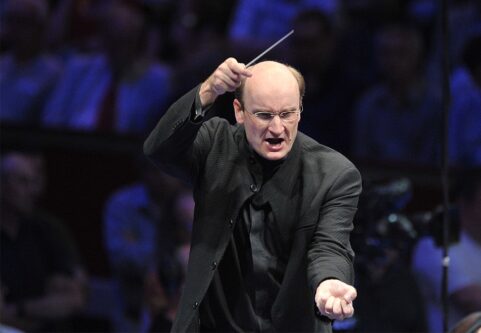
 Germany Dresden Music Festival 2026 [2] – Elgar, Haydn, Lawes, Bliss: Konstanze Pietschmann (cello), Dresdner Philharmonie / Andrew Manze (conductor). Kulturpalast, Dresden, 23.5.2026. (MC)
Elgar – Serenade in E minor for string orchestra
Haydn – Cello Concerto No.2 in D major Hob. VIIb:2
William Lawes – Fantasia Suite No.1 in G minor (arr. Andrew Manze for strings and harp)
Bliss – A Colour Symphony
Originally intended as an ‘all-English’ concert I admit disappointment that English cello soloist Sheku-Kanneh Mason had to withdraw due to a hand injury. Mason was to give the European premiere of Edmund Finnis’s Cello Concert, also removed was a performance of the English composer’s own string arrangement Hymn (after William Byrd). Consequently, the concert’s original title ‘Journey through English music’ didn’t seem quite appropriate as Leipzig cellist Konstanze Pietschmann, who stepped in as soloist, played Haydn’s Cello Concerto No.2 in D major. Our guide throughout the concert was award winning, former baroque violinist Andrew Manze who has transitioned to become a much acclaimed conductor, especially of Late and Post Romantic English music.
The concert opened with the first replacement work Elgar’s Serenade in E minor for strings. One of Elgar’s first important works the E minor Serenade written in 1892 was a gift to his wife to mark their third wedding anniversary. This much-admired gem for string orchestra was completed some seven years prior to his landmark work the Enigma Variations (1899). Manze asked for and received a splendidly paced performance with the Dresden strings having a mellow and inviting texture. Opening the score the Allegro piacevole movement with its gorgeous, pastoral melody easily evoked to me Elgar’s beloved Malvern Hills. Following on, the irresistible Adagio was full of an uncommon longing while to conclude the contrasting breezy Allegretto felt refreshingly alive.
It is fair to say Joseph Haydn’s Cello Concerto No.2 in D major from 1783 has experienced a chequered past. Its authenticity was questioned and even attributed to Antonín Kraft, first cellist in the Esterházy court orchestra. The musical who-done-it was solved when in 1951 Haydn’s own autographed score was unearthed. Now it is generally accepted the concerto was premiered by James Cervetto principal cellist of the Italian Opera in London who performed it in 1784. Cervetto was London born so there is an English connection.
Replacing cellist Sheku-Kanneh Mason was award winning soloist Konstanze Pietschmann who is first principal cellist of the Dresdner Philharmonie. Pietschmann was playing an attractive sounding cello by maker Charles Gaillard (Paris, 1867). An example of Viennese Classicism this entrancing D major score shifts mood between sadness and good humour. Pietschmann began rather unevenly with some intonation issues that she soon overcame confidently providing first class playing. I was impressed by Pietschmann’s handling of the conspicuous operatic qualities of cantabile melodies and virtuosic flourishes. Playing as soloist with her home orchestra Pietschmann’s performance drew much applause from the audience.
No stranger to bringing early music to the symphony orchestra. Here at Dresden, Manze turned his attention to 17th-century English consort repertoire from William Lawes. English early baroque composer Lawes notably served at the court of Charles I (1600–1649) king of England, Scotland and Ireland. From Lawes’s set of eight Fantasia Suites for two violins, bass viol and organ (c.1630) Manze has arranged the Fantasia Suite No.1 in G minor for strings and harp. Returning after the interval the stage was full of Dresden players in place for the Bliss symphony and it seemed slightly strange watching only the strings play with the large number of orchestra members watching on.
Under Manze, the Dresden players gave a performance that did justice to this elegantly scored Fantasia. I loved hearing the lovely warm wash of string sound and the pizzicato sections were so sensitively handled. No one in the audience seemed to realise that the Fantasia Suite had finished and there was no applause, so Manze jumped straight to the Bliss A Colour Symphony the major work of the evening.
A Colour Symphony by Sir Arthur Bliss is a work known more by its reputation rather than actual performances. Bliss was invited to write a new work for the 1922 Three Choirs Festival at Gloucester Cathedral. Inspired by reading a book on heraldry he was interested in how ‘symbolic meanings were associated to certain colours.’ Bliss settled on a symphony in four movements named Purple, Red, Blue and Green that corresponded to his characterful perception of each colour. At the premiere a disappointed Bliss commented how his A Colour Symphony was given ‘a miserable first performance’ largely due to limited rehearsal. This was not the case here at Kulturpalast as Manze and his players were at one with
Bliss’ magnificent score. I certainly don’t profess to be able to identify music to colours and I don’t think it makes any difference. Noticeably as each colour was played the lighting technicians at the Kulturpalast shone the appropriate colour around the hall.
Manze and the Dresden Philharmonic were in sterling form. The opening movement Purple sounded breezy and adventurous, evocative of a sea voyage from a bygone age reminding me of a Hollywood Film score such as Korngold’s score to the film The Sea Wolf (1941). Next the Red movement burst into life with tremendous energy creating a heroic sound broken only by a short central section having a pastoral feel. Prominent in the colour Blue was the principal flute together with solid contributions by other woodwind and brass. In the full orchestra at times, I detected a slight oriental feel to the music, also an undertow of melancholy towards the quiet conclusion. Ending the symphony was the colour Green that began with the strings that developed to an adventurous martial character. At one point some of Bliss’s rather quirky rhythms from the woodwind took me by surprise. Grinding forward the full orchestra, towards the end, were joined by timpani followed by a cymbal crash which marked the concluding bars of the score. With a resounding performance of distinction Manze and his Dresden Philharmonic served the memory of Sir Arthur Bliss proudly.
Any minor irritations I had with the altered programme simply didn’t matter a jot as the performance of the Dresden Philharmonic under Andrew Manze was an unqualified success. Undoubtedly the quality of Bliss’s A Colour Symphony would have been a delightful surprise to many.
Michael Cookson