 Switzerland Mozart, Die Zauberflöte: Soloists, Chorus amd Orchestra of Zurich Opera / Tarmo Peltokoski (conductor). Zurich Opera, 20.9.2026. (MF)
What a jolly affair! Zurich opera kicks off the new season with a crowd-pleaser in the best sense of the term. Avoiding intellectual overstretching, this production tells the story as it is, accepting its convolutedness and inconsistencies. The team treats the audience to a colourful, artistic, beautifully musical and humorous show. General director Matthias Schulz promised a Magic Flute for all ages, from 9 to 99. I say he delivered, and I suspect even younger people will enjoy the performance.
Swiss Director Daniele Finzi Pasca is a trained clown and a published playwright. He was in charge of three Olympic closing ceremonies and worked with Cirque de Soleil. Together with Hugo Gargiulo, he created a dreamlike set affording the young cast room to deploy its playful energy.
They kindly poke fun at the men in need of guidance. Sarastro’s throne is a remote-controlled chair on wheels, occasionally veering into a tailspin. Tamino, as likeable as disoriented, can’t find his way around the stage, until the very last notes when he forgets to leave the proscenium he had prematurely stepped on during the overture before the action even began. As a tailcoated violinist, he does not feel up to operating the magic flute he is handed. He is terrified by the apparent serpent, failing to recognize it as the cut-in-half puppet it is.
The set consists of various abstract and well-balanced pictures, punctuated here and there with ironic counterweights. The portrait that makes Tamino fall head over heels in love with a young woman he has never even heard of is a Manga videography appearing inside a monstrous dragon’s eye. Sarastro and his school of priests (the one low mark: why present them as a clumsy gang of dimwits?) meet in the ruins of a former marble temple. Did Pamina really lead Tamino through the fire and water trials – or was it all just a choreographed dream? Light, video and various building elements converge in harmonious unity.
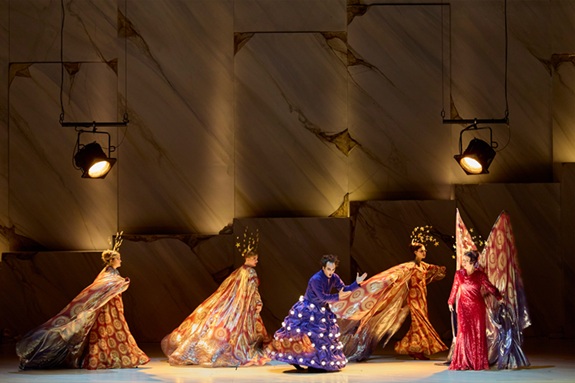
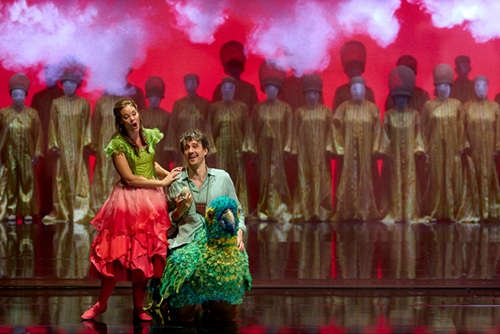
Magnificent costumes make it all very much an evening of creatures of the air. Papageno rides a parrot, the three boys are elves sitting astride young sparrows. The Three Ladies, in splendid peacock eye-patterned golden silk, as well as the Queen of the Night, ravishing in a sparkling crimson dress, sport butterfly-like wings and starry antlers. From beginning to end, a half-dozen strong flock of fantasy quails accompanies, helps, remote-controls and gently mocks the protagonists. The birds deliver props, dance to the music or entertain each other with artistry on trapezes of double-helix shapes. Papagena, after terrifying Papageno as an ‘eighty year and two minutes old’ small raven, sheds her black feathers to shine as the reassuring white swan she has always been. Monostatos resembles a caricature of what one might expect of the Queen of the Night, white make-up and clad in a purple hoop skirt riddled with light bulbs flashing in synchronicity with his emotions.
And then there is the music of course. 26-year-old Finnish-Philippine conductor Tarmo Peltkoski and the Zurich Opera Orchestra embark on a well-paced and careful rendering of what Peltkoski describes as one of the most enigmatic masterpieces in opera history. His conducting brings out the haunting magic, the intimate introspective searching, all the associated light and shadow and let’s not forget, the lighthearted fun Mozart infused in the score. The brass section’s sharp preciseness left a particular impression.
The cast is a visual and auditory joy. Above all, Regula Mühlemann as a light, bubbly, charming and at times pensive Pamina and Yannick Debus as Papageno. Debus, with his easy stage presence, develops an effortless, sonorous baritone; his never really intended suicide in the second act is a scene to remember. Magnus Dietrich’s Tamino needed a bit of time to warm up and then displayed a manifold presence, giving his lost character just the right amount of power and presence when it was needed. Jasmin Delfs as Queen of the Night delivered on all accounts. While her soprano comfortably reached the top notes, she also had moments of tender sadness. Nathan Haller was a suitably over the top Monostatos and Tobias Kehrer convincing as a somber Sarastro. The International Opera Studio was out in strong numbers with a charming Mariam Suleiman as Papagena. The cheekily seductive Three Ladies (Hannah McKay, Karima El Demerdasch and Dominika Stefanska) were competing for Tamino’s feelings. Without a doubt, one of the evening’s highlights were the Three Boys: Leo Eisenreich, Nicolas Bader and Benedikt Eberl of the Tölzer Boys’ Choir. In their elf-sat-on-sparrow costumes they hopped, chirped and sang their way straight into our hearts.
Performances run until 30 October 2026 and with a fresh cast in April 2027.
Michael Fischer
Featured Image: Nathan Haller (Monostatos), Jasmin Delfs (Queen of the Night), Dominika Stefańska, Hannah McKay and Karima El Demerdasch (Three Ladies) © Herwig Prammer
Production:
Director and Lighting – Daniele Finzi Pasca
Set – Hugo Gargiulo
Set assistance – Matteo Verlicchi
Costumes – Giovanna Buzzi
Choreography – Maria Bonzanigo
Video – Roberto Vitalini
Chorus director – Klaas-Jan de Groot
Dramaturgy – Kathrin Brunner
Cast
Tamino – Magnus Dietrich
Sarastro – Tobias Kehrer
Pamina – Regula Mühlemann
Queen of the Night – Jasmin Delfs
Papageno – Yannick Debus
First Lady – Hannah McKay
Second Lady – Karima El Demerdasch
Third Lady – Dominika Stefańska
Monostatos – Nathan Haller
First Priest / Speaker – Andrew Moore
Second Priest – Salvador Villanueva
First Armoured Man – Rafael Rojas
Second Armoured Man – Theodore McAlindon
Three Boys – Leo Eisenreich, Nicolas Bader, Benedikt Eberl