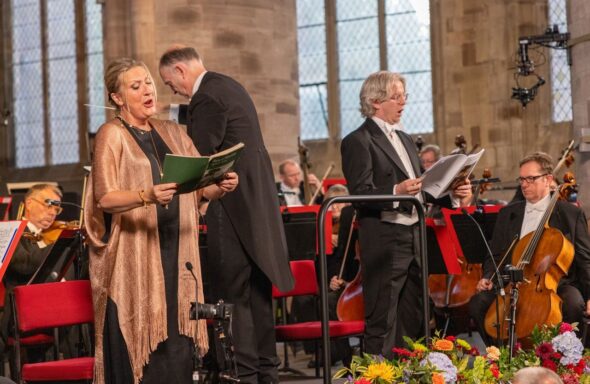
 United Kingdom Three Choirs Festival 2025 [3] – Howells, Bliss: Rebecca Hardwick (soprano), Dame Sarah Connolly (mezzo-soprano), Michael Bell (tenor), Malachy Frame (baritone), Three Choirs Festival Chorus, Philharmonia Orchestra / Adrian Partington (conductor). Hereford Cathedral 30.7.2025. (JQ)

Howells – Paradise Rondel; Hymnus Paradisi
Bliss – Mary of Magdala
This programme was a most attractive prospect: two works, one by Howells and one by Bliss, which I had never previously heard live, as well as Howells’s supreme masterpiece. In a clever and witty piece of programme planning we had the prospect of two visions of Paradise by Howells: an earthly one to begin and concluding with an incandescent view of heavenly paradise.
Herbert Howells is justly celebrated for his organ compositions and for his output of choral music, much of it written for the Anglican church. His orchestral works have received less attention, though, despite the fact that Richard Hickox recorded many of them for Chandos in the 1990s; a generous collection of those recordings is still available and well worth seeking out (Chandos CHAN24120). These orchestral works were mainly composed between the two World Wars, and I was delighted to have the opportunity to experience one of them in live performance.
Paradise Rondel is a Three Choirs work; the composer conducted the first performance during the 1925 Festival, which was held in Gloucester. Its name derives from the Gloucestershire hamlet of Paradise, which is situated between Gloucester and Stroud. The Cotswold Way, famous with walkers, passes through the village. In his notes accompanying the 1995 Hickox Chandos recording Lewis Foreman included this comment by Howells: ‘Paradise is a good walking place, full of tunes for those who can hear them’. Paradise Rondel is not to be confused with a slightly earlier orchestral work by Howells, Pastoral Rhapsody (1923). As Paul Spicer observed in his biography of Howells, the two pieces are ‘entirely different from one another’. Yet Spicer went on to make this telling comment about the two pieces: ‘it is the shape, impression and, most importantly, mood of the whole which is the overridingly important feature. Melody is important, but it is subservient to the overall intention of painting a large-canvass picture in which the atmosphere is dominant’. To prepare for this concert I listened to the Hickox recordings of both pieces. I did so before looking to see what Spicer had to say about them and when I read his words it seemed to me that he’d nailed it.
The performance was a fine one: the start was bright and airy and the Philharmonia’s playing was alert. My only mild disappointment was that here, and when the lively music returned later in the piece, the important piano part was very hard to hear, I suspect this was because, of necessity, the instrument was positioned at the side of the stage, behind a large pillar. There was ample compensation, though, in the animated playing from the orchestra; Adrian Partington had clearly prepared them well to convey the spirit of what must have been an unfamiliar piece. In the middle of the work Howells slows the pace and offers a radiant, beautiful interlude. This was played with exquisite sensitivity; I was especially taken with the solo playing of principal viola (Scott Dickinson, I presume) and the leader, Zsolt-Tihamér Visontay. Howells later resumes the lively tempo and a spirited pastoral dance ensues. The work’s slow and rapt ending was magically delivered; once again, the string principals offered lovely playing, and the first clarinet gently sang in the final bars. This was a super performance which seemed to me to be right in the spirit of the music. It prompted the question, why on earth don’t we hear this little gem of a piece more often?
This year marks the fiftieth anniversary of the death of Sir Arthur Bliss. Some of his songs and the Music for Strings have been included in the Festival programme and this concert featured the most high-profile celebration of Bliss with a rare performance of his cantata Mary of Magdala. I only knew of this piece by repute until I heard the premiere recording of it, which was made as recently as 2019 by Dame Sarah Connolly and Sir Andrew Davis (review here). I was delighted that the same soloist had been engaged to sing the work tonight. Mary of Magdala was commissioned for the 1963 Three Choirs Festival; the first performance was given in Worcester Cathedral under the composer’s baton and with Norma Proctor as soloist. Though I don’t believe that Bliss was a religious man, he described this work as a sacred cantata and in it he set the encounter between Mary Magdalene and the risen Christ in a most moving fashion; indeed, as Spicer pointed out in his programme note, the subject matter was chosen by Bliss. He enlisted the help of the poet Christopher Hassall (1912-1963). They had collaborated before; Hassall wrote the libretti for several of Bliss’s works, including the television opera Tobias and the Angel (1960) and the oratorio, The Beatitudes (1962). Mary of Magdala was to be their last collaborative venture: Hassall succumbed to a heart attack in April 1963; Bliss dedicated the work to his memory. Hassall compiled his text from the New Testament and from verses by two seventeenth-century poets, the Englishman, Edward Sherburne (1618-1702) and the Welsh poet, Rowland Watkyns (c.1614-1665).
Very briefly, the scenario of the piece depicts Mary Magdalene heading towards the sepulchre in which Christ had been laid after the Crucifixion. As she makes her way there, amid her anguished thoughts, she recalls her first encounter with Christ when, at a feast, she attempted to anoint his feet only to be derided by the other guests until Christ admonished them and allowed her to anoint him. On arrival at the tomb, she is dismayed to find that Christ’s body is not there, taken away, as she supposes, by grave robbers. Two angels appear to her, attempting to reassure her. Then she sees a man whom she presumes to be a gardener until he reveals himself to her as the risen Christ. The work ends with Mary and the chorus celebrating Christ as the gardener who tends and nourishes the souls of the faithful .
With the exception of Sarah Connolly, I imagine that the piece will have been new to all concerned performing it. One would not have known that because this was an assured and sensitive account of the piece. Before the concert I had a brief chat with one of the tenor members of the Festival Chorus; his enthusiasm for the piece was evident and, based on what I heard, that feeling was shared by his colleagues. The Festival Chorus was excellent throughout; I liked their sharp, incisive singing when they depicted the guests at the feast, mocking Mary and I thought they made a fine contribution to the closing section, after Christ has revealed himself to Mary. The two angels who meet Mary at the tomb are depicted by a small group of sopranos. The ladies who acted as the semi chorus (six of them, I think) sang clearly and confidently. The baritone soloist takes the role of Christ. I had previously heard Malachy Frame in the performance of Mathias’s This Worlde’s Joie. Though I liked some of what he offered in that performance, I felt that he wasn’t ideally suited to the rollicking nature of some of the piece (review here). Here he was ideally cast; the dignified music which Bliss wrote for the baritone suited Frame to a tee. I liked his performance very much. Inevitably, the prime focus falls on the mezzo soloist. It is a while since I have attended a live performance by Sarah Connolly, and I was delighted that she was on excellent form. The tone was rich and a delight to hear but what impressed me most was her identification with the role. Both words and music were put across with great conviction and no little intensity. You can experience that on the Chandos recording too, but the effect was greatly enhanced live. She inhabited the role in a way that I found very moving; Connolly drew her audience into the piece and into her character. Bliss’s orchestral scoring is resourceful and nicely illustrative and the Philharmonia’s excellent playing made an important contribution to the success of the performance which was guided in a sure, empathetic fashion by Partington. My guest, a singer herself, had not heard it before; she was very moved by both work and performance. I rather suspect that Mary of Magdala has not featured in a Three Choirs programme since its 1963 premiere, even though the score is attractive and sincere. If my guess is right, handsome amends were made on this occasion.
By contrast, Hymnus Paradisi is regularly heard at Three Choirs, and rightly so. It is surely Herbert Howells’s masterpiece; indeed, I would go so far as to say it is one of the select handful of truly great English choral/orchestral works along with The Dream of Gerontius and Belshazzar’s Feast. Howells composed it as an outlet for his grief after the death in 1935 of his son Michael tragically young at nine. The work was completed in 1938; however, Howells then shut the score away. The programme included a quote from an interview he gave in 1971 to Gramophone magazine (occasioned, I suspect, by the release of the work’s first, and still best, recording, conducted by Sir David Willcocks). Howells said ‘it was a private document and I didn’t want to share it with the public’. Fortunately, after the end of the Second World War, Howells showed the score to Herbert Sumsion, the Organist of Gloucester Cathedral. Sumsion recognised the stature and importance of the work and enlisted the help of Vaughan Williams and Gerald Finzi; the combined persuasion of these three musicians caused Howells to relent, and the composer himself conducted the first performance of Hymnus Paradisi in Gloucester Cathedral on 7 September 1950. Poignantly, the premiere was given the day after the 15th anniversary of Michael Howells’s death. By another serendipitous coincidence, almost exactly forty years earlier, on 6 September 1910, Howells and his great friend Ivor Gurney had been present in the same building when Vaughan Williams conducted the first performance of his ‘Tallis’ Fantasia, an event which stirred the young Howells to his core. The first hearing of Hymnus Paradisi made a profound impression on many musicians who were present. Reginald Jacques, the conductor of the Bach Choir, recalled later, ‘From the first solemn announcement of the opening theme to its reappearance at the very end when it rises to catch a gleam of light before fading into silence, Herbert Howells’s work took complete possession of me; for days afterwards I could think of little else, and I knew no peace until I had mastered its complexities’. Seventy-five years later, we are blessed that this great masterpiece is readily available to us through performances and several fine recordings; yet Hymnus Paradisi has not lost its power to move and to stir the listener’s soul.
In 2023, after many years of admiring and loving Hymnus Paradisi from afar, as it were, I finally got an unmissable opportunity to sing in a performance of the work. That experience gave me some insight into the challenges which face any choir which essays the work. One of the most formidable of those challenges is the complexity of Howells’s rich textures and his luxuriant, highly expressive chromatic harmonies. Another issue is that the nature of the orchestral scoring is such that it is easy for the choir to be swamped: to be honest, Howells rather overscored the piece in places. Tonight, I thought the Festival Chorus largely overcame those problems. In passing the second of those tests the singers were aided by the way in which the Philharmonia responded. They must have worked hard with Partington in rehearsal in order to do justice to Howells’s scoring without overpowering everything; that work paid off. There were one or two passages of loud music in which the textures became congested (the first half of the last movement ’Holy is the true light’ was one such) but I think the ‘blame’ – if that’s the right word – lies with the composer. In any case, perhaps Howells didn’t want clarity in such passages but aimed instead to create the sense of a teeming multitude?
Right from the start, the yearning harmonies in the orchestral Prelude made me reflect that the audience at that 1950 premiere must have sensed that a rather special piece was beginning to unfold; on this occasion, the burnished sound of the Philharmonia’s strings, horns and bassoons were a decided asset. This proved to be a harbinger of a very fine presentation of all aspects of the orchestral side of this work. There was power when needed but also many instances of sensitivity to savour. The choir excelled in all respects. Their diction was as clear as one has a right to expect in this music and in such a resonant acoustic. The tonal quality of their singing was equally impressive. They were sensitive to the dynamics and when the music required them to open up in loud, expansive singing, the quality of the sound in no way disappointed. I admired the incisiveness with which they articulated the biting music at ‘Yea, though I walk through the valley of the shadow of death’. The semi chorus has an important function at various points in the score and the fresh, clear singing of the small group of ladies’ voices was admirable.
The soprano and tenor soloists have key roles to sing. I admired the clarity of Rebecca Hardwick’s voice. However, I would have liked more warmth of tone; ideally, a soprano should have a creamy tone in this music – as well as clarity – and I felt that was lacking. There was much to enjoy in Michael Bell’s singing; his voice is very well suited to this music. He came into his own especially in the exquisite movement ’I heard a voice from heaven’ where he floated the lines plangently and poetically. Both soloists were somewhat swamped by the orchestra from time to time when singing lower in their respective registers but that is not their fault; the scoring is unkind to them.
Adrian Partington proved an ideal choice to conduct this work. He directed the performance with an intuitive understanding of the music and made very clear to the performers how everything should ‘go’
This was a marvellous concert. The programme had enticed me in advance; the music and the standard to which it was performed met my expectations in every way.
John Quinn
Hymnus Paradisi – Rebecca Hardwick
Many thanks to JQ for his comprehensive reviews of the two concerts (30-31.7.2025). Due to the sudden reoccurrence of an old back problem during the Bliss, I was forced to watch and listen to Hymnus Paradisi in the refreshment tent. Congratulations to the sound and audio team for setting this up. The camerawork was excellent and the sound was clearer and better balanced than I had experienced from the side aisle before the interval. Contrary to what John experienced, in the live relay Rebecca Hardwick’s voice sounded exceptionally warm and full. Fine as Michael Bell was, Rebecca Hardwick’s power and richness was dominant and totally captivating. Whether this difference in our perceptions can be put down to Cathedral acoustics vs. microphones/mixing, or just two different pairs of ears, who knows. Having not previously heard Rebecca Hardwick, I was very impressed, and will be looking out for a second chance in hopefully better circumstances.
A very memorable evening at the Three Choirs.