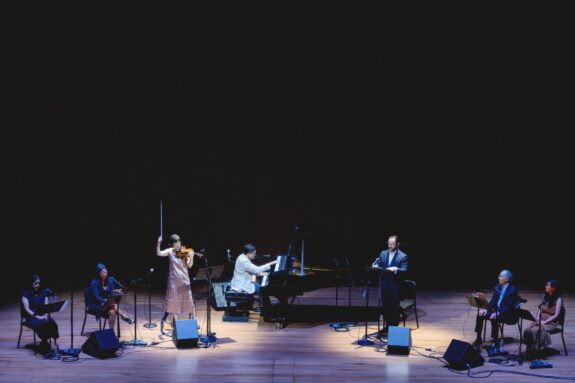
 United States RUN AMOC Festival: Paul Appleby (tenor), Miranda Cuckson (violin), Anthony Cheung (piano), David Bird (sound design). Alice Tully Hall, New York, 16.7.2025. (DS)

Anthony Cheung – the echoing of tenses
On the final night of Lincoln Center’s RUN AMOC Festival, Anthony Cheung addressed the audience from his place at the piano, expressing feelings of kinship with the American Modern Opera Company (AMOC) although he himself is not a member. Seated on either side of him were two longtime members of the company, violinist Miranda Cuckson and tenor Paul Appleby, and flanking them were guest poets from the world of Asian-American literature: Victoria Chang, Arthur Sze, Jenny Xie and Monica Youn.
Alice Tully Hall was packed, thanks to a brilliant move by the Lincoln Center Festival team to make tickets ‘choose what you pay’ this summer. Kudos to those behind the scenes who made that work. Cheung’s song cycle, the echoing of tenses, was programmed to bring to a close two weeks of operatic stagings by the likes of George Lewis and Matthew Aucoin. It was an interesting and laudable choice to end in a chamber ensemble mood.
Cheung explained to the audience that the echoing of tenses – an exploration of the memories immigrants and their descendants experience across generations – was less a song cycle than ‘poetry, panel discussion and song cycle all in one’. This was immediately evident as artists and poets shared a plethora of compelling reflections that offered insightful approaches to listening. Sze, for instance, mentioned the experience poetry gives to ‘dwell in uncertainties’ while Xie, from whose poetry the title of the piece is pulled, emphasized poetry’s ability to ‘crack open memory’. I particularly enjoyed Cheung’s remark that he hoped to create ‘new nerve endings’.
With a sophisticated harnessing of imagination, the echoing of tenses wove memories, stories, imagery and perspectives from the readings on the stage (and, in some cases, voice recordings such as Ocean Vuong’s work ‘The Gift’) with a cleanly constructed collage of sounds. The effect was dreamlike – credit is due to sound designer David Bird who created a perfect balance between the parts.
Intertwined with the spoken word, Cuckson’s violin ranged from sultry to whimsical to sweepingly melancholic. Her exquisite approach to ricocheted textures, harmonics and tremolos created a dramatic landscape. The piano offered an array of Lisztian turns, carefully coordinated around a delicate use of microtones and electronic samplings of sound bites that emphasized a rapport with the emotions and images in the poems. And when Appleby picked up the lines of text in song, it underlined his interpretation and displayed his caressing tenderness with each word.
Cheung’s complex work was executed with seeming effortlessness, thanks to the strong relationship among the musicians. In duets, Cheung and Cuckson showed their expert coordination (they are longtime collaborators in the new music arena). And in passages that paired Appleby’s voice with Cuckson’s violin, the two held attentive looks with each other to carry through the phrasing meticulously.
Words were displayed above the stage and allowed one to watch the artistry that may have been missed if glancing down at a program to follow the text. There was no shortage of absorbing material, like Youn’s metaphoric story of a magpie and Chang’s curious letter of wonderings to her grandmother. As they were leaving the hall, listeners could be heard repeating unforgettable images, like that of the ‘flowering pistachio trees’ or ‘the panda fidgets’ that Appleby’s singular voice had stamped in our hearts.
Without question, the echoing of tenses is another one of Cheung’s elegant approaches to composition and, most certainly, he created ‘new nerve endings’ for anyone lucky enough to hear the work.
Daniele Sahr
For more background to the echoing of tenses click here.
Featured Image: Performers of Anthony Cheung’s echoing of tenses at Alice Tully Hall © Lawrence Sumulong