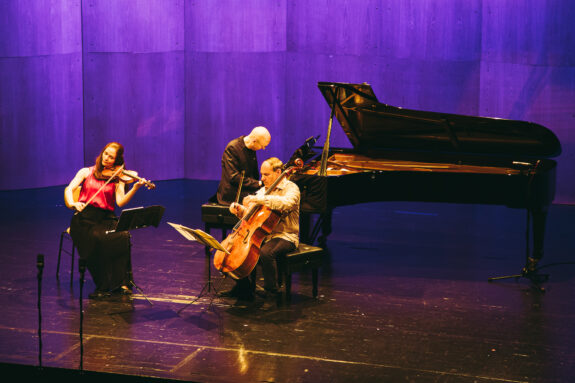
 Portugal Verão Clássico Festival 2025 [1] – Various: Anna Samuil (soprano), Stephan Picard, Lena Neudauer (violins), Muriel Razavi (viola), Gary Hoffman (cello), Alexandra Scott (double bass), Milana Chernyavska, Filipe Pinto-Ribeiro (piano). Centro Cultural de Belém, Pequeno Auditório, Lisbon, 23.7.2025. (LV)

Bruch – from Eight Pieces for violin, viola & piano, Op.83: No.2 (Allegro con moto), No.5 (‘Rumänische Melodie’), No.6 (‘Nachtgesang’)
Mozart – Sonata No.32 for Piano and Violin in B-flat major, K.454
Dvořák – Nocturne in B major for two violins, viola, cello and double bass, Op.40 (B47); ‘Song to the Moon’ from Rusalka
Beethoven – Piano Trio in D major, Op.70, No.1, ‘Ghost’
Now in its eleventh year, Lisbon’s Verão Clássico Festival continues to deepen its dual identity as an elite summer academy and a compelling public concert series. What began as a modest, musician-led initiative has grown – under the steady artistic direction of its founder, pianist Filipe Pinto-Ribeiro – into a festival of international reach and artistic ambition. The teaching staff draws from the upper echelons of the chamber world, and the student body grows more accomplished and cosmopolitan each year. The performances, like the one that opened this season’s MasterFest series, reflect this maturing spirit: focused, generous and rooted in a deep love of chamber dialogue.
The Pequeno Auditório at Lisbon’s Centro Cultural de Belém was full, with a mix of students, music lovers and – more visibly than in earlier editions – a quiet contingent of cultural figures and curators from the city’s broader arts scene. The programming followed a gentle arc from lyrical dusk to ghostly drama, showcasing not only a range of repertoire but also a diversity of artistic sensibilities.
The concert opened with three selections from Bruch’s Eight Pieces, Op.83 – works rarely heard in concert but here made vivid and affecting. Originally written for clarinet, viola and piano, the pieces adapt remarkably well to the violin-viola-piano configuration, especially when played with the level of sensitivity and ensemble heard here. Played out of order to support the evening’s atmospheric theme, the set began with the Allegro con moto, its sweeping gestures rendered with supple tone and beautifully judged interplay between Lena Neudauer (violin) and Muriel Razavi (viola). Razavi’s sound – smoky, expressive and richly centered – proved particularly evocative in the ‘Rumänische Melodie’, where her line moved like something remembered from a distant folk song.
At the piano, Pinto-Ribeiro shaped the flow with restraint and warmth. His left hand provided a foundation that never called attention to itself yet guided the group with poetic tact. In ‘Nachtgesang’, the ensemble found a rare intimacy – the violin and viola lines floated over gently arpeggiated figures, as if time itself had slowed to accommodate the music’s hushed beauty.
The presence of students throughout the audience subtly shaped the concert’s atmosphere. They weren’t simply there to observe – they were listening with the ears of apprentices, hearing their teachers translate technique and musical advice into expressive choices in real time. This added a layer of seriousness to the performance but also a sense of shared discovery.
Mozart’s Sonata No.32 in B-flat major brought a shift change in tone. Stephan Picard, who had recently led a public masterclass on the sonata, played it with quiet authority and unfussy elegance. His phrasing was rooted in the classical tradition – measured, proportioned, with no indulgence in ornament or mannerism. His partner, Milana Chernyavska, provided sparkle and character from the keyboard, particularly in the Allegretto, where Mozart’s conversational writing let her bring out flashes of humor and rhythmic lift. Picard himself allowed a touch of playfulness in this movement, slipping in a few sly embellishments with winking subtlety.
Dvořák’s rarely-heard Nocturne served as a transition back into the nocturnal, its suspended harmonies and gentle swells evoking the movement of wind through trees or ripples across dark water. Originally conceived as the slow movement of an early string quartet and later adapted temporarily into the Op.77 String Quintet, the quietly luminous piece is something of an orphan in Dvořák’s catalogue, eventually finding a voice of its own in this string ensemble version. The players maintained a soft, collective pulse, with individual lines drifting in and out of focus, Picard’s high E-string shimmering with a delicate radiance – less a solo moment than a thread of moonlight woven through the ensemble fabric.
Anna Samuil followed with ‘Song to the Moon’ from Rusalka in a performance of sweep and emotional immediacy. Her voice combined Slavic warmth with theatrical focus, drawing a clear arc from yearning to inevitability. The final ascent – glowing, expansive and edged with sorrow – brought the aria to a conclusion that felt both intimate and operatic.
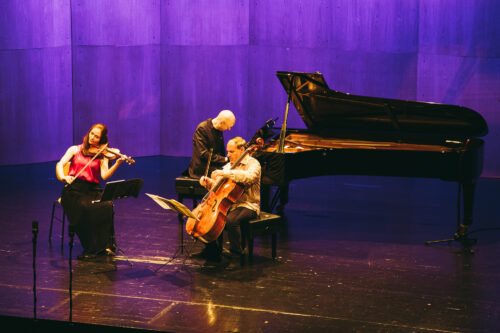
The concert concluded with Beethoven’s ‘Ghost’ Trio No.1 – its nickname a reminder of the Largo assai ed espressivo at its center, where music seems to haunt its own silences. From the outset, Hoffman, Neudauer and Pinto-Ribeiro established a taut ensemble and a sense of inner propulsion, their phrasing alert and their exchanges tightly woven. The Largo itself was the emotional center of the performance: played by the strings for stretches entirely sotto voce, with long, held lines suspended in a kind of whispered tension, as if the players were reluctant to let the music fully speak. Their control of dynamic stillness gave the movement its unsettling, otherworldly aura – less dramatic than haunted. The Presto finale brought full release, with brisk, buoyant energy and an undercurrent of Beethovenian fire.
As an artistic statement, the Festival’s opening concert embodied the core of what Verão Clássico has become: a place where musicians don’t just perform but model a chamber ideal – where pedagogy and artistry are inseparable and where listening is as vital as playing. And while the spotlight was thoughtfully distributed, one couldn’t help but hope for a solo moment at the festival’s twelfth edition from Filipe Pinto-Ribeiro; the artist who first imagined this gathering and continues to shape its quiet brilliance.
Laurence Vittes