 Germany Bayreuth Festival 2025 [2] – Wagner, Lohengrin: Soloists, Bayreuth Festival Chorus and Orchestra / Christian Thielemann (conductor). Bayreuther Festspielhaus, 9.8.2025. (DM-D)
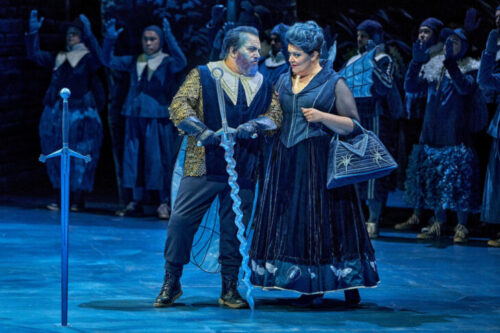
Yuval Sharon`s production was first seen in Bayreuth in 2018 and revived in 2019 and 2022. The inhabitants of Brabant wore wings of different sizes and colour shades, with at least size suggesting importance, perhaps power or privileges, in their society. When Lohengrin had been victorious in his battle against Telramund, he was given a pair of very large wings and the Brabantians were very impressed. Whether the wings suggested that the characters – in costumes reminiscent of classical paintings by Rembrandt – were indeed insects; perhaps dragonflies, to judge by the shape of some of the wings, or moths, as suggested by their attraction to light and electricity, was not clear. The Brabantians in the Hans Neuenfels Bayreuth production (first seen in 2010) were famously rats, and in a more recent production in Hagen, Germany, they were clearly birds.
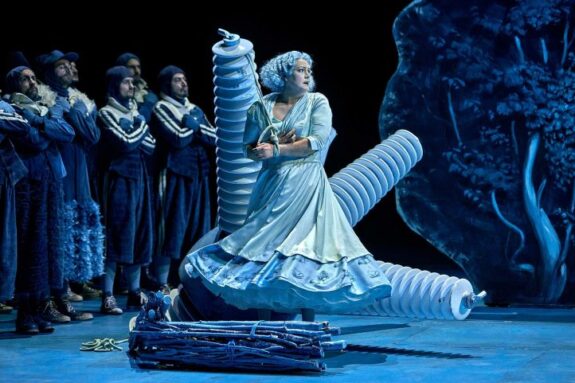
The Dutch context was developed much further by the colour scheme employed by the design team of Rosa Loy and Neo Rauch, which was inspired both by Delft porcelain and Nietzsche’s reference to Lohengrin as blue music: set, costumes, make-up and hair were given different shades of blue, as were the vast prospects of paintings providing the backdrops for the scenes. Central to the opera’s setting was what looked like a vast electrical power plant, with wires that visibly carried electric current at occasional moments, and Elsa was seen tied to large ceramic insulators. Spectators with any knowledge of British popular television could not but relate this set, as well as the brightly yellow interior of the bedroom in Act III, to the ever-popular sci-fi TV series Dr Who, in which the title character resides and travels through time and space in an old police box.
Such references, to Rembrandt, to Delft porcelain, to the power plant, to Dr Who, to dragonflies or moths, were cute; some were made use of more than others, some of that use was intriguing (for example, the question of what triggered the flow of electricity in the power station). However, they remained fleeting references that may have been intentional and for a purpose, or not. That vagueness may have been intentional in itself, in line with the vague nature of what is painted onto the vast canvasses for the backdrops, or the vagueness of what actually happens on the stage in occasionally extremely dim lighting (designed by Reinhard Traub). For the opening of Act II, we can see hardly anything, sometimes having to locate Telramund or Ortrud first by hearing where the sound of their voice emanates from.
There were interesting moments, for example, when Elsa was showered with wedding blossoms from a cordon of bridesmaids to the left and the right of the stage. The bridesmaids came to the centre to scatter the blossoms, and were immediately – and quite forcefully – yanked back into line by a corresponding man in the cordon. Elsa was brought already in chains of ropes to the court in Act I, and when she failed to answer the King’s questions, a stake was immediately built for her to be burnt. When Elsa showed signs of weakness with regard to the forbidden question in Act III, Lohengrin bound her hands with a rope, in the orange colour of the environment. When Ortrud had her moment of regaining her power towards the end of the opera, she bound the group of Brabantians, and the King, who was burnt at the stake. However, such moments remained just that – moments that stood out in a frame of vagueness, in a void.
In terms of the music, it is difficult to imagine what Wagner himself might have imagined or intended his Bayreuth to be like if not an event like this. Music poured forth from the pit in endless streams, enveloping the entire auditorium in an instant; ranging from the angelic opening of the Overture to all instruments playing fortissimo without losing cohesion and coherence – far from it, crescendos and fortissimos sounded as grand as possible. The very meticulous attention to incredible detail characteristic of Christian Thielemann’s conducting achieved both consummate fullness and complex distance side by side. That distance serves to avoid emotional indulgence or superficial moods, instead rendering the experience holistic. It is the kind of experience at the core of the philosophy behind the concept of Gesamtkunstwerk. The music in this production came closer to facilitating that experience than any other I have so far encountered in theatre and opera. In a way, the very vagueness of the production invited a shift of attention away from critical analysis which looks for meaning, and is disappointed if it does not find much that is tangible or unambiguous. It is a shift towards the holistic
Piotr Beczała had withdrawn from the performance due to illness, and Lohengrin was instead sung by Klaus Florian Vogt. He has sung the role for the past 23 years. It is striking how his musical interpretation has changed over those years as his voice developed in depth, particularly in the lower register, and strength. Just as Thielemann chisels every sound of the orchestra, Vogt sings every note with full intention for each one of ever so many nuances of its rendering. Without this becoming a merely intellectual exercise it fits in with the holistic approach to the music.
Elza van den Heever gave Elsa an interesting level of strength, determination and resilience both in her acting and her singing: her voice sounded vulnerable as needed, but also steely without ever becoming harsh. The timbre was silvery, the higher vocal range blossomed and bloomed. Miina-Liisa Värelä was appropriately impressive as Ortrud, singing her outbreaks with considerable gusto and making some shrill sounds come across as intended aspects of vocal characterisation. In this she was well matched by Olafur Sigurdarson as Telramund, who preferred a rough-edged vocal interpretation to match his character’s behaviour and intentions. Mika Kares as King Henry sounded very sonorous, at ease across registers, and his strong breath control allowed him to create long vocal arcs without interrupting them for intakes of breath. Michael Kupfer-Radecky had the vocal capacity to make the Herald a robust representative of the dominant power coming to visit Brabant. The chorus, in a new constellation of fewer chorus members than in previous years, and with Thomas Eitler-de Lint as their new director, did not have much to do by way of movement, in terms of Sharon’s production. They sang in good unison, although in more hushed passages the ‘s’ and ‘sch’ sounds came to the fore a little too much.
At the end, the audience cheered at full volume for more than 15 minutes in gratitude for a magnificent evening.
Daniel Meyer-Dinkgräfe
Featured Image: Lohengrin Act I: Elza van den Heever (Elsa von Brabant) © Bayreuther Festspiele/Enrico Nawrath
Production:
Director – Yuval Sharon
Stage design, Costumes – Neo Rauch, Rosa Loy
Lighting – Reinhard Traub
Chorus director – Thomas Eitler-de Lint
Cast:
Heinrich der Vogler – Mika Kares
Lohengrin – Klaus Florian Vogt
Elsa von Brabant – Elza van den Heever
Friedrich von Telramund – Olafur Sigurdarson
Ortrud – Miina-Liisa Värelä
The King’s Herald – Michael Kupfer-Radecky
Four Brabantine Nobles –Martin Koch, Gideon Poppe, Felix Pacher, Martin Suihkonen