
 Austria Innsbruck Festival for Early Music – Antonio Caldara, Ifigenia in Aulide: Soloists, Accademia Bizantina / Ottavio Dantone (conductor), Tiroler Landestheater, 10.8.2025. (AB)
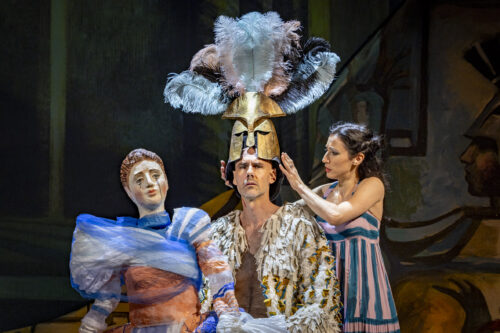
The Innsbrucker Festwochen der Alten Musik, long established as one of Europe’s leading festivals for baroque music, celebrates its 49th edition this year. The festival is known for reviving forgotten repertoire while maintaining the highest musical standards, and this year it presents a particular gift to aficionados of baroque opera: Antonio Caldara’s Ifigenia in Aulide, premiered in 1718 at the court of Emperor Charles VI and never staged again since.
Venetian-born Antonio Caldara (1670–1736) rose to become vice-court conductor in Vienna where he was a favourite of the Habsburg emperor, valued for his ability to combine contrapuntal craftsmanship with harmonic colouring – a combination that also unfolds to its full effect in Ifigenia in Aulide. Of the approximately seventy operas Caldara left behind, not all have survived and even fewer have been performed. This rediscovery in Innsbruck is therefore not merely a curiosity but welcomed by musicians and musicologists alike.
For the plot, librettist Apostolo Zeno draws on the mythological material surrounding Agamemnon, Iphigenia, Achilles, Clytemnestra and the Trojan War from the well-known version of Euripides’s tragedy, in which the Greeks are stranded on their way to Troy due to an endless calm. For the resolution, however, Zeno follows second-century author Pausanias’s version, in which it is not Iphigenia but Elisena – a newly introduced character and the secret daughter of Helen of Troy also originally named ‘Iphigenia’ – who must be sacrificed to enable for the Greeks to continue their journey. This version allows for more confusing intrigues and love entanglements typical for baroque opera, as well as a more acceptable lieto fine, which was entirely appropriate for the opera’s Viennese premiere as part of the imperial name day celebrations for emperor Charles IV on 4 November 1718.
Despite the happy ending on stage, the opera’s performance in Innsbruck in 2025 opera demands a lot from the audience: the evening lasts over four hours, including an interval. The extended and disproportionately frequent secco recitatives in particular require concentration – and, unfortunately, quickly become tiresome without scenic condensation.
This is primarily a problem with the staging: The two Spanish directors Anna Fernández and Santi Arnal – known primarily for their work with puppets as Companyia Per Poc – have decided to equip the three main female characters, Iphigenia, her mother Clytemnestra and Elisena, with life-size puppets, which are operated by the singers. The idea is not silly in itself: in the opera the three women are subject to the intrigues and interest of the men – particularly Agammemnon and Achilles – and so their puppet-like quality could stand for them being objectified.
Unfortunately, however, this potentially interesting concept – if it was intended at all – remains stuck in its tracks. Since the puppets, with their rigid expressions, do not move on their own but act simultaneously with the singers, physical gestures and facial expressions in the actual singers’ faces cannot be discerned – the puppets are simply in the way. Especially in a production in which the singers are directed to stand or sit and interact very little when singing, the effect is more distancing than illuminating.
Likewise, Alexandra Semenova’s stage design is visually impressive only at first glance: painted panoramas of Arcadia, the sea and landscapes of ruins change on and off, framed like Baroque panel paintings. But here, too, everything is at a standstill: the overall set remains virtually unchanged for over four hours. What initially appears to be clever framing quickly reveals itself to be monotonous repetition – the stage tells us nothing.
Stereotypical costumes further this impression: the women are clothed in loose robes, the men in jackets, short trousers, high helmets and bare-chested – more reminiscent of stylised silhouettes than psychologically developed characters. The clear separation of gender roles through the costumes may have been intended to underline the general concept, but it much more emphasises its one-dimensionality.
What the production lacks in dynamism is more than made up for by the music making and singing. Ottavio Dantone guides his Accademia Bizantina through the rich and fantastic score with a mixture of analytical clarity and theatrical drive so much missed on the stage. Dantone knows when to tighten the musical flow – especially in the long recitatives – and when to give the everchanging colours and sounds of the orchestral layers space. Caldara offers him ample opportunity to do so from the beginning: the opening trumpet solo, a tribute to Emperor Charles VI, are of magnificent nobility.
The numerous arias – astonishingly short but expressively precise – cover a broad spectrum of stylistic and tonal registers, showcasing Caldara’s compositional mastery, including a robust fugato aria which also demonstrates his contrapuntal skills.
Adding to that, a remarkable ensemble of excellent, young singers masters the challenges of the dry and unforgiving acoustics of the Tyrolean Landestheater astonishingly well. Above all Marie Lys is very convincing as Iphigenia with her luminous soprano and clear legato. Her aria before her supposed sacrifice is one of the vocal highlights of the evening – controlled, touching, without pathos. Carlo Vistoli as Achilles brings not only technical brilliance but also dramatic force to the role with his intense countertenor voice, particularly during the furious plea against the cruel sacrifice of his betrothed. Neima Fischer, particularly disadvantaged scenically by having to handle her puppet doppelgänger, nonetheless produced warm, graceful and moving vocal lines to render a moving portrait of Elisena, who commits suicide in the end and thus lifts the curse from the Greeks.
Shakèd Bar gives Clytemnestra emotional power – a mezzo-soprano with bite and depth, especially when she tries to save the life of her daughter in the confrontations with Agamemnon. The latter, portrayed by Martin Vanberg, possess the necessary vocal authority, even if his lower register is somewhat grainy. Laurence Kilsby was brilliant and almost cheeky as Ulisse, setting fine rhetorical accents with his tenor voice, trained in England since his days as a chorister – cleverly guided, lucid and expressive.
To sum up: a more considered handling of the dramatic potential and carefully introduced cuts could do wonders to this opera and assure that is not taking another 300 years before it reappears on stage.
Andreas Bücker
Featured Image: Ifigenia in Aulide at the Innsbrucker Festwochen der Alten Music © Birgit Gufler
Production:
Direction, Conception, Costumes – Anna Fernández & Santi Arnal (Companyia Per Poc)
Set designs – Alexandra Semenova
Choreography – Cesc Gelabert
Lighting – Noxfera
Cast:
Ifigenia – Marie Lys
Agamemnnone – Martin Vanberg
Clitennestra – Shakèd Bar
Achille – Carlo Vistoli
Elisena – Neima Fischer
Ulisse – Laurence Kilsby
Teucro – Filippo Mineccia
Arcade – Giacomo Nanni
Puppeteers – Ivan Terpigorev, Berta Marti