
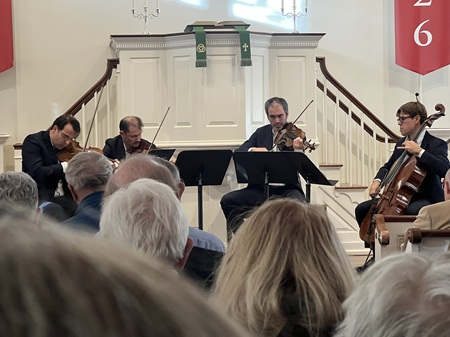
 United States Various: Modigliani Quartet (Amaury Coeytaux, Loïc Rio [violins], Laurent Marfaing [viola], François Kieffer [cello]). Wilton Congregational Church, Wilton, Connecticut, 18.10.2026. (ES-S)
Kurtág – Hommage à András Mihály; 12 Microludes, Op.13
Debussy – String Quartet in G minor, Op.10
R. Schumann – String Quartet in A major, Op.41, No.3
On a sunny afternoon, the historic Wilton Congregational Church in Connecticut welcomed the Paris-based Modigliani Quartet for the opening of the 79th season of Wilton Candlelight Concerts. Established in 1947 by a group of local music lovers, the chamber music series has become a longstanding musical tradition in the community.
From Kurtág’s concentrated miniatures to Debussy’s shifting colors and Robert Schumann’s Romantic lyricism, the Modiglianis traced more than a century of music in reverse. What unified this program of contrasts, as suggested by the quartet’s interpretations, was the imaginative use of brief musical motifs, engaging the listener’s working memory through Kurtág’s fleeting gestures and the more elaborate thematic development of Debussy and Schumann.
The members of the Quatuor Modigliani studied with the Hungarian composer György Kurtág in 2004, establishing a personal connection with the now-centenarian master. Over the past year, the ensemble has frequently performed his Hommage à András Mihály, a cycle of twelve microludes that compress an extraordinary range of expression into a handful of notes. In their most recent rendition, they revealed the subtle structure beneath the music’s fragmented, Webernian surfaces: each aphorism centers on a different pitch, the sequence of tonal centers ascending by semitones through all twelve notes of the chromatic scale. The quartet shifted deftly between delicate harmonics and abrasive sonorities, navigating abrupt changes in texture and dynamics without losing the music’s unsettling atmosphere. The caesurae between the miniatures seemed to resonate as powerfully as the notes themselves, turning silence into an essential part of the musical discourse.
In Debussy’s String Quartet in G minor, the Modiglianis favored supple phrasing, giving the melodies room to breathe and changes of color to emerge naturally. In the Animé et très décidé, they varied the articulation and dynamics of recurring motifs as these passed between instruments, revealing new expressive possibilities with each return. Even in the animated scherzo, the individual lines remained clearly audible, the players maintaining a lightness of touch amid the intricate exchanges. The Andantino was particularly compelling, its gently inflected melodies and occasional glissandi creating an intimate, almost vocal quality. The soundscape of Pelléas et Mélisande, which Debussy began sketching in 1893, the year he completed the quartet, seemed already to insinuate itself into the earlier work. Elusive harmonies, shifting textures and melodic gestures appeared, only to fade before fully taking shape. At moments, François Kieffer’s low, speech-like cello lines, with their hesitant rises and falls, appeared to foreshadow Golaud’s questioning vocal lines in the opera.
In Robert Schumann’s String Quartet Op.41, No.3, the Modigliani Quartet brought urgency and dramatic intensity to the opening movement, avoiding the perception of longueurs during its extended thematic development. In the unconventional Assai agitato second movement, the players highlighted the successive transfigurations of a brief, syncopated theme through shifts in articulation, texture and rhythmic emphasis. At the same time, its underlying nervous tension remained palpable even in the more restrained passages. In the hymn-like Adagio molto, an insistent, clock-like ostinato in Loïc Rio’s second violin, initially built around a minor third, introduced a sense of unease beneath the tender melody. The finale opened with the same dotted rhythm, now transformed into a forceful gesture. The ensemble gave Schumann’s dense textures a full-bodied sonority, maintaining a sense of forward motion through the closing measures.
Edward Sava-Segal