 Germany Verdi, Otello: Soloists, Chorus and Children’s chorus of Theater Krefeld Mönchengladbach. Niederrheinische Sinfoniker / Mihkel Kütson (conductor). Theater Krefeld, 16.10.2026. (DM-D)
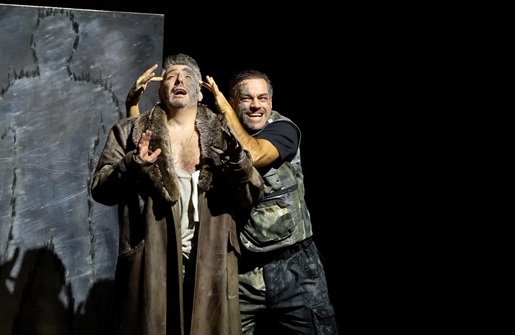
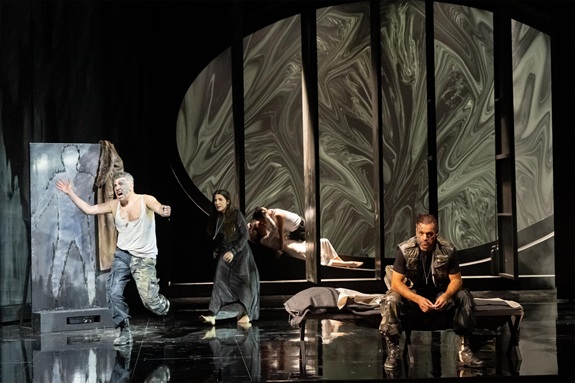
In this production of Otello at Theater Krefeld Mönchengladbach, director Roman Hovenbitzer presented yet another version of Otello as a traumatised war veteran. The events of the opera happened predominantly in his mind, and at times he realised this and beat his head with his fists to force the hallucinations to disappear. The only thing that remained irrevocably real was Desdemona’s death at his own hands. However, even the details of Otello’s own death became the object of his disturbed mental state: Jago, who, in Otello’s visions, was the manipulator of all events, gave him a glass with water in which he had previously dissolved poison. Jago as the visible key to all events and their observer – this was the most striking aspect of the production. Jago snapped his fingers and the walls of the set moved to signal scene changes. He snapped his fingers and the fanfares announcing the arrival of the envoys from Venice sounded. He arranged Desdemona’s wedding gown on the floor after Emilia had placed it on Desdemona’s bed. He observed the events in Desdemona’s chamber, the ‘Willow Song’, and forced Emilia to leave, unseen by Desdemona, before her ‘Ave Maria’. This aspect of Jago observing and steering the events was developed in considerable and always consistent and cogent detail.
Alfred Peter had created a set that cleverly supported this directorial approach. The walls to the side of the stage and at the back were grey metal sheets, which shifted in different ways and at different angles in relation to each other, thus creating different spaces of outer environment and inner grounds, all parts and expressions of Otello’s mind afflicted by the impact of post-traumatic stress syndrome. An oval shape at the very back was used in several key moments as projection screen of video by Peter Issig, showing Jago’s eyes, but mainly the details of the iris and pupil of one eye, observing and watching the events it saw. Susanne Hubrich’s costumes were variations on historically and geographically unspecified military uniforms, again with Otello wearing a dirty, blood-stained vest under his heavy leather coat (the coat was later ceremoniously bestowed on Cassio when he took over command from Otello).
General music director Mikhel Kütson put much drive into the score, conducting with great precision, emphasising emotional abandon within the framework set by the acoustic givens of the venue and the singers’ individual needs. Visiting tenor Mickael Spadaccini was very convincing as Otello. He presented the mentally imbalanced character with many meaningful nuances, both through his acting and vocally. His voice shifted at will between burnished (in the moments in which his mind was not overshadowed by an episode of malfunction, as in the love duet with Desdemona in Act I) and rough and gravelly, while still pitch perfect, for times of mental disturbance. Luka Brajnik was a member of the Opera Studio Niederrhein, based at Theater Krefeld Mönchengladbach, from 2019-2022, returning to the role of Jago as a visiting artist. His debut in that role took place in January 2025 at the Slovene National Theatre in Maribor. His voice struck me as particularly strong, sounding voluminous even when he was singing piano passages, and easily able to ride the orchestra when they played at full throttle. The nature of Brajnik’s voice and its volume reminded me of Andreas Schager: critics admire the sheer volume at which Schager loves to produce his sounds. Schager has learnt, or, as some suggest, is still learning to sing less loudly, and I am confident Brajnik will develop his voice in that way, too. Absolutely nothing whatsoever about his acting or singing deserved the boos he received on his solo curtain calls.
The remaining roles of the opera were sung by resident members of the company and the opera studio. Sofia Poulopoulou was wonderful as Desdemona. She played her as a confident young woman very much in awe of and in love with Otello; she pleaded for Cassio because he was of her own age and generation, and she just happened to like him, but not in any way that would have justified Otello’s jealousy. Her voice is developing a very rich lower register, both in its own right and as the foundation for an even fuller bloom into the top register. She was able to express her emotions very movingly both in her acting and through her voice. The ‘Willow Song’ and ‘Ave Maria’ have rarely moved me as much. Having to sing her high A-flat lying down full length on her side on the floor must have presented an additional physical challenge, so the exquisite rendering of that note was particularly striking.
Eva Maria Günschmann sang Emilia with conviction. Woongyi Lee’s light and bright tenor as Cassio was appropriately very different from that of Spadaccini. Ramon Mundin (a member of the opera studio) as Roderigo made you want to hear more of his voice, Matthias Wippich and Rafael Bruck as Lodovico and Montano were noble in vocal and physical demeanour.
Daniel Meyer-Dinkgräfe
Featured Image: Mickael Spadaccini (Otello), Sofia Poulopoulou (Desdemona), and Luka Brajnik (Jago) © Matthias Stutte
Production:
Director – Roman Hovenbitzer
Stage design – Alfred Peter
Costume design – Susanne Hubrich
Lighting design – Hermenegild Fietz
Video – Peter Issig
Chorus director – Michael Preiser
Dramaturgy – Andreas Wendholz, Ulrike Aistleitner
Cast:
Otello – Mickael Spadaccini
Desdemona – Sofia Poulopoulou
Jago – Luka Brajnik
Cassio – Woongyi Lee
Emilia – Eva Maria Günschmann
Roderigo – Ramon Mundin
Lodovico – Matthias Wippich
Montano – Rafael Bruck