 Germany Wagner, Die Meistersinger von Nϋrnberg: Soloists, Chorus and Orchestra of Deutsche Oper am Rhein / Christoph Gedschold (conductor). Deutsche Oper am Rhein, Düsseldorf, 17.10.2026. (DM-D)
This was the first new production of Die Meistersinger von Nürnberg at Deutsche Oper am Rhein since 1983. It had been postponed initially as a result of the pandemic and further delayed by a week in the course of the opera house having to close to the public at short notice to address urgent structural issues with the building. Long-term former general music director Axel Kober was to have conducted all performances of this new production, but was unable to do so, also at relatively short notice. Wagner specialist Christoph Gedschold took over.
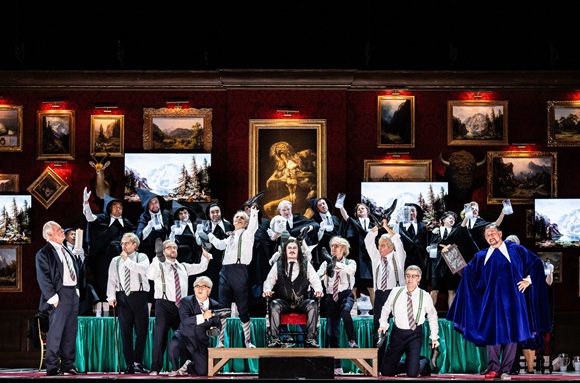
Director Daniel Kramer chose to set the opera in three distinct contexts in times of location and time, and not corresponding neatly with the three acts. The first act was set in a country-house style meeting room, with a lot of ennobling green paint on the walls, some oak or other elegant wooden panels, and a few top-range LED screens immediately indicating contemporary times rather than anything before the digital age. There were also prominent paintings on the walls, indicators of a high-level conservative, culturally aware setting. The central painting was Goya’s Saturn Devouring His Son, depicting a horrible scene, and the LED screens introduced the Mastersingers one by one with images, clearly created by AI, as if they were members of a football team. The painting and football team connotation were means of popularising those potentially aloof masters and their strange activities. Magdalena and David were just as much in love with each other, although they had known each other for longer, as Eva and Walther, who had only met recently. While Walther seemed used to being adored, adoring the man she loved was a new experience for Eva, and she relished both Walther and the feeling of being in love irrespective of her partner’s identity. Within this context, the production gently set its tone and worked as a prolonged exposition, flowing at a gentle and amiable pace.
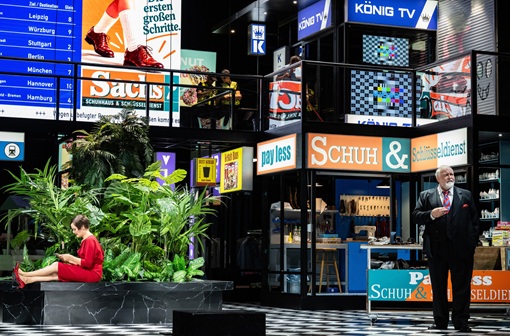
Act II was set most strikingly in the entrance area of a typical German railway station. In the centre there was a board with white letters on blue background indicating the list of trains with departure times and destinations, sometimes with in-between stops. This LED board appeared to function in real time, with indications of date and time of day, the year indicated at 2023, and frequently shifting indications of late-running or cancelled trains and special announcements at the bottom of the screen, such as delays because of trespassers on the track, train cancellations or even system shut-downs. The LED display changed occasionally from being a train departure board to advertising the opera, blatantly and wittily tongue-in-cheek: a monumental film was announced, Wotan’s Return. Another screen advertised Pogner’s Bank, or König TV (an insider joke on Hans-Peter König singing Pogner) or announced the Johannisfest activities.
This train station hall was created on two levels, with a wedding outfit studio as the main other feature at the top besides the LED board. On the ground floor we had a branch of Pogner’s Bank, complete with cash machine used at some point by two Muslim women who gave some of the money they had just withdrawn to Beckmesser singing for Eva, whom they mistook for a busker. There was also a branch of a nameless shoe/key cutting shop advertising cheap services, owned by Hans Sachs. In the middle of the stage a little further back was a large patch of greenery with seating on the edges. To Eva’s delight, at some point Walther tore at the foliage to support his aggressive lines against the state of contemporary society, while Walther and Eva, and at times Magdalena, hid nearby awaiting the Sachs/Beckmesser scene. A homeless person slept near the bank; whenever anything potentially edible was left around he was quick to snatch it.
Towards the end of Act II, a group of people, including children, crowded in the train station hall with many rugged suitcases and bags, their clothing suggesting migrants or refugees. They were harassed and beaten up by a group of hooded people – we were unable to see who they were. Police later arrived and disbanded the attackers. They turned to the homeless man and their body language suggested that he had not survived the particularly vicious and prolonged attack.
The first scene of Act III turned the exterior of Act II towards the interior of Sachs’s shop. The migrants were still around, sleeping on makeshift blankets. Sachs had taken them in out of compassion an act reminiscent of Germany accepting large numbers of refugees particularly from 2015 onwards. On one occasion, Sachs gave a few coins to a refugee child so it could take a ride on a toy plane in the train station hall.
For the final scene of the opera in Act III on the festival meadow, a large single projection told us that we were now witnessing the festivities in the year 2035. The curtain on that scene then opened to reveal the chorus as a group of junior rank military officers with spotless uniforms and incredibly synchronized military movements. The Mastersingers were no longer footballers, but senior ranking military men, with Pogner and Sachs as generals. A large LED screen introduced them one by one with name and rank. Eva was overjoyed when Walther did not want to be a Master. She and Walther, dressed in white and thus in stark contrast to the green uniforms surrounding them, left the event hurriedly and with determination. Sachs was very serious in his final plea for arts and culture and the status quo represented in political terms by the flags of Germany, the EU and NATO. Afterwards he lay down on the podium and remained motionless (had he died?). A group of soldiers in a different set of uniforms suddenly swarmed in, killed all the unprepared officers on the stage and knocked over the flags.
Kramer’s production was cogent and consistent within its well-defined and well-executed contexts and contents. It is this coherence that allows, with hindsight, to present all the details from memory with considerable ease. Some spectators at the opening night booed the production team at the curtain call. I dislike booing anyway and, on this occasion, certainly did not agree with them.
It had been announced that Martin Gantner as Hans Sachs was recovering from a cold. I did not hear any such shortcomings. His voice sounded clear and robust throughout, on the brighter side rather than dark in terms of timbre, and with obvious emphasis on the two monologues and the final scene. Christoph Pohl stood out as Beckmesser, able to express the many facets of this complex character both through his acting and his singing. In neither did he need to exaggerate to present this deeply sad individual, who knows about all of his shortcomings but is, when faced with specific situations, just not able to step out of his comfort zone and break with patterns of thinking and behaviour he clearly knows are at best problematic and often simply wrong. Düsseldorf resident company stalwart Hans-Peter König sang a very dignified Pogner, relishing the long arcs of his music. Daniel Frank sang Walther. His voice was neither very big nor particularly baritonal, but the timbre was very pleasant, albeit a little nasal at times. He rose very well and with ease to the challenges of shifting back and forth between more lyrical and more dramatic material and made the Prize Song a fitting climax. David Fischer sang David with a fresh, bright and very lyrical tenor. Anke Krabbe’s lyrically sung Eva was another highlight of the evening. The voice sounded very young and fresh, and Krabbe was able to modulate her voice as needed in terms of register and volume, easily taking the lead in the quintet. Anna Harvey sang Magdalena with particular strength and foundation in her lower register. As a result, her voice was well differentiated from that of Krabbe.
It took a while for the orchestra and their conductor, Christoph Gedschold, to find common ground. Once it was reached, the music was exuberant for the comic passages and heavily emotional for Sachs’s general reflections on life. Altogether a thought-provoking event on a high level of musical achievement.
Daniel Meyer-Dinkgräfe
Featured Image: Deutsche Oper am Rhein’s Act I Die Meistersinger von Nϋrnberg © Sandra Then
Production:
Director – Daniel Kramer
Concept collaboration – Stephan Müller
Set design – Elizabeth Clachan
Costume design – Heide Kastler
Video – Chris Kondel
Lighting design – Elana Siberski
Chorus director – Albert Horne
Dramaturgy – Juliane Schunke
Live Video Operator – Chantal Bergemann
Cast:
Hans Sachs – Martin Gantner
Veit Pogner – Hans-Peter König
Sixtus Beckmesser – Christoph Pohl
Walther von Stolzing – Daniel Frank
David – David Fischer
Eva – Anke Krabbe
Magdalene – Anna Harvey
Kunz Vogelgesang – Andrès Sulbarán
Konrad Nachtigall – Jake Muffett
Fritz Kothner – Bogdan Baciu
Balthasar Zorn – Tae-Hwan Yun
Ulrich Eisslinger – Florian Simson
Augustin Moser – Henry Ross
Hermann Ortel – Rolf A. Scheider
Hans Schwarz – Valentin Ruckebier
Hans Foltz – Torben Jürgens
Night Watchman – Beniamin Pop