 United States Various: Ben Bliss (tenor), Christopher Allen (piano). Cal Performances, Hertz Hall, University of California Berkeley, 18.10.2026. (HS)
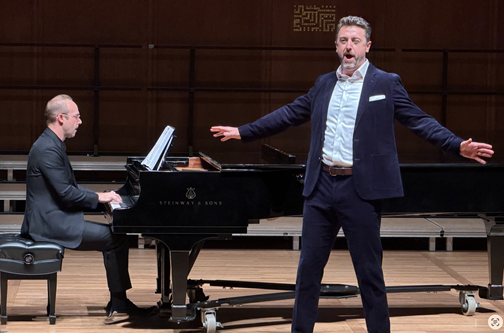
Ben Bliss is blessed with a lyric tenor that can find its way through all sorts of music. His specialty may be Mozart operas, but his stage presence and natural poise make all his opera characters believable, whether it’s Don Ottavio in Don Giovanni or Tom Rakewell in The Rake’s Progress.
His recital with the formidable conductor Christopher Allen as pianist took a very different road in Berkeley, the final stop on a coast-to-coast tour. To celebrate the 250th anniversary of the Declaration of Independence, Bliss found a very personal way to build a recital of American vocal music. Instead of familiar songs, ‘I decided to explore nooks and crannies of the repertoire, diverse from the primrose path’, he told the audience.
Part American songbook, part pop songs and part classical composers’ quirkier options, he held together the first half with casual banter about his own path overcoming nervousness and other impediments. He began with Stephen Sondheim’s ‘I’m Calm’ from A Funny Thing Happened on the Way to the Forum and ‘Everybody Says Don’t’ from Anyone Can Whistle. Closing the first half was ‘I’m Gonna Live Till I Die’, a Tin Pan Alley favorite made popular by Frank Sinatra.
The songs of the second half explored the life of a freelance traveling solo musician (which, technically, he was on this tour). That arc started with Kurt Weill and Langston Hughes’s ‘Lonely House’ and finished with Harold Arlen and Johnny Mercer’s ‘One for My Baby’.
Many of the songs are best suited for Broadway belters, pop crooners or jazz artists, and the tenor toned down his operatic squillo for a more conversational style. When it worked it was a treat to hearing the music from an artist who can phrase words and melodies with equal acumen, combined with a pianist willing to take the byways as enthusiastically. Some songs, however, did not find a comfortable style.
Bliss showed a perfect match for Sondheim in the two songs in the first half, with a conversational quality to the words and singular turns in the music. A set of true art songs began with dutiful performances of Charles Ives and Lowell Liebermann, but the real find came with two works by John Gruen (who later became a music critic) that had fun with e.e. cummings poems. Although the songs were never published, Bliss read about them and tracked them down, thanks to Gruen’s daughter. They deserve the exposure.
Less comfortable was the tenor’s handling of two pop classics that followed. Nice as it was to hear Paul Simon’s ‘Bridge Over Troubled Water’ voiced so clearly, Bliss’s extra emphases never quite caught the song’s serene simplicity. Bliss also fell short of the blues inflections in Ray Charles’s famously soulful arrangement of ‘America the Beautiful’. Pianist Allen never quite got the rhythm right either.
On the other hand, ‘Lonely House’ (with its jazz overtones) fit Bliss and Allen ideally as the second-half opener. The singer crooned Weill’s tune with softness and longing. ‘Nocturne’, Samuel Barber’s lovely art song, benefitted from similar polish and restraint as did Leonard Bernstein’s wistful ‘Some Other Time’ with lyrics by Betty Comden and Adolph Green. ‘One for My Baby’, a longtime favorite of jazz singers, created a relaxed, tender soulfulness in a song describing the loneliness of a bar at ‘quarter to three…and no one in the place except you and me’.
The program’s finale stumbled into weirdness with ‘Wichita Vortex Sutra’, an oddball mix by Beat Generation poet Allen Ginsberg and minimalist composer Philip Glass. (That Wichita is in his home state of Kansas apparently was enough to stand in for going home, even if Ginsberg’s poetry was typically ripe with allusions and references to whatever came to his mind.) The words were spoken, delivered as a good actor might, underscored by Glass’s music in a style reminiscent of his film scores. As Bliss noted, ‘It’s not a song but I did use my voice’.
A reprise of ‘Live Until I Die’ did lift spirits.
In the encore, Liszt’s ‘Pace non trovo’, Bliss unleashed a truly invigorating operatic tenor. If he meant to convince skeptical audience members that he can sing music that he described as ‘a little more tuxedo’, that was not necessary. For me, another Sondheim song could have done that just as well and fit more snugly.
Harvey Steiman
Sondheim – ‘I’m Calm’ from A Funny Thing Happened on the Way to the Forum; ‘Everybody Says Don’t’ from Anyone Can Whistle; ‘Being Alive’ from Company
DePaul/Mercer – ‘The What-Cha-Ma-Call-It’
Ives – ‘The Things Our Fathers Loved (and the greatest of these was Liberty)’
Liebermann/Longfellow – ‘The Arrow and the Song’
Gruen/cummings – ‘Spring is like a perhaps hand’; ‘Lady will you come with me into’
Simon – ‘Bridge over Troubled Water’
Ward/Bates, arr. Ray Charles – ‘America the Beautiful’
Fain/Yellen – ‘Are You Having Any Fun?’ from George White’s Scandals of 1939
Kent/Hoffman/Curtis – ‘I’m Gonna Live Till I Die’
Weill/Hughes – ‘Lonely House’ from Street Scene
Rodgers/Hart – ‘Where or When’ from Babes in Arms
Barber/Prokosch – Nocturne No.4, Op.13
McHugh/Loesser – ‘Say It (Over and Over Again)’ from Buck Benny Rides Again
Styne/Comden & Green – ‘Just in Time’ from Bells Are Ringing
Bernstein/Comden & Green – ‘Some Other Time’ from On the Town
Coward – ‘Let’s Say Good-bye’ from Words and Music
Arlen/Mercer – ‘One for My Baby (and One More for the Road)’ from The Sky’s the Limit
Glass/Ginsberg – ‘Wichita Vortex Sutra’
Encore: Liszt – ‘Pace non trovo’