 Poland Maxim Kolomiiets, The Mothers of Kherson: Soloists, Artos Children’s Choir, Chorus and Orchestra of the Polish National Opera / Keri-Lynn Wilson (conductor). Teatr Wielki – Polish National Opera, Warsaw, 16.10.2026. (RP)
Seldom, if ever, do geopolitics and opera converge as searingly as at the world premiere of Maxim Kolomiiets’ The Mothers of Kherson at Teatr Wielki – Polish National Opera. The opera recounts one of the most harrowing episodes of Russia’s war against Ukraine. Its premiere came in a week when searing images of the devastation wrought by Russian ballistic missiles and attack drones flooded the news, even as continued US support for Kyiv was once again called into question.
The opera was inspired by the thousands of Ukrainian children transferred to Russia or Russian-occupied territory since the full-scale invasion began in 2022. By October 2026, fewer than 2,700 had been returned, while many others remained separated from their families. Vladimir Putin and Maria Lvova-Belova, Russia’s commissioner for children’s rights, are the subjects of International Criminal Court arrest warrants alleging their responsibility for the unlawful deportation and transfer of Ukrainian children.
George Brant, whose one-woman play Grounded was transformed into Jeanine Tesori’s full-scale opera for the Met, crafted a lucid, piercing, English-language libretto inspired by real events. Its fictionalized characters embody the experiences of mothers whose children were taken to a summer camp in Russian-occupied Crimea under false assurances.
Kateryna has a gut feeling that something is wrong but trusts a teacher’s assurances that the camp will offer the children a welcome reprieve. She agrees to send her daughter, Lilia, as does her friend Dasha, whose daughter, Ołena, also goes. Mother-daughter tensions complicate Kateryna’s decision, which is driven in part by fears for Lilia’s safety in a city where Russian soldiers are stationed on every street corner. When Kateryna gives permission, Lilia opens a Telegram livestream to announce the news. Kateryna is baffled by the technology which, Lilia explains, can broadcast around the world. She dismisses her mother as out of touch, a judgment that later events will prove mistaken.
When Lilia’s stay at the camp is extended, along with that of Inna, who is being raised by her grandmother, Olha, Kateryna’s suspicions deepen. She spots the teacher, Tetyana Borysowa, boarding a train to Moscow and fears the girls will not return. Meanwhile, with Kherson once again under Ukrainian control, Kateryna’s husband, Vitaly, returns to see his daughter. When he learns Lilia is in Crimea, he bluntly declares that she is never coming back.
As international attention focuses on the children, Lvova-Belova denies wrongdoing and promises that parents can collect them if they appear in person. Kateryna, Dasha and Olha decide to take her at her word. With help from a foundation that assists parents in rescuing their children, they prepare to travel to Russia, assembling the documents demanded by Russian authorities. Even a minor error could jeopardize their mission.
Meanwhile, at Camp Friendship, the children face indoctrination and the prospect of being sent to Russia for adoption. They resist attempts to reshape their identities and endure sexual advances from male counselors. One of the boys, Kostya, has become a poster child for the Russian scheme. Indoctrinated into believing that his parents lied about their Nazi past, he is slated for adoption by one of Moscow’s wealthiest men.
The mothers’ nearly 3,000-mile journey takes them through Poland and Russian-friendly Belarus to Moscow, followed by a four-day drive to the camp. Their bus driver is a crusty, worldly-wise man in his seventies who has spent his life fighting Russians. He is as adept at greasing the palm of a Belarusian border guard as he is at charming and cajoling those he encounters. Ever the optimist, he insists that the empty seats on the bus are reserved for the children who will return with the women.
At the camp, Lilia, Ołena and Inna are told they will be going to wonderful foster parents – strict disciplinarians who will not tolerate their nonsense. Worse, the girls will be sent to live far apart. When the mothers arrive and demand their children, the principal dismisses their meticulously prepared paperwork as too perfect for peasants to have assembled on their own. In desperation, Kateryna pulls out her phone and opens Telegram, broadcasting a demand that the principal return Lilia or expose Lvova-Belova’s promise as a lie.
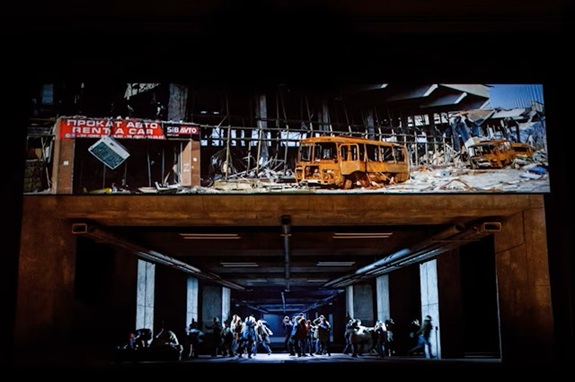
Barbara Wysocka opts for stark realism in the production’s visual elements. Apartments, factory floors and the bunk beds at Camp Friendship are sparsely detailed but all the more powerful for their simplicity. The basement where people shelter from missile attacks is rendered so convincingly that it brought tears to the eyes of Slovak journalist Sara Cincurova, seated beside me. She has reported from Ukraine throughout the war and experienced such conditions firsthand.
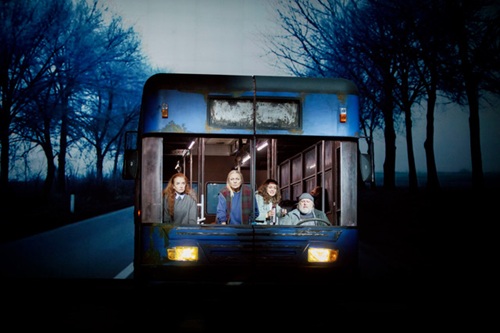
Video projections establish the setting, showing bombed-out buildings in Kherson and the countryside the women traverse. Their blue bus revolves and opens like a book, revealing the women clutching their children’s puffer jackets. The empty seats remain unfilled. Along with the scene in which the mothers search for their children in a large hall at the camp, this image is among the production’s most telling. Wysocka finds theatrical images that convey the mother’s desperation without resorting to melodrama.
The Met’s General Manager Peter Gelb is on record declaring that this was a project that had to succeed. Of the 74 composers who applied, Ukrainian composer Maxim Kolomiiets was chosen for his potential, his ability to write modernist music accessible to a broad audience and his stylistic flexibility.
Kolomiiets sought a musical language that would speak directly to the women whose experiences inspired the opera. That ambition was tested when a concert version, translated into Ukrainian, was performed at the National Opera of Ukraine in Kyiv on 4 June 2026, Ukraine’s Day of Remembrance for Children Killed as a Result of Russian Aggression. In the audience were mothers and children who had experienced the abductions, including Yulia Radzevilova, one of the mothers whose story inspired the opera, and her son Maxim.
Folkloric elements are evident from the outset. After a turbulent, brooding introduction, Kateryna sings a quiet lullaby to her daughter, awakened by the sounds of tanks, rifle shots and screams. The lullaby recurs throughout the opera, returning at its conclusion. Another source of poignancy is the bandura, a traditional Ukrainian plucked-string instrument whose resonant sound lends the score a distinctly Ukrainian character.
Kolomiiets’s setting of Brant’s libretto is natural and effective, as is his orchestral writing. Vivid orchestral colors convey the horrors of war while giving voice to its more human elements, such as Olha’s musings over the fate of the Russian soldier. Lvova-Belova delivers her speech against a riot of sounds that underscores the absurdity of her remarks.
The mothers seemed to step straight out of Greek myth. Izabela Matuła’s Kateryna possessed the nobility and vulnerability of Andromache and Hecuba, who endured profound suffering during the Trojan War. Matuła’s voice was a magnificent column of sound, roaring when she confronted the men who thwarted her. She was most vulnerable in her dealings with her daughter Lilia, portrayed by Hanna Sosnowska-Bill, who deftly captured a teenager’s emotional U-turns.
Kamila Dutkowska was an equally noble Dasha, her soprano blazing with conviction. For Dasha, defeat was an obstacle to overcome not a reason to throw in the towel. Weronika Wojtkowska’s Ołena was less fiery than Sosnowska-Bill’s Lilia but equally compelling. Their scene comforting Marcelina Chmurska’s much younger Inna was a study in affection and compassion.
Although the story offers little humor, Małgorzata Walewska’s Olha and Ólafur Sigurdarson’s Bus Driver brought wryness, warmth and humanity to their roles. Olha’s simple pleasures were disrupted by a Russian guard posted outside her window. She got her wish when he was shot but would not live to see sunflowers bloom where his body fell.
The male characters were just as strongly cast although few emerged as heroes beyond Sigurdarson’s Bus Driver, Andrei Bondarenko’s Vitaly and Tomasz Rak’s Rescue Planner. Bondarenko’s firm baritone conveyed both anger and bravery during his brief time on the stage. Wojciech Parchem’s Belarusian Border Guard was particularly ruthless, demanding one woman’s wedding ring. Tomasz Madej’s Belarusian Airport Security Guard was equally cruel, preventing another woman from boarding a plane because of her sunflower and poppy tattoos and branding her a Nazi and Ukrainian nationalist.
At Camp Friendship, Adrian Domarecki’s Kostya was a repellent blend of pride, conceit and condescension toward his campmates. His gleaming tenor made the character all the more despicable. Tadeusz Szlenkier brought macho bravura and a stellar tenor to the Camp Principal, whose officious manner crumbled when he found himself caught in a vise between granting the mothers access to the children and upholding Lvova-Belova’s promise.
Children filled the stage as actors and choristers. The Artos Children’s Choir conveyed emotion through both singing and acting. In the final scene, mothers and children gathered for a reprise of the lullaby, its beauty and raw emotion cutting to the quick.
Gelb described conductor Keri-Lynn Wilson as being on the artistic front line of the war in Ukraine. As conductor of the Ukrainian Freedom Orchestra, she was instrumental in bringing The Mothers of Kherson to the stage. Wilson led a performance of conviction and authority, matched by the passion of the Polish National Opera’s Chorus and Orchestra.
The Mothers of Kherson is a political statement intended to rally support for Ukraine. In Warsaw, little persuasion was necessary, but the opera touched hearts, perhaps an even greater achievement. The Metropolitan Opera will present the opera in April 2028. The audience will be very different but the world may be as well.
Rick Perdian
Featured Image: Act I of The Mothers of Kherson © Krzysztof Bieliński
Rick Perdian’s travel and accommodations were generously provided by The Polish Cultural Institute New York.
Production:
Librettist – George Brant
Director – Barbara Wysocka
Sets – Barbara Hanicka
Costumes – Julia Kornacka
Lighting – Marc Heinz
Video – Barbara Wysocka and Artur Sienicki
Movement director – Alisa Makarenko
Dramaturgy – Paul Cremó
Chorus master – Łukasz Hermanowicz
Children’s Choir master – Danuta Chmurska
Cast:
Kateryna – Izabela Matuła
Lilia – Hanna Sosnowska-Bill
Dasha – Kamila Dutkowska
Ołena – Weronika Wojtkowska
Tetyana Borysowa – Elissa Pfaender
Olha – Małgorzata Walewska
Inna – Marcelina Chmurska
Filip – Ryszard Nowinski
Halyna – Jadwiga Postrożna
Vitaly – Andrei Bondarenko
Maria Lvova-Belova – Katarzyna Wietrzny
Deputy Commissioner for Children’s Rights – Marcel Orłowski
Rescue Planner – Tomasz Rak
Bus Driver – Ólafur Sigurdarson
Kostya – Adrian Domarecki
Camp Principal – Tadeusz Szlenkier
Counselor One – Valerii Zadorozhnyi
Counselor Two – Przemysław Cierzniewski
Belarusian Border Guard – Wojciech Parchem
Belarusian Airport Security Guard – Tomasz Madej
Russian Border Guard – Rafał Żurek
Camp Guard – Paweł Trojak