
 Poland Gounod, Roméo et Juliette: Soloists, Chorus and Orchestra of the Polish National Opera / Sébastien Rouland (conductor). Teatr Wielki – Polish National Opera, Warsaw, 17.10.2026. (RP)
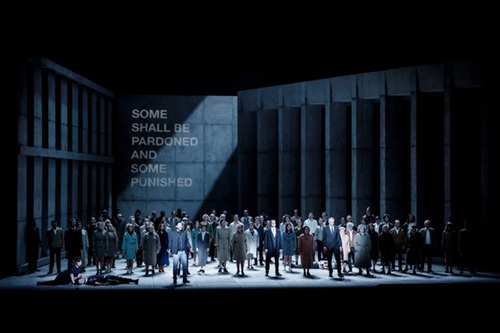
Barbara Wysocka’s production of Gounod’s Roméo et Juliette, first staged at Warsaw’s Teatr Wielki on 13 June 2026, originated at Dresden’s Semperoper where it premiered in 2025. This revival in Warsaw featured an exciting cast, led by Gabriela Legun’s radiant Juliette.
Gounod and his librettists, Jules Barbier and Michel Carré, streamlined Shakespeare’s plot, reducing the number of secondary characters and concentrating on the lovers’ relationship. Most significantly, Juliette awakens before Romeo dies, allowing the two to sing a final duet before she takes her own life. The opera omits Shakespeare’s concluding reconciliation between the feuding families.
Reimagined productions of the opera have traded Renaissance Verona for a contemporary world of drugs, violence and urban alienation: switchblades replace swords, drug-fueled rock parties supplant balls, and Romeo takes his life with a hypodermic needle. A somewhat tamer approach recasts the feuding families as rival haute couture houses, with Juliet as a teenage model, a fashion-show ball, paparazzi on the prowl, golf clubs in place of swords and poison served in a martini glass.
By those standards, Wysocka’s approach is conventional and succeeds on its own terms, without undue harm to Shakespeare or Gounod. The Fascist-era architecture appears to evoke Italy under Mussolini, while the costumes suggest a more contemporary setting. Although the production makes no overt reference to today’s politics, projected excerpts from Shakespeare’s play reinforce the impression that the star-crossed lovers seek human connection in a brutal society where love and intimacy are rare.
Polish soprano Gabriela Legun has rapidly established an international career, appearing at the Polish National Opera in Warsaw, Berlin’s Komische Oper, Teatro Regio di Torino and La Monnaie in Brussels since her professional debut as Cunegonde in Bernstein’s Candide at the Baltic Opera in Gdańsk. As Juliette, Legun embodied youthful innocence, her luscious lyric soprano as alluring as her stage presence. She was particularly impressive in ‘Je veux vivre’ which showcased her vocal bravura, especially her expressive coloratura and full-bodied high notes.
Piotr Buszewski is building an international career with appearances at major opera houses in New York, London, Dresden and Zurich. He has the makings of a fine Romeo but the role remains a work in progress. The tenor has the vocal goods and the looks, making the unevenness of his portrayal something of a mystery. He was convincing in the Act I finale but less persuasive in the love duet and in ‘Ah! lève-toi, soleil!’ in Act II, where he struggled to convey Romeo’s ardor.
In the love scenes, Buszewski sang beautifully, with elegant phrasing and sensitive dynamic shading. What was missing was a bit of oomph. When roused to anger, however, he found his fire and his voice blazed thrillingly. That intensity carried into the final duet where he and Legun conveyed the lovers’ ecstasy in singing that united Gounod’s soaring lyricism with dramatic urgency before giving way to the anguish of their impending deaths.
Baritone Paweł Trojak made an immediate impact as Mercutio, Romeo’s irrepressible and combative friend whose death turns the love story into a tragedy of vengeance. Tenor Mateusz Zajdel’s Tybalt was cool, calculating and lethal. The fight scenes among the three principal protagonists were electrifying.
Seray Pınar’s quicksilver wit and sparkling voice made her Stéphano a delight. With its stark, massive sets, Wysocka’s production feels earthbound. Pınar’s Stéphano and Legun’s Juliette sent it heavenward.
Rafał Siwek’s impressive dramatic bass lent authority to Frère Laurence, whose compassion and concern could not halt the downward spiral of violence. As Gertrude, Nataliia Tepla was prim, proper and briskly efficient. Her assured presence and singing helped anchor the performance dramatically.
Conductor Sébastien Rouland, General Music Director of Saarbrücken’s Saarländisches Staatstheater since 2018, brought an assured command of Gounod’s idiom to the score. His finely honed interpretation was matched by distinguished playing from the orchestra and singing from the chorus. Together, they balanced the spell of romance with the visceral impact of the implacable feud between the Capulets and Montagues.
Rick Perdian
Production:
Director – Barbara Wysocka
Sets – Barbara Hanicka
Costumes – Julia Kornacka
Video – Barbara Wysocka
Lighting – Fabio Antoci
Chorus master – Łukasz Hermanowicz
Cast:
Roméo – Piotr Buszewski
Juliette – Gabriela Legun
Stéphano – Seray Pinar
Gertrude – Nataliia Tepla
Frère Laurence – Rafał Siwek
Capulet – Paweł Konik
Tybalt – Mateusz Zajdel
Mercutio – Paweł Trojak
Grégorio – Mateusz Kulczyński
Pâris – Adam Dobek
Benvolio – Adam Walasek
Le Duc de Vérone – Michał Romanowski