
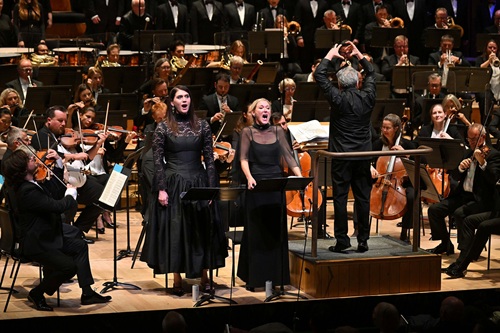
 United Kingdom Dai Fujikura, Mahler: Maria Bengtsson (soprano), Noa Beinart (contralto), London Symphony Chorus and Orchestra / Sir Antonio Pappano (conductor) Barbican Hall, London, 18.10.2026. (AV-E)
Dai Fujikura – Amber Alchemy (UK premiere)
Mahler – Symphony No.2 ‘Resurrection’
Programming can often produce its own unintended consequences; the juxtaposition of Dai Fujikura’s miniature Amber Alchemy with Mahler’s monumental Resurrection Symphony promised a provocative contrast, but the gulf between the works and their worlds proved more distracting than illuminating.
Dai Fujikura’s Amber Alchemy, commissioned by Nomura Holdings to mark the company’s centenary, takes inspiration from the beehives on the roof of Nomura’s London office. Fujikura draws a parallel between the hive’s intricate social organisation and the orchestra, with individual musical lines swarming, interweaving and clustering into a larger collective organism. The title evokes the transformation of nectar into honey, each tiny contribution supposedly combining to produce something richer than the sum of its parts.
The concept is ingenious, but in practice these bees failed to give either me or the music much of a buzz. There was plenty of industrious activity, a great deal of carefully choreographed flying-beeing-darting, yet little sweetness to show for all that labour: the musical nectar never quite set into honey. The score felt like an impeccably organised hive in which every bee knew the job, but none had discovered anything particularly delicious to make.
For all the love and care lavished on the score, Fujikura’s miniature felt quaint. The orchestral writing displayed considerable craftsmanship, with meticulously arranged sonorities and shifting instrumental colours, yet the musical language had no sting and relied on cliched postmodern parlance that seemed dated even as it unfolded. Beneath the ornate refinement lay a nagging predictability: the compositional collage accumulated textures and effects without developing the sense of inevitability that makes Mahler’s stinging scoring feel as though no other sequence of notes could have served.
Placing Amber Alchemy immediately before the Resurrection Symphony only accentuated the disparity, leaving it reduced to amber ashes before the symphony had even begun. However, the London Symphony Orchestra played Fujikura’s score with scrupulous precision and Antonio Pappano conducted it with evident care.
Mahler’s Resurrection sounded startlingly fresh, urgent, and alive in this compelling performance. The opening Allegro maestoso gained remarkable vitality, driven by cellos with a gutsy, dark-edged sonority whose restless figures established an atmosphere of unbearable anxiety. A taut, inexorable funeral march tread exploded into shattering brass and percussion. Pappano’s exemplary pacing resisted spending climaxes too early, patiently accumulating pressure and systematically building orchestral tension toward the movement’s core. Respecting the score’s architecture before the central cataclysm, the pacing avoided turning Mahler’s molto pesante instruction into empty rhetorical effects, purging the laboured mannerisms indulged in by Rattle, who failed to wait for the written ritardando, heavily dragging the tempo right from the start of the molto pesante and turning the segment into a turgid, ponderous crawl. Pappano, by contrast, delivered the crushing weight of the molto pesante at tempo, only executing the deceleration exactly where Mahler actually wrote it. Thunderous, dual-timpani triplets then drove the climax into Tempo I without sacrificing organic momentum. Ultimately, this central cataclysm was delectably devastatingly delivered, capped off and beheaded by nailing percussion.
The contrast with the movement’s expansive second subject was beautifully judged. Its lyrical warmth briefly opened a window onto another world, but the serenity remained fragile, haunted by the funeral march’s grim insistence. As the music surged towards its heights, the LSO unleashed a formidable weight of sound without sacrificing clarity or detail. After all that visceral violence, Pappano drew the movement towards its close with extraordinary eloquence, allowing the tension to ebb into hushed stillness. The returning funeral march figures lent the ending a grim inevitability, before the music finally subsided into quiet. This was the most moving account of the ending I have ever heard: the LSO strings sounded simply divine, their hushed, sustained playing radiating extraordinary tenderness. Pappano judged the final transition perfectly, allowing the last notes to settle with heartbreaking naturalness.
Pappano shaped the Andante moderato with a lilting, dance-like buoyancy, the LSO bringing an almost elfin elegance to Mahler’s gently swaying Ländler. The opening strings had an exquisite lightness of touch, their graceful phrases unfolding with unforced ease, while the cello countermelody lent the music a tender, inward glow. Pappano allowed the dance to breathe naturally, preserving its rustic charm without sacrificing its poise. Yet beneath this beguiling simplicity lay a wistfulness, as though the melody were recalling a happiness already lost. The darker central episode disturbed the idyll with restless triplet figures and a sudden surge of agitation, the music briefly shedding its innocence before the Ländler returned. Pappano judged these changes of mood beautifully, allowing the shadows to gather without overwhelming the movement’s delicate grace. The final return was especially touching: the textures took on an almost weightless delicacy, the melody floating beautifully before the music dissolved into a fleeting, dreamlike coda. It was exquisitely proportioned playing, tender and poetic, with the faint ache of memory lingering beneath its apparent serenity.
In ruhig fließender Bewegung began with two forceful timpani strokes, from which the LSO launched into Mahler’s ceaselessly flowing, intricately patterned music. Pappano maintained an excellent sense of pace, allowing the strings and woodwinds to sustain the movement’s restless momentum while keeping the intricate exchanges crisp and clearly defined. The clarinets brought out the score’s sardonic touches, and the orchestra handled the rapid shifts in texture and dynamics with impressive precision. The contrasting episodes were carefully shaped, their changes of colour and mood emerging naturally without disrupting the underlying pulse. Suddenly, the orchestra erupted in a blaze of dissonance — a terrifying ‘cry of despair’ whose violence was all the more startling against the movement’s perpetual motion. The strings and woodwinds then resumed their restless, rippling figures, letting the music vanish into the shadows.
The Urlicht, featured mezzo-soprano Noa Beinart, whose warm, velvety voice lent Mahler’s prayer-like setting a poignant intimacy. The voice had a distilled presence, with a rich, rounded timbre and a stark directness that gave the solo a compelling gravity. Pappano and the LSO caressed her phrases with an appropriately affectionate accompaniment.
The final Aufersteh’n (Resurrection) unfolded through a succession of violent outbursts, desolate passages, and eerie suspensions. This vast introductory landscape can often sound like listless dead wood, but Pappano transfigured it into an inert, impenetrable miasma of sound. Rather than sagging into aimless waiting, the sparse solo woodwind fragments hung suspended like half-glimpsed shapes shimmering in a motionless, miserable mist.
Sadly, soprano Maria Bengtsson began with a rather nervous wobble and simply lacked presence and projection for the vast demands of the finale. The voice sounded far too slight, timorous and tremulous, rather than cutting through the texture with the necessary radiance and authority, and often seemed to recede into the orchestral sound, diminishing the impact of the solo contribution at a crucial point in the symphony’s relentless struggle towards timeless transcendence.
The spatial staging was a masterstroke. From the left, near the artists’ entrance, came a volley of offstage trumpet fanfares and shattering percussion, only to be answered by a piercing celestial salvo from the hall’s highest gallery. The placement was immaculate: neither frustratingly distant nor aggressively upfront, this fractured Fernorchester effectively tore open the Barbican Hall’s tight acoustic seams. Facing down the main orchestra with an eerie, apocalyptic resonance, the effect was utterly hair-raising — the most visceral, brilliantly engineered deployment of Mahler’s offstage forces I have ever encountered.
Yet the overwhelming force of the climax swept all before it. As the chorus sang with full-throated splendour, Pappano drew the orchestra and singers into a tremendous collective surge, the sound expanding to fill the hall with an almost unbearable intensity. The arrival of the Resurrection felt not merely triumphant but transformative, the accumulated turmoil giving way to an unflinching affirmation of life and transcendence. The London Symphony Chorus was absolutely magnificent, and the final pages brought this pulsating performance to an awe-inspiring, consummately cathartic resolution that detonated the audience into an ecstatic, earth-shattering wall of sound that left the hall reeling. The instant the final chord cut, the audience became its own chorus of thunderous approval, rising resurrected as one in a breathless standing ovation.
Pappano brought a rare combination of structural clarity and visceral intensity to Mahler, making the performance feel both rigorously judged and dangerously alive.
Alexander Verney-Elliott