
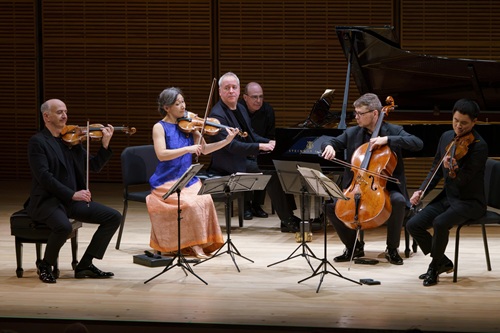
 United States Various: Jeremy Denk (piano), Takács Quartet (Edward Dusinberre, Harumi Rhodes [violins], Richard O’Neill [viola], Mihai Marica [cello]). Zankel Hall at Carnegie Hall, New York, 16.10.2026. (ES-S)
Mendelssohn – String Quartet in F minor, Op.80
Carlos Simon – Warmth from Other Sons
Franck – Piano Quintet in F minor
Encore: Dvořák – Scherzo (Furiant) from Piano Quintet No.2
After more than half a century at the forefront of chamber music, the Takács Quartet has a new cellist. Mihai Marica has succeeded András Fejér, the last remaining founding member of the ensemble formed in 1975 at Budapest’s Franz Liszt Academy of Music. Judging by the performance at Zankel Hall, Marica has integrated seamlessly into the ensemble.
The cellist’s warm, singing tone was evident in the Adagio of Mendelssohn’s String Quartet, Op.80, while his rhythmic precision contributed to the driving energy of the Scherzo and finale. Written in the aftermath of the death of the composer’s sister Fanny, the quartet inhabits a darker emotional world than the Mozartian elegance associated with some of his earlier music. Its troubled harmonies, restless rhythms and abrupt shifts between tenderness and anguish recall the spirit of late Schubert. The Takács gave the Allegro vivace assai a fierce urgency, almost as if refusing to accept the finality of loss. The Scherzo had a menacing edge and incisive rhythmic articulation, evoking the dim, mysterious forests of the German Romantic imagination. The Adagio remained steeped in grief, its gentler contours offering little respite from the surrounding turbulence. The players’ restrained phrasing gave the music a more intimate quality without diminishing its expressive weight. In the finale, the players sustained the music’s intensity without unnecessary effusion. The four musicians displayed a shared musical vision while allowing individual expression to emerge, notably in Edward Dusinberre’s violin playing.
Introducing Carlos Simon’s three-movement Warmth from Other Suns (2020), violinist Harumi Rhodes spoke briefly about Isabel Wilkerson’s book of the same title which chronicles the Great Migration of Black Americans. The Takács brought out an undercurrent of unease in Simon’s atmospheric writing, with its echoes of jazz and spirituals. In ‘Rays of Light’, the ethereal violin harmonics were unsettled by the cello’s agitated motif while the incisive rhythms of ‘Flight’ propelled the music forward. The concluding ‘Settle’ suggested arrival but not quite resolution. The Takács gave the three movements a coherent emotional trajectory, rather than treating them as separate illustrations of Wilkerson’s narrative.
With Franck’s Piano Quintet, the program returned to F minor, the key of Mendelssohn’s quartet. The anguish so palpable in Mendelssohn and more subtly expressed in Simon resurfaced here on a more expansive scale. Jeremy Denk demonstrated once again his exceptional abilities as a chamber musician, listening attentively to his partners and maintaining a finely judged balance between piano and strings. As in Mendelssohn’s Scherzo, a sense of mystery permeated the first movement, deepening its passionate, almost obsessive character. Motifs passed repeatedly from one string instrument to the next before being taken up and expanded by the piano. The interplay among the five musicians was remarkably fluid. The tension lingered in the Lento, where the dialogue between first violin and cello seemed to foreshadow Debussy’s harmonic language. The phrases changed color as they passed between the instruments, while the movement’s apparent calm never entirely dispelled its inner restlessness. The finale unfolded with mounting dramatic force, while the performers maintained a firm sense of proportion without lapsing into Romantic grandiloquence.
After an evening of sustained tension, Edward Dusinberre announced that the musicians would offer something lighter for their encore. They did so with the Scherzo (Furiant) from Dvořák’s Piano Quintet No.2, bringing out both its effervescence and its spirited Bohemian folk-dance character.
Edward Sava-Segal