 Germany R. Strauss, Ariadne auf Naxos: Soloists, Bavarian State Orchestra / Robin Ticciati (conductor). Nationaltheater, Munich, 16.10.2026. (AL-L)
First seen at the Prinzregententheater during the 2008 Munich Opera Festival, it migrated to the Nationaltheater in September 2009 and was taken on tour to the Hong Kong Arts Festival in 2024: Robert Carsen’s Ariadne auf Naxos has become one of the pillars of the Munich repertoire. The Canadian director, one of the most prolific of his generation, has only rarely worked with Bavarian State Opera. Eighteen years after its premiere, this revival confirms that the production remains a remarkable achievement.
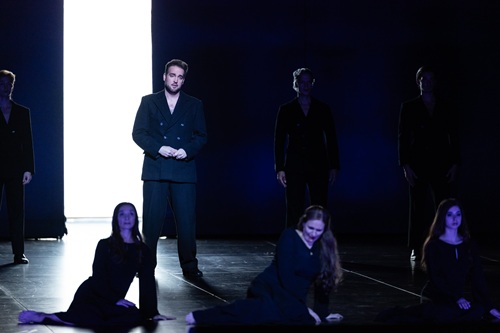
Its first virtue is economy of means. There is no outsized set: the Prologue relies on an intelligent play of mirrors, while the opera unfolds on an almost bare stage with black walls, evoking the austerity of Greek tragedy. Manfred Voss’s lighting is remarkably subtle, never more so than during the Composer’s hymn, ‘Musik ist eine heilige Kunst’.
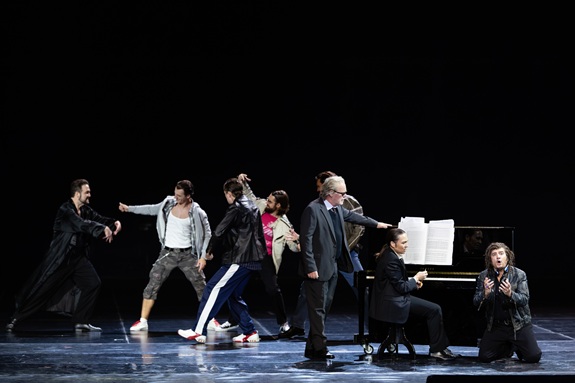
Carsen builds his staging around a recurring motif of two groups facing each other. There are two teams of dancers auditioning from the very start before the richest man in Vienna and his Major-Domo, the opera seria troupe and Zerbinetta’s Italian comedians, male and female dancers, and then the duet of Ariadne and Bacchus suddenly floods the back of the stage with brilliant white. Above all, the two companies are genuinely brought together here, rather than merely superimposed, which is far from being a given with this work.
As in any Ariadne, the comic touches raise a smile: the Tenor tosses his wig into the pit, the Major-Domo stirs the sugar in his master’s cup, and a few mildly suggestive winks punctuate the evening. But there is never any vulgarity – unlike the production seen this summer in Salzburg (review here) – nor any trace of the misogyny that is easily found in Richard Strauss. The staging also respects the music: the three nymphs mostly sing side by side, bringing out the richness of the harmonies Strauss wrote for them, whereas Salzburg had them scattered to the four corners of the stage. And, as the final image makes clear, the true victor of the piece remains the Composer.
The direction of the singers is dense and detailed, and the ensembles are drilled with the precision of Broadway numbers. One of Munich’s strengths is its ability to maintain an ensemble whose members take on the smaller roles season after season with the same commitment; that, too, is how a great opera house can be recognised.
The musical standard is very high. The three nymphs of Sarah Dufresne, Emily Sierra and Eirin Rognerud are superb, it is a genuine pleasure to see the veteran Kurt Rydl again, even in the spoken role of the Major-Domo, and having Konstantin Krimmel as Harlequin is a luxury. Recently Sieglinde in Tobias Kratzer’s Die Walküre (review here) Irene Roberts is a slightly stiff Composer in the passages that border on speech, but she is immediately at ease once the line turns lyrical, with a fine top. Sabine Devieilhe’s voice is a little small for the Nationaltheater’s 2000-odd seats, but the notes are all there; a superb actress, her Zerbinetta radiates an infectious joy in life.
In the treacherous role of Bacchus, Brian Jagde wins the listener over with the quality of his phrasing and the security of his upper register. Anja Kampe shows what a singer who has sung Isolde can bring to Ariadne: volume and dramatic instinct serve the Straussian line instead of weighing it down. The final duet is well balanced and – dare one say it – does not seem as long as it can with other performers.
Robin Ticciati was making his debut in the Munich pit (reportedly with Sir Simon Rattle in the audience on the first night of the run). He is no stranger to the score: he conducted it only this summer at Glyndebourne, in Laurent Pelly’s new production (review here). His conducting is striking for its precision and assurance. Some of the more theatrical passages could gain in suppleness, but Ticciati is truly present whenever the music turns lyrical. A real success.
Munich has its classics, productions the public returns to with regularity: Jean-Pierre Ponnelle’s La Cenerentola, August Everding’s Die Zauberflöte, La Fura dels Baus’s Turandot, Andreas Kriegenburg’s Wozzeck. This joyful and intelligent Ariadne stands on the same level.
Antoine Lévy-Leboyer
Featured Image: Bavarian State Opera’s Ariadne auf Naxos © Geoffroy Schied
Cast:
Major-Domo — Kurt Rydl
Music Master — Martin Gantner
Composer — Irene Roberts
Tenor/Bacchus — Brian Jagde
Officer — Zipei Zheng
Dancing Master — Tansel Akzeybek
Wigmaker — Hector Bloggs
Lackey — Christian Rieger
Zerbinetta — Sabine Devieilhe
Prima Donna / Ariadne — Anja Kampe
Harlequin — Konstantin Krimmel
Scaramuccio — Joel Williams
Truffaldino — Paweł Horodyski
Brighella — Lucas van Lierop
Naiad — Sarah Dufresne
Dryad — Emily Sierra
Echo — Eirin Rognerud
Production:
Director — Robert Carsen
Sets — Peter Pabst
Costumes — Falk Bauer
Lighting — Manfred Voss
Choreography — Marco Santi
Dramaturgy — Ingrid Zellner